
Written By: Dean Shali
Fact Checked By: Sabré Cook
Reviewed By: Tamara Warren
Just step into your car, close that damn door and take a deep breath: if the air feels heavy, musty or unpleasant then it is the signal of having something fixable.
Even, there’s studies in environmental health that shows that enclosed spaces such as: car interiors can trap up moisture, bacteria and airborne particles that are far more easy to be trapped than in open environments.
In fact, even something as simple as a spilled drink, damp floor mat or clogged cabin air filter can create the perfect conditions for odor-causing microbes to grow tremendously.
And, over the time: if these smells does not go away, then they can spread to your car’s ventilation system and makes every drive less comfortable and sometimes even affects the very air your lunges breathe in.
Now, the real truth is most of the people actually try to cover up these odors with the air fresheners, but that only hides the problem rather than solving it for real good.
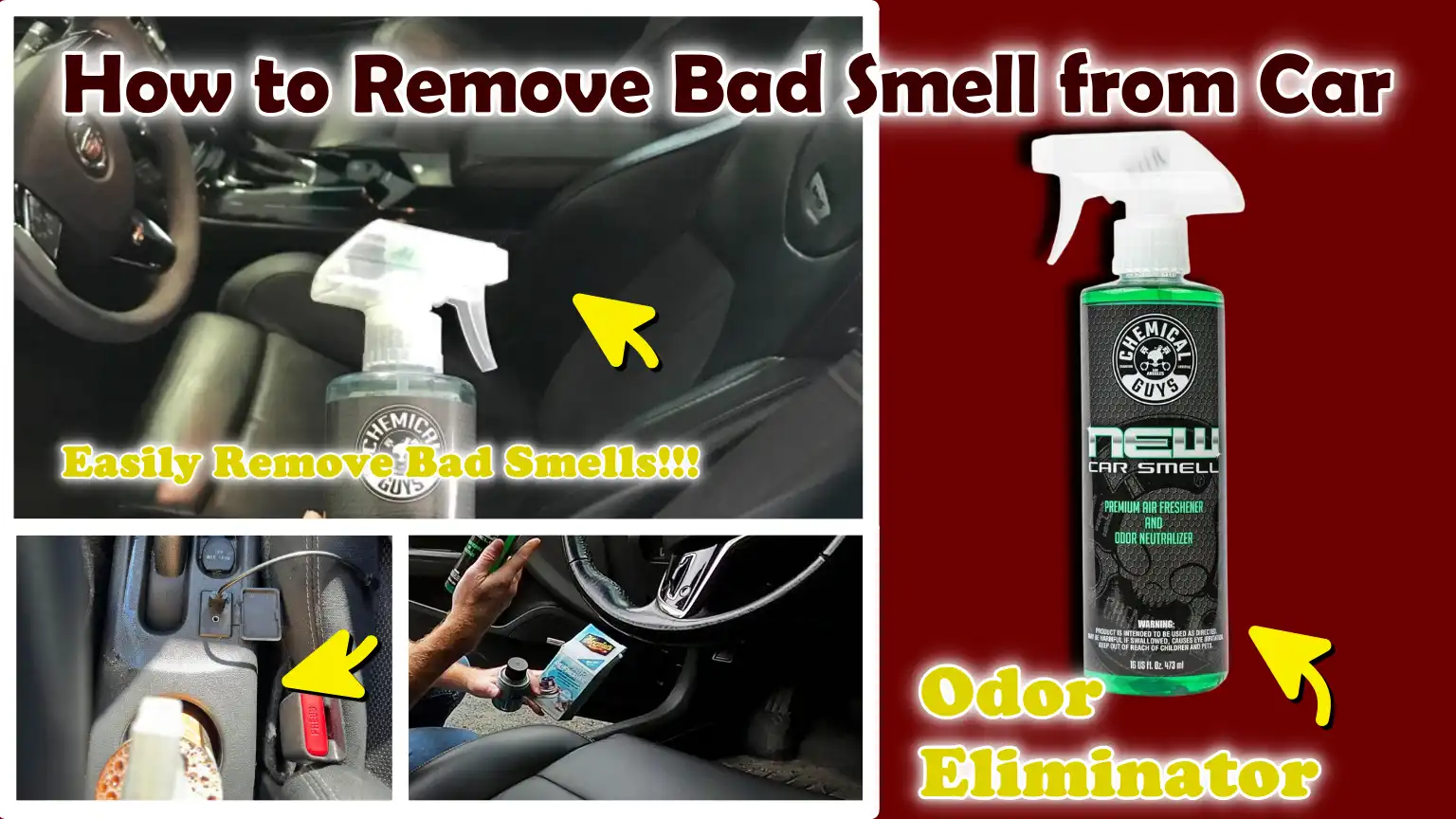
And, in this guide you’ll learn how to identify the exact cause of bad smells in your car and then How to Remove Bad Smell from Car by applying simple hacks.
Know, Common Causes of Car Odors
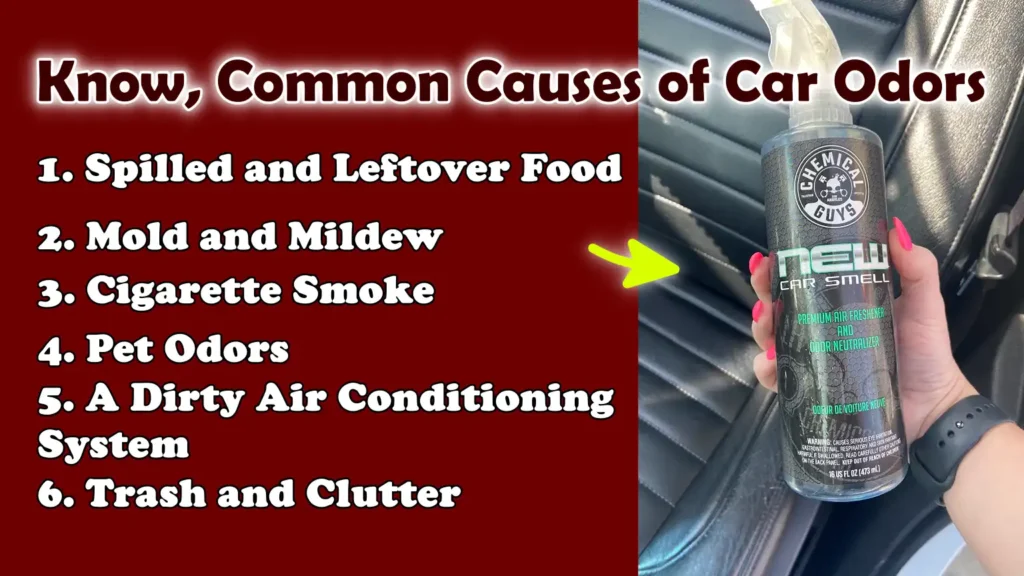
1. Spilled and Leftover Food
One of the most common causes of odors in a car is spilled food; this problem often begins with small crumbs or drops of liquid that frequently go unnoticed.
When food particles fall into the crevices between seats, onto the carpet, or underneath the seats, they gradually begin to decompose over time, specially when the car is parked and the interior temperature rises.
This process generates bacteria and gases, resulting in an unpleasant odor.
Spilled liquids such as: milk, juice, or coffee, are even worse, as they are thoroughly absorbed into the fabric and padding; this makes them difficult to clean and causes deep-seated decay within the inner layers of the material.
Even if the surface appears clean at first glance, the organic matter hidden beneath continues to decompose.
This is why, until the true source of the odor is thoroughly cleaned and removed, the smell will only intensify day by day.
2. Mold and Mildew
When moisture remains trapped inside your car for an extended period, mold and mildew begin to thrive; this is one of the most serious causes of car odors.
Moisture can enter the car through water leaks, wet footwear, spilled liquids, or even condensation generated by the air conditioning system.
When carpets, seats, or floor mats are left damp, they create the perfect environment for mold and mildew to flourish.
Mold emits a pungent, musty odor that quickly permeates the car cabin, particularly when the vehicle is stationary.
This odor is not only unpleasant, but it can also negatively impact the air quality inside the car.
Many people do not realize that if a damp area is not dried properly, mold can thrive there; this is why identifying and eliminating moisture inside a car is absolutely essential.
3. Cigarette Smoke
Removing the odor of cigarette smoke from a car is one of the most difficult tasks, as the smoke does not merely linger in the air; it clings to almost every surface within the vehicle’s interior.
Smoke particles settle deep into the seats, carpets, headliner and even the ventilation system.
Over time, these particles accumulate and begin to emit a stale, pungent odor that becomes deeply embedded in the car’s interior.
Even if you quit smoking, the smell can persist for a long time, because it remains trapped within soft materials (such as fabric and foam) and is released only gradually.
The heat generated by sunlight can intensify this odor further; this is why cars in which smoking has taken place often retain a strong smell that requires deep cleaning to be completely eliminated.
4. Pet Odors
Pets can leave behind strong odors in a car, specially if they travel in it frequently.
Their hair, skin particles and dander can get trapped in the seats and carpets, while accidents such as urination can soak deep into the upholstery fabric.
These organic materials break down over time, creating a breeding ground for bacteria, which, in turn, generate unpleasant odors.
Even if the car appears clean, these particles can remain hidden and continue to produce smells.
The warm environment inside the car can further amplify these odors and without proper cleaning, they can permeate the entire vehicle.
Regular cleaning and the use of appropriate measures are essential to completely eliminate pet-related odors.
5. A Dirty Air Conditioning System
Your car’s air conditioning system can also be a major source of foul odors, specially if it is not cleaned regularly.
During normal operation, moisture accumulates inside the AC system, creating an environment where bacteria and mold can thrive, particularly within the evaporator and vents.
When you switch on the AC, these particles disperse throughout the cabin, resulting in a stale or musty smell.
A dirty or clogged cabin air filter can further exacerbate this problem by trapping dust, pollen and other debris.
Many drivers only notice the unpleasant odor when the AC is running; this is a clear indication that the system requires cleaning or the filter needs to be replaced.
6. Trash and Clutter
Trash and clutter inside the car are simple, yet often overlooked, causes of foul odors.
Items such as food wrappers, empty bottles, tissues, or leftover food can quickly begin to generate smells, specially within a hot, enclosed space.
As these items sit over time, they begin to decompose, emitting unpleasant odors that permeate the entire cabin.
Clutter also makes it difficult to thoroughly clean the car, allowing dirt and bacteria to accumulate in hidden crevices.
Even a small amount of overlooked debris can produce a surprisingly strong odor; therefore, to keep your car smelling fresh, it is essential to regularly check for and remove any trash.
Easy Ways to Remove Odors from Your Car
1. Properly Ventilate Your Car
The easiest and most effective way to reduce odors in your car is to let fresh air in.
When a car remains closed for an extended period, odors get trapped and accumulate inside, intensifying over time.
By opening all the doors and windows for a few minutes, you allow stale air, moisture and odor particles to escape naturally.
Parking your car in direct sunlight can also be beneficial, as the heat helps to rapidly evaporate moisture from carpets and seats, thereby reducing conditions that foster odors.
Sunlight also possesses mild natural antibacterial properties that can help inhibit odor-causing germs.
This method works best as a preliminary step, before using any cleaning products, as it prepares the car’s interior for the complete elimination of odors.
2. Use Baking Soda
Baking soda is renowned for its ability to not merely mask odors, but to eliminate them entirely; for this reason, it is highly effective for car interiors.
It works by absorbing moisture and neutralizing the acidic and basic molecules responsible for creating odors.
To use it correctly, sprinkle a thin, even layer over the carpets, fabric seats and floor mats; pay particular attention to areas where the odor is most concentrated.
Allow it to sit for a few hours, or, ideally, overnight, to maximize odor absorption.
Afterward, thoroughly vacuum the car’s interior to remove all the powder and any trapped odor particles.
This method is particularly beneficial for odors caused by spills, moisture, or general wear and tear; when used correctly, it is safe for most fabric surfaces.
3. Use Activated Charcoal
Activated charcoal is a highly effective natural odor absorber that works by trapping odor molecules within its porous surface.
Unlike air fresheners, which merely mask odors, charcoal completely eliminates odors from the air inside your car.
It is particularly effective against strong and persistent odors, as it continuously absorbs moisture and airborne particles.
For best results, place small bags or containers of activated charcoal under the seats, in cup holders, or in the trunk, ensuring there is adequate airflow around them.
Leaving it in the car for a few days can significantly reduce odors without the use of any chemicals.
This method is simple, reusable and works gradually to keep the air inside your car fresh.
4. Try a White Vinegar Solution
White vinegar is a natural and effective odor remover, as it can break down odor-causing compounds and kill certain types of bacteria.
Its acidic nature helps to neutralize odors rather than simply masking them.
You can use it by mixing equal parts water and white vinegar; lightly spray this solution onto fabric surfaces such as seats and carpets.
Alternatively, you can leave a small bowl of vinegar inside the car overnight to allow it to absorb airborne odors.
It is essential to use this in moderation and ensure proper ventilation, as vinegar itself possesses a pungent odor that gradually dissipates as it dries.
When applied with care and used consistently, this method proves highly effective in eliminating stubborn odors such as smoke or mildew.
5. Use Leftover Coffee Grounds
Leftover coffee grounds offer a simple and natural way to absorb and neutralize unpleasant odors inside your car.
They contain compounds that help trap and neutralize odor particles while simultaneously releasing a subtle, pleasant aroma.
Dry coffee grounds work best, as moisture can diminish their effectiveness.
You can place them in an open container or a breathable pouch and position them under the seats or in any stable spot within the vehicle.
Over time, they absorb unwanted airborne odors, leaving the car’s interior atmosphere feeling fresher and more fragrant.
Adopting this method is remarkably easy and yields excellent results, whether used as a temporary fix or combined with other cleaning techniques for optimal outcomes.
How to Remove Bad Smell from Car – The Deep Cleaning Method
1. Remove Trash and Clutter
The first and most crucial step in deep cleaning your car is to remove all trash and unnecessary items from the interior.
Even small pieces of trash such as: food wrappers, tissues, or leftover food, can begin to emit a strong, foul odor as they decompose, specially when confined within a hot, enclosed space.
It is essential to inspect every area carefully, under the seats, inside door pockets, in cup holders and within storage compartments, as hidden debris is often the primary culprit behind persistent odors.
Removing clutter not only directly eliminates odor-causing items but also makes it significantly easier to thoroughly clean all surfaces during the subsequent steps.
2. Vacuum Thoroughly
To eliminate odors from a car, it is vital to remove dust, dirt, food crumbs and other particles; for this, vacuuming is absolutely essential.
These tiny particles often become deeply embedded in the carpeting, seat upholstery and tight crevices; even if they are invisible to the naked eye, they continue to emit odors over time.
When vacuuming, attention must be paid to every area such as: beneath the seats, in the gaps between seats and along the edges where debris frequently accumulates.
Using the appropriate attachments helps reach into tight spaces and ensures that even deeply embedded dirt is extracted.
This step not only enhances the overall cleanliness of the car but also prepares the surfaces for the more intensive deep cleaning procedures that follow.
3. Clean the Upholstery
Cleaning the upholstery (the fabric covering the seats and interior panels) is a crucial step, as seats and interior surfaces tend to absorb and retain odors much more readily than any other part of the car.
Moisture, spilled liquids and bacteria get trapped within the fibers of fabric seats; if not cleaned properly, these can continue to emit foul odors for a long time.
Using cleaners specifically formulated for fabrics helps remove deep-seated dirt and odor-causing elements trapped within the fibers.
Leather seats require a different approach; while they do not absorb liquids in the same way, odors can still linger on their surfaces.
Using a mild cleaner designed for leather helps remove dirt and restore freshness, without causing any damage to the material.
A thorough cleaning of the upholstery ensures that the primary areas where odors tend to accumulate are effectively sanitized.
4. Shampoo the Carpets and Floor Mats
Carpets and floor mats are among the leading causes of odors in a car, as dust, moisture and spilled liquids tend to accumulate in them over time.
Regular vacuuming alone is insufficient to remove this deep-seated grime; therefore, shampooing is essential for a complete and thorough cleaning.
Using a carpet cleaner or shampoo helps dislodge stubborn dirt, bacteria and odor-causing particles trapped deep within the fibers.
Floor mats should be removed and cleaned separately to ensure they are thoroughly washed and allowed to dry properly.
After cleaning, it is absolutely essential to allow the carpets and mats to dry completely; If even a trace of moisture remains, mold can develop and the foul odor may return.
Deep cleaning these specific areas makes a significant difference in eliminating odors from the entire vehicle.
5. Clean the Car’s Air Vents
Air vents play a crucial role in circulating odors throughout the car, particularly when the air conditioning system is active.
Dust, dirt and moisture can accumulate inside the vents, creating a breeding ground for bacteria and mold; this is precisely why unpleasant odors begin to permeate the car’s cabin.
Cleaning the vents with a soft brush removes surface dust, while using a disinfectant spray helps reduce the bacteria present within the system.
After cleaning, it is essential to run the air system for a short period to allow fresh air to circulate and to expel any remaining dirt or particles.
This step helps improve both the air quality and the odor situation inside the car.
6. Replace the Cabin Air Filter
The function of the cabin air filter is to purify the air entering your car through the ventilation system; when this filter becomes dirty or clogged, it can become a hidden source of odors inside the vehicle.
Over time, dust, pollen, moisture and other impurities accumulate within the filter; as air passes through it, it carries with it a stale or musty odor.
If the filter is not replaced regularly, it can restrict airflow and cause unpleasant odors to spread throughout the entire car whenever you turn on the air conditioning or heater.
Replacing the cabin air filter is a simple yet highly effective measure; it improves the air quality inside the vehicle and helps eliminate trapped odors.
This ensures that once the deep-cleaning process is complete, the air circulating inside your car is completely clean and fresh.
How to Remove Specific Odors from a Car
1. How to Remove Smoke Odors from a Car
Smoke odor is one of the most stubborn smells to eliminate, as tiny smoke particles adhere to every interior surface of the car, including the seats, carpets, headliner and even the air ventilation system.
These particles continue to emit odors over time, particularly when the car heats up.
The most effective method for removing this odor is to deep-clean every interior surface of the vehicle.
This requires the use of appropriate cleaning agents capable of breaking down residual smoke particles.
Fabric components should be thoroughly washed, while hard surfaces must be carefully wiped down to remove any sticky residue left behind by the smoke.
In cases where the odor is particularly severe, an “ozone treatment” serves as an excellent solution, as it chemically breaks down the odor-causing molecules.
This procedure should be performed with caution, or, ideally, by a professional, as precise execution is essential for it to be effective.
Completely eliminating smoke odors takes time; however, cleaning both the surfaces and the air circulation ducts is crucial for achieving lasting results.
2. How to Remove Mold and Mildew Odors
Mold and mildew odors typically manifest as a strong, musty smell.
This odor is caused by moisture trapped inside the car’s interior.
This constitutes a serious problem, as mold can grow on carpets, seats and in hidden crevices where water has accumulated.
The first and most critical step is to thoroughly dry out the car’s interior by removing all sources of moisture such as: wet floor mats or damp spots.
Ensuring proper ventilation and exposure to sunlight can significantly accelerate the drying process.
Subsequently, an ‘anti-fungal’ cleaning treatment is required to eliminate the mold and prevent its recurrence.
Cleaners specifically formulated for mold removal can be applied to surfaces where mold growth is evident.
Ensure that the cleaner penetrates deep into the fabric or material where the mold may be lurking.
Taking immediate action is crucial because, if left untreated, the mold can spread and the accompanying odor may intensify over time.
3. How to Remove Pet Odors
Pet odors typically originate from their fur, shedding skin particles (dander) and occasionally urine or other organic matter that becomes trapped inside the car.
As these substances decompose, they generate bacteria, resulting in a strong, unpleasant odor.
Vacuum cleaning is the first step in removing shed fur and dander (dry skin flakes) from car seats, carpets and tight crevices.
However, routine cleaning alone is often insufficient, as odor-causing compounds can remain deeply embedded within the fibers of the fabric or upholstery.
In such cases, ‘enzyme cleaners’ prove highly effective, as they break down organic matter at a microscopic level.
Thus, rather than merely masking the odor, they eliminate the actual source of the smell.
Applying these cleaners to affected areas and allowing them sufficient time to work effectively results in the complete elimination of pet odors.
Consistent cleaning is essential to prevent the odor from accumulating again.
4. How to Remove Food Odors
Food-related odors typically stem from spills, leftover scraps, or forgotten items that have begun to decompose inside the car.
These odors can intensify very rapidly, particularly in warm weather.
The most crucial step in eliminating food odors is, first and foremost, identifying the actual source of the smell; this could be hidden beneath the seats, inside storage compartments, or deep within the carpeting.
Once the source of the odor has been removed, it is essential to thoroughly clean and sanitize the affected area to eliminate any residual grime.
Cleaning solutions help break down oils and organic matter left behind by food spills, while proper drying ensures that no lingering moisture remains to generate future odors.
If the odor has permeated the entire vehicle, cleaning the surrounding areas is also necessary to fully restore the freshness of the car’s interior.
5. How to Remove Gas or Chemical Odors
Gas or chemical odors inside a car should never be ignored, as they may signal a potential safety hazard.
These odors can result from fuel leaks, chemical spills, or malfunctions within the engine or fuel system.
The first step is to identify the source of the odor as quickly as possible.
If there are any indications of a fuel leak or the presence of strong chemicals, the vehicle should be inspected immediately, as such situations can be dangerous.
Simple cleaning alone will not resolve this type of issue until the underlying cause has been rectified.
Once the mechanical problem has been resolved, any lingering odors can be eliminated by cleaning the affected areas within the car’s interior.
Ensuring proper ventilation and removing any contaminants helps restore a safe and fresh environment inside the vehicle.
Know, Difference Between Natural vs Chemical Odor Removal Methods
1. Natural Methods
Natural methods are widely used for removing odors from cars because they are simple, safe and effective at resolving everyday odor issues.
Substances such as baking soda, activated charcoal and white vinegar work by absorbing or neutralizing odor molecules rather than merely masking them.
Baking soda is particularly beneficial for carpets and fabric seats, as it draws out moisture and neutralizes the chemical compounds responsible for foul odors.
Activated charcoal possesses a highly porous structure that traps odor particles from the air; consequently, it is highly effective at continuously controlling odors within the confined space of a car.
White vinegar operates differently; due to its mild acidity, it breaks down odor-causing substances, thereby helping to eliminate odors from both surfaces and the air.
These natural alternatives are easy to use, economical and generally safe for regular application; however, they may take longer to completely eliminate very strong or deeply ingrained odors.
They are best suited for mild to moderate odors and for maintaining freshness after cleaning.
2. Chemical Products
Chemical odor removal products are formulated to deliver faster and more precise results, particularly for strong or stubborn odors that natural methods may fail to eliminate completely.
Odor-eliminating sprays work either by chemically neutralizing odor molecules or by utilizing agents that break down odor-causing compounds.
Some products also contain disinfectants that kill bacteria and mold, common sources of foul odors within a vehicle.
These products are easy to use and can yield quick results, making them beneficial when immediate improvement is required.
However, they may contain strong fragrances or chemicals that, if not used correctly, merely mask the odor; furthermore, excessive use can sometimes create a mixed or artificial scent inside the car.
When comparing natural and chemical methods, natural solutions are safer and more suitable for long-term maintenance, whereas chemical products are more effective at quickly eliminating deeply embedded odors.
Choosing the right method depends on the severity of the odor and the condition of the car’s interior.
The Best Products for Eliminating Car Odors
1. Odor-Eliminating Sprays
Odor-eliminating sprays are one of the most widely used methods for removing unpleasant smells from cars, as they are easy to use and work quickly.
These sprays do not merely mask odors with fragrance; rather, they are designed to neutralize the specific molecules responsible for the stench, making them far more effective than standard air fresheners.
Many high-quality sprays contain active ingredients that break down the chemical compounds causing bad smells, including odors resulting from smoke, food and bacteria.
They can be applied to seats and carpets, as well as sprayed directly into the air; however, it is crucial to apply them evenly and avoid overuse, as applying too much product can result in a strong, artificial scent.
When used correctly, odor-eliminating sprays can provide immediate relief and significantly enhance the freshness of a car’s interior.
2. Car Air Purifiers
Car air purifiers are modern devices designed to improve the air quality inside a vehicle by removing odor-causing particles from the atmosphere.
These devices often utilize filters such as: HEPA or activated carbon, to capture dust, pollen, smoke particles and other contaminants that generate unpleasant smells.
Some purifiers also employ ionization technology to reduce airborne particles and bacteria.
Unlike sprays, which offer only temporary relief, air purifiers operate continuously while the car is in use, ensuring that the air remains consistently clean and fresh.
These are particularly beneficial for individuals who drive frequently or who struggle with persistent odor issues caused by pollution, pets, or smoke.
Although they do not directly clean surfaces, they play a crucial role in controlling and preventing airborne odors.
3. Interior Cleaning Products
Interior cleaning products are essential for eliminating the root causes of unpleasant odors, as they specifically target and clean the very surfaces where odors typically originate.
These products are specially formulated for various materials such as: fabric, leather, plastic and vinyl, to ensure effective cleaning without causing any damage.
Fabric cleaners help remove deep-seated stains, spilled liquids and bacteria trapped within seat fibers, while leather cleaners gently clean and condition surfaces without drying them out.
Using the right interior cleaning product helps break down dirt, oils and organic matter that can generate odors over time.
Thoroughly cleaning all surfaces, including seats, carpets and the dashboard, is vital to completely eradicate odors rather than merely masking them.
For this reason, interior cleaners are considered one of the most indispensable tools for achieving long-lasting odor elimination.
4. Odor Absorbers
Odor absorbers are simple yet highly effective products that eliminate unpleasant smells by absorbing them from the air inside the car.
Unlike sprays, which provide immediate results, these absorbers work gradually, continuously absorbing moisture and odor particles to reduce overall odor levels.
Common types of absorbers include activated charcoal bags and gel-based absorbers; both can be placed inside the car for continuous use.
These are particularly useful for maintaining freshness after a deep cleaning or for controlling mild, everyday odors.
Using these products requires minimal effort and they can be utilized for several weeks before needing to be replaced or reactivated.
They offer a practical solution for keeping a car smelling fresh without the use of harsh chemicals, fragrances, or odor absorbers.
How to Prevent Odors in Your Car
1. Keep Your Car Clean Regularly
Regular cleaning is the most effective way to prevent odors from developing inside your car.
Dirt, dust, food scraps and moisture can accumulate rapidly in an enclosed space and even small amounts can begin to generate unpleasant smells over time.
Adopting a simple weekly cleaning routine stops this buildup before it becomes a major problem.
This involves removing trash, wiping down surfaces and vacuuming carpets and seats to extract hidden dirt.
Consistent cleaning not only keeps your car looking good but also inhibits the growth of bacteria and odor-causing agents, making it much easier to maintain a fresh interior environment without the need for frequent deep cleaning.
2. Avoid Eating Inside the Car
Refraining from eating inside your car can significantly reduce the likelihood of odors developing.
Food scraps and spills are among the primary causes of car odors, as they can easily fall into hard-to-reach places, such as the crevices between seats and into the carpeting.
Once trapped, these particles begin to decompose and emit foul odors, specially in warm weather.
Liquids like milk, juice, or coffee can soak into the upholstery and, if not cleaned up immediately, can cause lingering smells for a long time.
By eating outside the car, or by exercising extreme caution when eating inside, you can prevent one of the most common causes of odors and minimize the need for frequent cleaning.
3. Use Floor Mats
Floor mats play a crucial role in protecting your car’s interior from dirt, moisture and spilled food, all of which can generate unpleasant odors.
They act as a barrier between your shoes and the carpeting, trapping mud, water and dirt that would otherwise soak into the flooring.
As mats can be easily removed and cleaned, they make maintenance both simple and effective.
Keeping floor mats clean and dry prevents moisture from accumulating underneath them, a common cause of mold and musty odors.
Using high-quality mats and cleaning them regularly helps maintain a fresh atmosphere inside the car.
4. Replace the Cabin Air Filter Regularly
To keep the air inside your car clean and odor-free, it is crucial to replace the cabin air filter at regular intervals.
This filter is designed to trap dust, pollen and other airborne particles; however, over time, it can become clogged and begin to emit stale or musty odors.
Adhering to the recommended replacement schedule, typically every 12,000 to 15,000 miles, ensures that the air circulating through your car’s ventilation system remains fresh.
A clean filter improves airflow and prevents odor-causing contaminants from spreading throughout the cabin.
This simple maintenance step is often overlooked, yet it plays a vital role in preventing odors.
5. Keep Moisture at Bay
Moisture is one of the primary causes of odors in a car, as it creates the perfect environment for mold and bacteria to thrive.
Water can enter the vehicle through leaks, wet footwear, spills, or excessive humidity; if not removed immediately, it can lead to a strong, musty odor.
As soon as a leak is detected, it is crucial to repair it immediately and to promptly dry out damp areas using proper ventilation or sunlight.
If even the slightest amount of moisture trapped in the carpets or seats is overlooked, it can eventually evolve into a persistent odor problem.
Keeping the car’s interior dry at all times is the most effective way to prevent odors and maintain a clean, healthy environment inside the vehicle.
Read More:
- How to Restore Faded Car Paint
- How to Polish Car Headlights
- How to Remove Scratches from Car Paint
- How to Wax Car By Hand
- How to Wash Car Properly
Signs You Need Professional Cleaning Immediately
As well as, car interiors has huge spaces, as they are complex environments where pollutants and microbes that can build up in quick way, as research also shows that vehicle cabins can trap harmful particles and gases at high concentrations, which literally shows why bad smells often develop and persist if not properly cleaned as well.[¹]
1. Lingering Odors Even After Cleaning
If your car continues to emit an unpleasant odor even after a thorough cleaning, it is a clear indication that the problem cannot be resolved through standard cleaning alone; rather, the issue runs much deeper.
Odors can become trapped in hard-to-reach areas such as: beneath the carpet padding, within the seat foam, or inside the air ventilation system.
Moisture, bacteria and organic matter can accumulate in these hidden pockets, continuing to generate foul smells long after a superficial cleaning has taken place.
In such instances, professional cleaning is essential, as it utilizes specialized equipment and techniques to penetrate these deeper layers and completely eliminate the root cause of the problem.
Ignoring persistent odors can allow the issue to worsen over time, making it even more difficult to eradicate later on.
2. Water Damage or Mold Growth
Water damage is one of the most critical reasons to seek professional cleaning services, as it frequently leads to the growth of mold inside the vehicle.
When water infiltrates a car’s interior, whether due to leaks, flooding, or spills, and is not dried properly, it seeps into the layers of the carpet, upholstery and insulation.
This creates a damp environment where mold and mildew can proliferate rapidly, resulting in a strong, musty odor that permeates the entire vehicle.
Mold can also lurk in unseen areas, making it difficult to treat effectively without the appropriate tools and expertise.
Professional cleaners possess the necessary equipment to extract moisture, apply anti-fungal solutions to affected areas and ensure that the vehicle’s interior dries out completely.
This not only eliminates odors but also helps prevent further damage to the car’s interior.
3. Smoke Damage
Dealing with smoke damage inside a vehicle is a challenging task, as smoke particles penetrate deep into the upholstery, plastics and ventilation system.
These particles leave behind a sticky residue that causes a persistent odor over time, particularly when the temperature inside the vehicle rises.
Standard cleaning methods often fail to completely remove this type of contamination, which is why the odor frequently returns.
In such cases, professional cleaning is recommended, as it involves deep cleaning of all surfaces combined with the use of advanced techniques that break down and eliminate smoke particles at a microscopic level.
This process ensures that both visible grime and hidden sources of odor are completely eradicated, thereby restoring a clean and fresh environment within the car’s interior.
Know, The Professional Methods for Odor Removal
1. Steam Cleaning
Steam cleaning is one of the most effective professional methods for removing odors from a car, as it utilizes high-temperature steam to deep-clean surfaces.
The heat from the steam helps break down dirt, grease and odor-causing substances trapped within carpets, seats and other interior components.
It also eliminates various types of bacteria and germs responsible for foul odors.
Unlike superficial cleaning, steam can penetrate deep into the layers of fabric and padding, the very places where odors often tend to linger.
Another advantage is that it requires significantly less water compared to traditional washing methods, thereby reducing the risk of residual moisture remaining inside the vehicle.
When performed correctly, steam cleaning not only removes visible surface dirt but also eradicates the root cause of the odor, leaving the car’s interior feeling significantly cleaner and fresher.
2. Ozone Treatment
Ozone treatment is a powerful technique employed by professionals to eliminate strong, stubborn odors that resist standard cleaning methods.
This process utilizes ozone gas, which reacts with odor-causing molecules to break them down at a chemical level.
By doing so, it does not merely mask the odor but eliminates it completely.
This treatment is particularly effective against odors caused by smoke, mildew, or accumulated grime.
During this procedure, the vehicle is completely sealed and an ozone generator is used to fill the interior with ozone gas.
This ensures that the gas reaches every nook and cranny of the car, including areas that are inaccessible to manual cleaning.
However, this method must be employed with extreme caution, as inhaling high concentrations of ozone can be detrimental to health.
Consequently, this task is typically performed exclusively by specially trained professionals.
Once the process is complete, the vehicle is thoroughly ventilated to ensure it is safe for use.
3. Detailing Services
Professional detailing services provide a comprehensive and deep cleaning of a car’s interior.
Special attention is paid to all potential sources of odors, whether they are visible on the surface or hidden from view.
These services include deep vacuuming, shampooing of carpets and seats, cleaning of hard surfaces and cleaning of the air system to eliminate the root cause of the odor.
Detailers utilize specialized tools and cleaning products specifically formulated to break down stubborn dirt, stains and odor-causing bacteria.
They also focus specifically on small, hard-to-reach areas such as: the crevices between seats, beneath the carpeting and inside the air vents.
It is often in these very spots that odors lie hidden and go unnoticed.
Detailing not only eliminates existing odors but also helps restore the car’s interior to a like-new condition.
Therefore, for those facing issues with strong or persistent odors, which cannot be resolved through standard cleaning methods, this serves as a reliable solution.
Conclusion – How to Remove Bad Smell from Car
Bad smell is literally clear warning signs that should never be ignored, also you need to maintain it over the time: Simple Hack!
Whether the cause is spilled food or beverages, accumulated moisture, lingering smoke residue, or grime trapped within the air conditioning system, every odor has a specific source.
And if not properly eliminated, the smell will only intensify.
The key takeaway is that truly eliminating an odor means more than just masking it; it requires identifying and rectifying its root cause.
In the early stages, simple measures such as: airing out the car and utilizing natural odor absorbers, can be helpful; however, for more severe issues, a thorough cleaning of the carpets, seats and air vents is essential to completely eradicate the problem.
It is also crucial to understand that prevention is far more effective than a cure.
Regular cleaning, keeping moisture at bay and maintaining components like the cabin air filter, these habits can prevent most odors from developing in the first place.
A clean car interior not only smells pleasant but also improves the quality of the air you breathe, making every journey more comfortable.
When odors become particularly strong or persistent, professional cleaning services can offer a comprehensive solution.
They possess the capability to access and clean those areas that are typically difficult to reach during a standard DIY cleaning.
Ultimately, consistency and vigilance are paramount in keeping your car clean and smelling fresh.
Small habits such as: removing trash, immediately drying up wet spots and regularly wiping down surfaces, can make a significant difference over time.
Now, that’s it from this guide from this guide about How to Remove Bad Smell from Car, now give me questions in the comment box below.
Frequently Asked Questions
FAQ 1: What is the fastest way to remove odors from a car?
The fastest way to remove odors from a car is to first open all the doors and windows to allow fresh air to circulate, thereby venting out any trapped odors. Next, remove any visible trash or sources of the odor such as: food, spills, or damp items. Applying baking soda to the carpets and seats helps absorb odors quickly, while an odor-eliminating spray can help neutralize airborne smells. However, it is important to understand that these quick-fix methods are most effective for mild odors. If the odor is very strong or has been present for a long time, a deep cleaning will be required to eliminate it completely.
FAQ 2: Why does my car still smell bad after cleaning?
If your car still smells bad after cleaning, it often means that the root cause of the odor has not been completely eliminated. Odors can be deeply trapped within the seat foam, underneath the carpets, or inside the air conditioning system areas that standard cleaning methods often fail to reach. Trapped moisture in these areas can also lead to mold growth, resulting in a persistent foul odor. In many cases, people only clean the surface areas, while the actual source of the odor remains hidden underneath. To resolve this issue, a deep cleaning or professional assistance may be required to completely eradicate the odor.
FAQ 3: Does baking soda really remove car odors?
Yes, baking soda is highly effective at removing car odors because it doesn’t merely mask the odor-causing particles; instead, it absorbs and neutralizes them. It is particularly effective against odors caused by food and beverages, moisture, or general dust and grime. When sprinkled over carpets and seats and left for a few hours, it draws both moisture and odors out of the material. After vacuuming, the odor is significantly reduced. However, baking soda works best for mild to moderate odors and may not be sufficient for very strong or deeply embedded smells.
FAQ 4: Can the car’s AC cause odors?
Yes, a car’s air conditioning system can be a major source of odors. Moisture naturally accumulates inside the AC system during use, creating an ideal environment for bacteria and mold to thrive. When you turn on the AC, these odor-causing particles are dispersed throughout the car along with the airflow; this is why a strange smell often becomes noticeable as soon as air begins to flow from the AC vents. A dirty or clogged cabin air filter can further exacerbate this problem. Cleaning the AC system and replacing the filter can help eliminate such odors.
FAQ 5: How do I remove a musty smell from my car?
A musty smell is typically caused by moisture and mold; therefore, the first step is to remove any wet items and thoroughly dry out the car. Moisture levels can be reduced by opening the windows and parking the car in direct sunlight. Next, it is essential to clean the carpets, seats and affected areas with an appropriate cleaner to eliminate mold and bacteria. Using baking soda or activated charcoal can help absorb any lingering odors. To prevent odors from recurring, it is crucial to identify and repair any leaks or points of water intrusion.
FAQ 6: Why does my car smell like something is rotting?
A strong, rotting smell inside a car typically stems from the decomposition of organic matter such as: spilled food, forgotten leftovers, or pet waste. When these items are left in a hot, enclosed space, bacteria multiply rapidly and release potent, noxious gases. Sometimes, the source of the odor may be hidden beneath the seats or trapped within the carpeting, making it difficult to locate. Removing the source of the odor and thoroughly cleaning the affected area is the only effective way to eliminate such smells.
FAQ 7: How long does it take to remove an odor from a car?
The time required to remove an odor from a car depends on the intensity of the smell and its underlying cause. Mild odors can often be mitigated within a few hours using simple methods, such as airing out the car and using baking soda. Light odors can usually be eliminated within a day or two with proper cleaning. More severe odors caused by smoke, mold, or deep-seated grime, as it may take several days to dissipate completely, or may even require professional assistance. Regular cleaning and proper drying are essential for achieving the best results.
FAQ 8: Are air fresheners sufficient for removing car odors?
Air fresheners are not sufficient for removing car odors because, rather than addressing the root cause of the smell, they merely mask it. Although they may make the car smell pleasant for a while, the underlying problem persists; as soon as the fragrance fades, the odor often returns. To properly resolve this issue, it is essential to clean and eliminate the source of the odor whether it be dirt, moisture, or bacteria. It is best to use air fresheners after the car has been thoroughly cleaned; this helps maintain a fresh and pleasant-smelling environment inside the vehicle.
References:
[1] Air quality inside motor vehicles’ cabins: A review
https://www.researchgate.net/publication/310466891_Air_quality_inside_motor_vehicles%27_cabins_A_review
Hello Folks, Dean Shali here to help you out to solve the problems with your lovely vehicle, as i have lots of experience and knowledge about automotive industry as i woks directly with the customers and repair vehicles and i love to help the people to keep their cars safe and running smoothly.