Written By: Dean Shali
Fact Checked By: Sabré Cook
Reviewed By: Tamara Warren
Most of the cars literally capable of “LASTING TWICE” as long as they actually do, but only if their owners know how to maintain in right way.
As, most of the people also believe that cars wear out simply just because they aged now, but the truth is far more revealing: as modern vehicles are engineered to last well beyond 200,000 miles and many can even reach 300,000 miles with proper care.
Yet, millions of cars actually retired early not because they are now “OLD”, but just because they are neglected with their due maintenance.
Additionally, even small issues such as: dirty engine oil, low tire pressure or worn-out filters quietly build up over the time, that reduces efficiency, damages critical components and eventually leads to the costly breakdowns as well.
Even, there’s research and automotive data that consistently shows that prevention and maintenance can reduce the major repairs risk by a significant margins and literally saves thousands of dollars over the period of vehicle’s lifetime.
Furthermore, you need to understand that: your car is not just a ordinary machine, as it is a system of interconnected parts that heavily depends on regular attention to function in proper way.
So, in this guide you’ll learn about How to Maintain Car for Long Life, so that you can learn proven and very practical steps to help your car to be stay reliable, efficient and road-ready for years to come.
Let’s Understand Your Car’s Maintenance Needs
To ensure that your car lasts for the long haul, the first step is to understand that every vehicle is designed with specific care requirements in mind.
Neglecting these requirements is the primary reason why cars break down prematurely.
Although modern vehicles are built with advanced engineering, they still require certain basic maintenance such as: clean fluids, proper lubrication and timely parts replacement, to remain reliable.
When maintenance is performed on schedule, it minimizes internal engine friction, prevents overheating issues and ensures that all systems continue to function correctly.
Conversely, when maintenance is delayed, minor issues such as: dirty oil or worn-out parts, gradually inflict damage upon major components like the engine and transmission, ultimately leading to costly repairs.
The fundamental truth is simple: your car does not break down overnight; rather, it undergoes gradual wear and tear over time, depending on the care it receives.
Precisely understanding what your car needs, and when it needs it, gives you complete control over its longevity, performance and safety.
1. Read the Owner’s Manual – Your Most Reliable Resource
The owner’s manual serves as the most reliable and accurate guide for your car’s maintenance, as it is produced by the very manufacturer who designed and rigorously tested the vehicle.
It clearly outlines the recommended service intervals for essential tasks, such as changing the oil, replacing filters and inspecting the brakes and fluids.
These intervals are based on extensive real-world testing and are specifically designed to ensure that the engine runs smoothly and remains protected against long-term damage.
For instance, over time, engine oil gradually loses its ability to effectively lubricate and protect the vehicle’s moving parts.
If it is not replaced at the recommended intervals, it can lead to increased friction, engine overheating and wear and tear on internal components.
The manual also specifies the types of fluids and parts required for your car.
Knowing this is crucial, as using incorrect products can compromise the car’s performance and even cause damage.
Skipping or delaying these scheduled services may not result in immediate issues, but over time, it accelerates wear and tear on vehicle components, reduces fuel efficiency and significantly shortens the car’s overall lifespan.
Adhering to the manual is not merely a suggestion; it is the most effective way to ensure that your car continues to run trouble-free for many years to come.
2. Understand Your Driving Conditions
Driving conditions have a direct impact on the rate at which your car experiences wear and tear.
Many drivers do not realize that their daily habits can alter their car’s maintenance requirements.
For example, city driving involves frequent stopping, starting and idling; this places greater strain on the engine, brakes and transmission compared to continuous highway driving.
Consequently, components may wear out faster and may require more frequent inspection.
Weather conditions also play a significant role; Excessive heat can cause the engine to overheat and fluids to degrade rapidly, whereas extreme cold can cause fluids to thicken, making it difficult to start the engine and ensure it runs smoothly.
Furthermore, driving with heavy loads, towing, or making frequent short trips, during which the engine does not fully warm up, as it can place additional strain on the vehicle’s critical systems.
Short trips are particularly challenging because the engine fails to reach its ideal operating temperature; this can lead to moisture accumulation within the engine and negatively impact its efficiency.
Once you understand your specific driving conditions, you can tailor your vehicle’s maintenance schedule accordingly; this ensures that your vehicle receives the extra care it needs to remain reliable and serve you for the long haul.
Do Regular Fluid Maintenance – The Lifeblood of Your Car
Fluids are what enable every major system in your car to function correctly; without them, even the most advanced vehicle can quickly break down.
Engine components move at high speeds, generating heat and friction; fluids work to minimize this friction, dissipate heat and protect parts from wear and tear.
Over time, all fluids degrade, lose their effectiveness and accumulate dirt or metal particles, rendering them unable to adequately protect your vehicle.
When fluids are not replaced at the recommended intervals, the damage is not immediate but rather accumulates gradually, leading to engine overheating, reduced performance and potentially costly repairs.
Regularly checking and replacing fluids is the simplest and most effective way to extend your car’s lifespan, improve fuel efficiency and avoid sudden breakdowns.
Understanding the specific function of each fluid, and knowing when it requires servicing, empowers you to maintain your vehicle in a way that ensures its reliability for years to come.
1. Changing Engine Oil and Filters
Engine oil is the most critical fluid in your car, as it lubricates the engine’s moving parts and prevents metal surfaces from grinding against one another.
As the engine runs, the oil also helps cool internal components and carries away dirt and tiny metal particles.
This is precisely why the oil filter is essential: it traps these particles, thereby keeping the oil clean.
In most modern vehicles, depending on the type of oil used and driving conditions, an oil change is required every 3,000 to 7,500 miles.
When oil becomes old or dirty, it loses its ability to protect the engine, which can lead to increased friction, engine overheating and long-term damage.
Some common signs indicating that your oil needs changing include: the oil appearing dark or dirty, strange noises coming from the engine, reduced fuel efficiency, or a warning light illuminating on the dashboard.
Changing your oil and filter on time is the easiest way to avoid major engine problems and ensure that your car continues to run smoothly.
2. Transmission Fluid
Transmission fluid serves to lubricate and cool the internal components of the transmission, one of the most complex and expensive systems in any vehicle.
It facilitates smooth gear shifting and prevents excessive heat buildup while driving.
Over time, heat can degrade the transmission fluid and cause contaminants to accumulate within it, rendering it unable to properly protect the internal parts.
When this occurs, the transmission may fail to shift gears correctly, slip between gears, or overheat.
Changing the transmission fluid at scheduled intervals, typically between every 30,000 and 60,000 miles for many vehicles, helps maintain vehicle performance and prevents costly damage.
Keeping this fluid clean and at the proper level is crucial, as transmission repairs are often far more expensive than routine maintenance.
3. Coolant – Antifreeze
Coolant, also known as antifreeze, plays a vital role in regulating engine temperature and preventing the engine from overheating.
An engine generates a significant amount of heat while running; coolant absorbs this heat and dissipates it, thereby maintaining the engine’s temperature at a safe level.
It also prevents the engine from freezing in cold weather and helps protect the cooling system from rust and corrosion.
Over time, coolant can lose its protective properties and become less effective, increasing the risk of engine overheating and internal damage.
Replacing the coolant at scheduled intervals, typically every few years, ensures that the cooling system continues to function properly.
Symptoms of coolant-related issues include rising engine temperatures, leaks, or a sweet odor emanating from the engine compartment.
Maintaining the cooling system in good condition is crucial to prevent major engine damage.
4. Brake Fluid, Power Steering Fluid, Washer Fluid
Brake fluid is vital for safety, as it transmits the force applied by your foot on the brake pedal to the braking system, causing the vehicle to slow down and come to a stop.
If brake fluid becomes old or contaminated with moisture, it can compromise braking performance and increase stopping distances, a potentially dangerous situation.
Power steering fluid facilitates easy turning of the steering wheel by reducing the physical effort required to maneuver the vehicle; if this fluid is low or dirty, the steering may feel heavy or fail to function correctly.
Washer fluid may seem like a minor detail, but it plays a crucial role in maintaining clear visibility by removing dirt, dust and debris from the windshield.
Keeping all these fluids at their proper levels and replacing them when necessary ensures that your vehicle remains safe, easy to drive and comfortable in all weather conditions.
What’s Regular Inspection Checklist – Prevent Problems Before They Arise
Regular inspections are one of the most effective ways to ensure the longevity of your car, as they help you detect minor issues before they escalate into major, costly repairs.
Many car components do not fail suddenly; they wear down gradually and, if you know what to look for, they provide clear warning signs.
By regularly inspecting specific components of your vehicle, you can enhance safety, maintain performance and avoid sudden breakdowns.
Inspections also save you money, as fixing a minor issue in its early stages is always easier and cheaper than repairing a major malfunction later on.
Maintaining a well-kept car involves more than just adhering to a scheduled service routine; it also requires paying close attention to the condition of critical components and taking timely action.
1. Tires and Alignment
Your tires are the only part of the car that comes into contact with the road; therefore, their condition has a direct impact on safety, fuel efficiency and overall driving performance.
Rotating your tires every 5,000 to 8,000 miles ensures even wear, thereby extending their lifespan and improving handling.
Maintaining proper tire inflation pressure is also crucial, as underinflated tires can reduce fuel efficiency and wear out prematurely, while overinflated tires can compromise road traction and make for a less comfortable ride.
Tire tread depth is another critical aspect, as worn tread reduces road grip, particularly on wet or slippery surfaces, thereby increasing the risk of accidents.
Wheel alignment also plays a crucial role, as poor alignment causes tires to wear unevenly and can cause the car to pull to one side.
Regular checks of tire condition and alignment ensure better handling, extend tire lifespan and guarantee safer driving.
2. Brakes and Suspension
The braking system and suspension are vital for both safety and comfort; therefore, any issues related to these components must be taken seriously.
Brakes wear down over time and common warning signs include squealing or grinding noises, increased stopping distances, or a brake pedal that feels soft or spongy.
Ignoring these signs can compromise braking performance and increase the risk of accidents.
The suspension system, which includes components such as shocks and struts, helps keep the vehicle stable and ensures a comfortable ride.
If the suspension malfunctions, you may experience jarring bumps while driving, excessive bouncing, or difficulty controlling the vehicle on rough terrain.
Timely replacement of worn brake pads and suspension components not only enhances safety but also prevents damage to other interconnected parts, thereby ensuring that your car remains reliable for the long haul.
3. Battery Health
A car’s battery provides the essential power needed to start the engine and operate the electrical systems; consequently, its condition has a direct impact on the vehicle’s overall reliability.
Most car batteries last between 3 to 5 years, although this lifespan can vary depending on factors such as climate, driving habits and usage patterns.
Over time, a battery’s ability to hold a charge diminishes, which can result in slow engine cranking or even total battery failure.
Common symptoms of a weak battery include dim headlights, electrical system malfunctions, or difficulty starting the car, particularly in cold weather.
Corrosion on the battery terminals can also impede the flow of electricity, negatively impacting the car’s performance.
Regularly checking the battery’s condition and replacing it when necessary helps prevent sudden breakdowns and ensures that your car starts reliably every time.
4. Belts and Hoses
Belts and hoses are small yet critical components that help keep your car’s various systems functioning properly.
Belts drive essential components such as the alternator, water pump and air conditioning system, while hoses transport fluids such as: coolant, to every part of the engine.
Over time, due to heat and constant use, these components can deteriorate, develop cracks, or become loose.
A faulty belt can snap unexpectedly, causing essential systems to shut down and potentially leading to engine overheating or a loss of power.
Similarly, leaking or ruptured hoses can result in fluid loss, which may cause the engine to overheat or lead to other serious mechanical issues.
Regularly inspecting belts and hoses for signs of wear such as: cracks, leaks, or softening, and replacing them when needed is a simple way to avoid major problems and keep your car running smoothly.
Smart Driving Habits That Extend Your Car’s Lifespan
How you drive your car on a daily basis has a direct and profound impact on how long it will last.
Despite proper maintenance, poor driving habits can gradually damage critical components such as the engine, transmission, brakes and suspension.
Conversely, driving carefully and smoothly minimizes wear and tear, conserves fuel and ensures that your car continues to operate reliably for many years to come.
Many drivers focus solely on servicing their vehicles, but daily habits such as: how you accelerate, brake and respond to warning signals, are equally important.
Driving with awareness and control reduces mechanical stress on the vehicle, prevents engine overheating and ensures that all systems function exactly as they were designed to.
Simply put, your driving style can either preserve your car or gradually degrade it over time.
1. Avoid Aggressive Driving
Aggressive driving is the fastest way to shorten your car’s lifespan, as it places sudden and repetitive stress on various vehicle components.
Rapid acceleration forces the engine and transmission to work harder than necessary, generating excessive heat and causing internal wear and tear.
Hard braking causes brake pads and rotors to wear out prematurely and it can also place significant strain on the suspension system.
Sudden stops and starts not only reduce fuel efficiency but also place unnecessary stress on the vehicle’s moving parts, accelerating damage over time.
Driving smoothly and at a steady pace, which involves gentle acceleration and gradual braking, helps alleviate this stress and keeps your vehicle’s components in better condition.
By avoiding aggressive driving habits, you can extend the lifespan of your brakes, tires and engine, while also making your driving experience safer and more comfortable.
2. Warm Up Your Engine Properly
Warming up the engine correctly is crucial, although the specific requirements depend on the type of car you drive.
Older vehicles used to take longer to warm up because their engines and fuel systems were not as technologically advanced.
However, most modern cars are designed to be driven immediately after starting and no longer require prolonged idling.
The key is to give the engine a few moments before driving so that the oil can circulate properly throughout the engine specially in cold weather.
Driving gently for the first few minutes ensures that the engine oil reaches all moving parts, thereby reducing wear and tear.
Revving the engine hard immediately after starting it can cause damage, as the oil has not yet fully lubricated the internal components.
Proper engine warm-up habits help reduce stress on the engine, improve its efficiency and maintain its long-term durability.
3. Do Not Ignore Warning Lights
The warning lights that illuminate on your dashboard are your car’s way of communicating with you; they signal that something requires attention.
Ignoring them can lead to serious problems.
These lights are connected to sensors that monitor various systems, such as the engine, brakes and fluid levels.
When a warning light turns on, it typically indicates an issue that needs to be addressed as soon as possible.
For instance, an engine warning light may signal problems such as misfiring, improper fuel combustion, or a faulty sensor; Meanwhile, a brake warning light may indicate low brake fluid levels or worn brake components.
Ignoring these warnings allows minor issues to escalate into major problems, resulting in increased repair costs.
Paying attention to warning lights and taking immediate action helps prevent further damage, ensures that your car remains safe to drive and guarantees that minor issues are resolved before they evolve into major malfunctions.
How to Keep Your Car Clean – Inside and Out
Keeping your car clean isn’t just about aesthetics; it also plays a crucial role in protecting the vehicle from long-term damage and maintaining its resale value.
Road grime, dust, moisture and chemicals, if not removed regularly, as it can gradually degrade both the exterior and interior components of your car.
Over time, these elements can lead to rust, paint discoloration, cracking and general wear and tear, thereby shortening your car’s lifespan and making it less reliable and less comfortable.
Regular cleaning helps you detect minor issues such as: paint damage or leaks, early on and it also prevents the buildup of harmful deposits that can negatively impact the vehicle’s critical systems.
A clean car also performs better in several respects, as it reduces aerodynamic drag, preserves surface integrity and allows all systems to function exactly as they were designed to.
Caring for both the exterior and interior of your car is a simple yet effective habit that significantly enhances the vehicle’s longevity and overall condition.
1. Exterior Washing and Waxing
Washing your car’s exterior removes dirt, road dust, bird droppings and other contaminants that can damage the paint over time.
While these substances may initially appear harmless, they can gradually erode the protective “clear coat” layer covering the paint, leaving the underlying metal exposed and increasing the risk of rust.
Regular washing helps prevent such damage and keeps the car’s surface clean and protected.
Applying wax adds an additional layer of protection; It seals the paint and mitigates the adverse effects of sunlight, water and environmental pollutants.
Furthermore, it allows water to slide off the car’s surface with ease, thereby reducing the likelihood of water spots and rust formation.
Keeping the car’s exterior clean and protected not only enhances its aesthetic appeal but also preserves its structural integrity and resale value.
2. Interior Care
Your car’s interior also requires regular maintenance, as it is constantly exposed to sunlight, heat, dust and daily wear and tear.
Over time, these factors can cause the seats, carpets and dashboard components to fade, crack, or become worn out.
Cleaning the interior removes the dirt and debris that can damage the car’s surfaces and lead to unpleasant odors.
Using the appropriate cleaning products helps prevent materials such as fabric, leather and plastic from drying out or becoming brittle.
Sunlight can have a detrimental effect on the dashboard and other surfaces; if left unprotected, they may fade and develop cracks.
Maintaining a clean and well-kept interior enhances comfort, preserves the quality of the materials and ultimately improves the overall driving experience over the long term.
3. Underbody Cleaning
The underside (underbody) of your car is often overlooked; however, keeping it clean is one of the most critical maintenance tasks, as it is constantly exposed to water, dust and road chemicals.
In regions where salt is applied to roads during the winter, the car’s underbody faces a heightened risk, as salt can accelerate the process of rust and corrosion on metal components.
Even in regions where there is no snowfall, mud and moisture can accumulate and water may become trapped near metal components, leading to gradual damage over time.
Regularly cleaning the underbody of the car removes these harmful substances, thereby safeguarding critical components such as the frame, suspension and exhaust system.
Keeping this area clean is essential for preventing rust, maintaining the structural integrity of the vehicle and ensuring the long-term reliability of your car.
Know, About Seasonal Car Care Tips
Changes in weather have a profound impact on your car’s performance and the rate at which its components wear down; therefore, to ensure that the vehicle remains reliable over the long term, seasonal maintenance is absolutely essential.
Varying temperatures place different types of stress on the engine, battery, tires and fluids.
Cold weather can slow down chemical reactions and cause fluids to thicken, while hot weather can elevate heat levels, accelerate fluid degradation and place excessive strain on the cooling system.
Many car-related issues arise at the onset of a new season precisely because the vehicle has not been properly prepared for the changing conditions.
By adjusting your maintenance routine according to the time of year, you can avoid common weather-related problems, enhance safety and ensure that your car runs smoothly in any environment.
Understanding how winter and summer conditions affect your vehicle helps you take the right steps at the right time to protect critical components and extend the lifespan of your car.
1. Winter Preparation
Winter conditions can be particularly challenging for a car, as low temperatures impact both mechanical and electrical systems.
The battery is one of the components most significantly affected, as cold weather diminishes its power-generating capacity, making it difficult to start the engine.
Therefore, it is crucial to inspect the battery’s condition and ensure it is fully charged before the onset of winter.
Attention must also be paid to the tires, as cold air causes tire pressure to drop, a factor that can adversely affect traction and handling.
Tires maintained at the correct pressure and featuring good tread provide superior grip on cold or slippery roads.
Antifreeze, or coolant, is particularly vital during the winter months, as it prevents the engine from freezing and helps maintain a consistent operating temperature.
If the coolant is old or its level is insufficient, the engine risks sustaining damage in freezing temperatures.
Preparing your car for winter ensures that it starts reliably, operates safely and remains protected against damage caused by low temperatures.
2. Summer Preparation
The heat of summer can place a unique strain on your car, particularly on the engine and cooling system.
Elevated temperatures increase the risk of engine overheating, a condition that, if not properly addressed, can lead to severe engine damage.
The cooling system, comprising the radiator, coolant and hoses, must be in good working order to handle this excess heat.
Checking coolant levels and ensuring there are no leaks helps maintain a stable engine temperature.
Heat also affects tires, as high temperatures can cause the air inside them to expand, thereby increasing tire pressure.
Overinflated tires wear unevenly and offer reduced grip on the road; therefore, maintaining the correct tire pressure is crucial for both safety and performance.
Preparing your car for summer prevents engine overheating, enhances driving comfort and ensures that your vehicle continues to run smoothly, even in extreme heat.
Best Practices for Fuel and Engine Maintenance
The engine is the heart of your car and the type of fuel you use, along with how you maintain it, has a profound impact on its longevity and performance.
A modern engine generates power by mixing fuel and air in a precise ratio and igniting that mixture at the exact right moment.
When any part of this process malfunctions, the engine’s efficiency diminishes, it consumes more fuel and it experiences accelerated wear and tear over time.
Many long-term engine problems originate from minor issues such as: poor-quality fuel, restricted airflow, or worn-out spark plugs.
These may seem insignificant at first, but they can gradually degrade performance and eventually necessitate major, costly repairs.
Proper maintenance of the fuel system and key engine components ensures smoother operation, improves fuel economy and maintains the engine’s reliability for the long haul.
By understanding these fundamentals, you can keep your engine clean, efficient and protected from unnecessary damage.
1. Use High-Quality Fuel
Using high-quality fuel is crucial, as it directly influences how cleanly and efficiently your engine operates.
Fuel with the correct octane rating and appropriate additives facilitates complete combustion within the engine, thereby boosting power output and minimizing the accumulation of harmful deposits inside the engine.
Poor-quality fuel can lead to carbon deposits forming on critical engine components such as: fuel injectors and valves, resulting in reduced performance, rough idling, or diminished fuel economy.
Over time, these deposits can force the engine to work harder, accelerating the rate of wear and tear.
Using the specific type of fuel recommended for your vehicle ensures proper combustion, maintains optimal performance and provides enhanced protection for engine components.
Consistently using high-quality fuel keeps the engine clean and contributes to its longevity.
2. Replace Air Filters Regularly
Air filters play a crucial role in protecting the engine by preventing dust, dirt and debris from entering the combustion system.
The engine requires a steady flow of clean air to mix with the fuel; if the air filter becomes clogged, it restricts airflow and diminishes the engine’s efficiency.
When this occurs, the engine may consume excessive fuel, generate less power and experience increased wear and tear due to an insufficient air supply.
A dirty air filter can also lead to incomplete fuel combustion, potentially causing carbon deposits to accumulate inside the engine over time.
Replacing air filters at regular intervals is a simple and cost-effective way to maintain proper airflow, improve fuel efficiency and extend the engine’s lifespan.
Clean air allows the engine to operate exactly as it was designed to, while simultaneously reducing the strain placed on its internal components.
3. Spark Plug Maintenance
Spark plugs are small yet vital components that generate the necessary spark to ignite the air-fuel mixture inside the engine.
It is this combustion process that generates the power required to propel your car forward.
Over time, spark plugs can wear out, become fouled, or lose their ability to generate a strong spark.
When this happens, the engine may misfire, run unevenly, or suffer a loss of power; furthermore, fuel efficiency can also be negatively affected.
Worn-out spark plugs prevent fuel from burning completely, leading to increased fuel consumption and placing unnecessary strain on the engine.
Replacing spark plugs at the recommended intervals ensures smooth engine performance, facilitates easier starting and optimizes fuel efficiency.
Maintaining spark plugs in good condition ensures that the combustion process remains robust and consistent, a factor crucial for the long-term health of the engine.
How to Create a Maintenance Schedule – Pro Strategy
When car maintenance is performed on time, the vehicle lasts longer; and the easiest way to ensure this is to follow a clear and consistent schedule.
Many car owners know what needs to be done, yet they often forget to perform necessary services or delay them.
A maintenance schedule eliminates this problem by providing you with an easy-to-follow plan based on both time and usage.
A car consists of many different components that wear out at varying rates and each component has its own specific service interval.
When these intervals are strictly adhered to, the car remains efficient, safe and reliable.
Conversely, when they are neglected, minor issues gradually escalate into major problems, potentially leading to significant damage.
Creating a schedule helps you stay organized, reduces stress and ensures that your car receives exactly the care it needs, precisely when it needs it.
It also helps you plan your finances more effectively, as you can anticipate and prepare for maintenance expenses without being caught off guard by sudden, unexpected repair bills.
1. Monthly, Quarterly and Annual Tasks
Different maintenance tasks require attention at different times and understanding this allows you to care for your car easily and without feeling overwhelmed.
Some checks should be performed every month, as they directly impact safety and daily performance such as: monitoring tire pressure, fluid levels and the lighting system.
Other tasks can be performed every few months such as: checking the brakes, rotating the tires and inspecting the battery’s condition, because while these components wear down gradually, they still require regular attention.
Some maintenance tasks are annual or mileage-based such as: changing the oil, replacing filters, checking coolant levels and inspecting spark plugs, and these are crucial for maintaining the engine’s long-term health.
Adopting a simple, time-based approach helps you stay consistent and ensures that no essential component is overlooked.
When maintenance is performed regularly, rather than attempting to do everything all at once, it becomes far more manageable and proves much more effective in preventing potential problems.
2. Use Apps or Logs to Track Maintenance
Keeping track of your car’s maintenance history is just as important as performing the maintenance itself, as it helps you stay organized and ensures that you never forget to schedule a necessary service.
Many drivers forget when they last changed their vehicle’s oil or replaced its filters; consequently, the car’s components begin to wear out prematurely, leading to increased wear and tear.
By using a simple logbook or mobile app, you can maintain a record of every service, including the date, mileage and the specific work performed.
This creates a clear and easily accessible record that you can consult at any time, making it much easier to plan your next scheduled service.
Record-keeping also helps you identify specific patterns such as: certain components wearing out faster than expected, which could signal a hidden underlying issue within the vehicle.
Furthermore, maintaining a complete record of your vehicle’s maintenance can enhance its resale value, as it serves as proof that the vehicle has been properly cared for.
Keeping a detailed maintenance log ensures consistency in your routine, prevents you from missing any scheduled services and gives you greater control over keeping your vehicle in good condition for the long term.
Cost vs Value – How Maintenance Saves You Money
Many car owners view maintenance as an additional expense; however, in reality, it is the most sensible way to save money over time.
A car is a complex machine and small, low-cost servicing tasks help safeguard expensive components such as the engine, transmission and braking system.
When maintenance is performed on schedule, it ensures that all parts function smoothly and prevents them from deteriorating.
Conversely, when maintenance is delayed or neglected, minor issues escalate into major problems that require costly repairs.
The true benefit of maintenance lies in prevention, as it reduces the likelihood of vehicle breakdowns, improves fuel efficiency and extends the car’s lifespan.
Furthermore, a well-maintained car retains its value over time, meaning that if you decide to sell it, you will command a good resale price.
Simply put, regular maintenance spreads minor expenses out over time, whereas negligence often leads to sudden, major financial outlays.
1. Comparing Maintenance Costs vs Major Repairs
There is often a vast disparity between the cost of regular maintenance and that of major repairs; understanding this difference makes it clear why routine care is so essential.
Basic servicing tasks such as: changing the oil, replacing filters and checking fluid levels, incur relatively low costs, yet they play a crucial role in protecting the engine and other vital systems.
For instance, engine oil lubricates moving parts and prevents them from overheating; changing it on schedule ensures that the engine remains in optimal condition.
If the oil is not changed regularly, it becomes contaminated and loses its protective properties, which can lead to damage within the engine’s internal components.
Repairing or replacing a damaged engine can cost thousands of rupees, a sum far exceeding the cost of regular oil changes over the same period.
This same principle applies to other systems, such as brakes and transmissions, where simple maintenance can prevent very expensive repairs.
Spending small amounts regularly is far more economical than having to spend a large sum all at once.
2. Real-World Examples
Real-world examples clearly demonstrate how maintenance saves money and helps prevent major problems.
Consider a scenario where a driver, in an attempt to save money, neglects regular oil changes; over time, the engine begins to deteriorate due to a lack of proper lubrication.
This can lead to complete engine failure, one of the most expensive repairs a car can require.
Conversely, getting regular oil changes costs very little and ensures that the engine continues to run smoothly for many years.
Another example involves the braking system: replacing worn brake pads in a timely manner is quite inexpensive; however, if neglected, the brake rotors can sustain damage, significantly increasing the cost of repairs.
Cooling system maintenance is equally important; simply replacing the coolant can prevent the engine from overheating, whereas neglecting this task can result in severe engine damage.
These examples illustrate that maintenance is not merely about keeping the car operational, but also about avoiding large, unexpected expenses by fixing minor issues before they escalate into major problems.
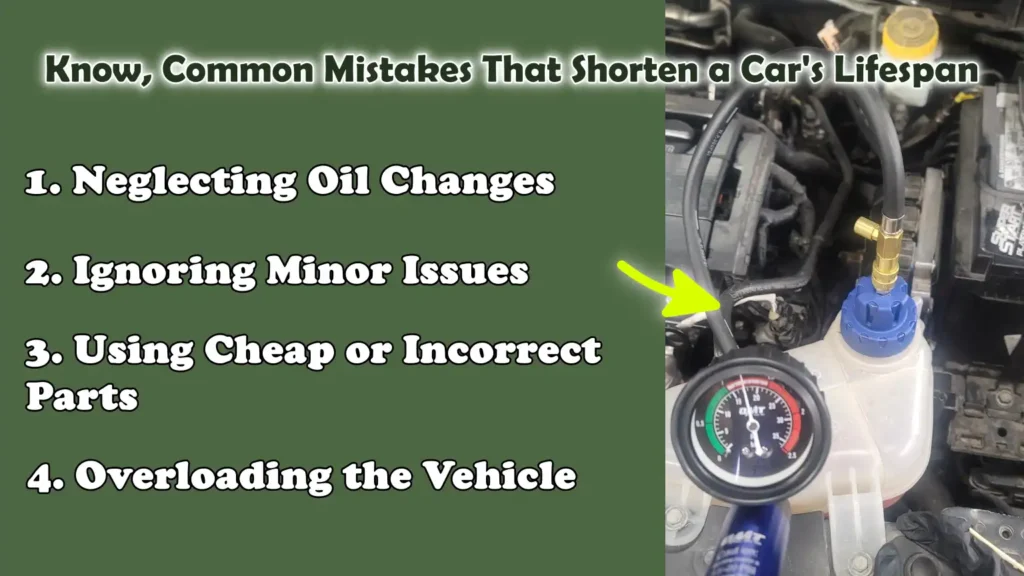
Know, Common Mistakes That Shorten a Car’s Lifespan
Many cars break down long before they reach their intended lifespan; this is not due to their age, but rather due to certain common, and avoidable, mistakes made over time.
A modern vehicle is designed to last for many years, but to reach its full potential, it requires proper care and correct usage.
When basic maintenance is neglected or poor habits are repeatedly practiced, damage gradually accumulates in critical components such as the engine, transmission and suspension.
These issues are often minor and go unnoticed; yet, they slowly degrade the vehicle’s performance, increase fuel consumption and ultimately necessitate costly repairs.
Understanding these common mistakes allows you to avoid unnecessary damage and keep your car running smoothly for many years to come.
A few simple, timely steps can make a significant difference in how reliable and long-lasting your car proves to be.
1. Neglecting Oil Changes
Failing to change the oil is one of the most damaging mistakes you can make, as engine oil is responsible for lubricating and protecting the moving parts within the engine.
Over time, the oil becomes contaminated and loses its ability to reduce friction and dissipate heat.
When old oil is not replaced, metal components begin to grind against one another, leading to accelerated wear and creating a risk of engine overheating.
This damage does not occur all at once; rather, it accumulates gradually and can eventually lead to severe engine problems, or even total engine failure.
Changing the oil is a simple and inexpensive task, yet neglecting it can result in extremely costly repairs.
Keeping the oil clean and at the correct level is one of the most crucial steps in maintaining a healthy engine.
2. Ignoring Minor Issues
Ignoring minor issues is another major reason why cars develop serious problems over time.
Many drivers notice certain warning signs such as: strange noises, vibrations, fluid leaks, or illuminated warning lights on the dashboard, yet they delay getting them fixed.
These minor issues often indicate that a specific component is wearing out or malfunctioning; if left unaddressed, they can cause damage to other interconnected parts of the vehicle.
For instance, even a minor coolant leak can cause the engine to overheat, creating a risk of engine failure; similarly, if brake pads are not replaced in a timely manner, worn pads can damage the brake rotors.
Fixing minor issues early on is generally easier and less expensive; however, if you wait too long, these very issues can escalate into complex and costly repairs.
Paying attention to early warning signs allows you to avoid major breakdowns and keep your car in excellent condition.
3. Using Cheap or Incorrect Parts
Using low-quality or incorrect parts can negatively impact your car’s performance and shorten its lifespan, as these components often fail to meet the necessary standards for durability and compatibility.
Every vehicle is designed to operate with specific components; using parts that do not match these specifications can lead to poor performance and accelerated wear and tear on the parts.
Cheap parts can fail prematurely, break down even under normal driving conditions, or cause damage to other internal vehicle systems.
For instance, using the wrong type of oil or filter can compromise engine protection, while low-quality brake components can negatively impact the vehicle’s stopping performance and safety.
Opting for reliable, high-quality parts ensures a proper fit, superior performance and long-lasting results.
Investing in the right parts safeguards your vehicle and minimizes the risk of needing frequent repairs.
4. Overloading the Vehicle
Overloading your vehicle places immense strain on several critical systems, including the engine, transmission, brakes and suspension.
Every car is designed with a specific weight limit; exceeding this limit forces the engine to work harder, increases fuel consumption and accelerates wear and tear on key components.
The suspension system, responsible for supporting the vehicle’s weight, as it can deteriorate over time under the constant pressure of excessive loads.
Brakes also wear out more rapidly, as they must handle a heavier load to bring the vehicle to a halt.
Furthermore, excess weight can adversely affect the vehicle’s handling and stability, making it less safe to drive.
Keeping your vehicle within its recommended weight capacity helps maintain performance, enhances safety and prevents unnecessary strain on vital components, thereby extending the car’s lifespan.
Know, The Pro Tips for Extending Your Car’s Lifespan
Extending your car’s lifespan isn’t just about basic maintenance; it also depends on making smart decisions that preserve the vehicle over time.
A well-maintained car can last far longer than expected, provided that the right parts are used, issues are diagnosed by experts and all maintenance records are meticulously kept.
These extra steps may seem minor, but they have a profound impact on reliability, performance and long-term value.
Many experienced car owners adopt these practices because they minimize the risk of sudden breakdowns and help keep the vehicle in the best possible condition.
When you combine regular maintenance with these proven methods, you create a care system that supports your car at every stage of its life.
Also, there’s research on the vehicle life cycle that clearly shows that how a car is maintained directly affects how long it stays useful and efficiently working, as the vehicles that are properly maintained then they continue to perform well and remain environmentally efficient as well, other than this poorly maintained cars actually lose their efficiency and contributes to the higher fuel consumption and emissions. This clearly means that maintenance is not only important for saving money but also it keeps the car running cleanly and efficiently for a longer time, that’s why proper care ensures that the vehicle delivers its full value throughout its lifetime.[¹]
1. Use Only OEM or High-Quality Parts
Using original or high-quality parts is essential because your car is designed to operate with specific components that meet certain standards.
OEM parts, manufactured by the Original Equipment Manufacturer, are engineered to match your vehicle’s exact specifications, ensuring a precise fit and optimal performance.
High-quality aftermarket parts can also be a viable option, provided they meet or exceed these standards.
Low-quality or incorrect parts may seem inexpensive initially, but they often fail prematurely, compromise functionality and can even cause damage to other systems.
For instance, a poor-quality filter may fail to effectively trap contaminants, while substandard brake components can compromise stopping performance.
Choosing reliable parts helps maintain the balance of the vehicle’s systems, enhances durability and reduces the likelihood of frequent repairs.
2. Regular Professional Inspections
Even if you take excellent care of your car, professional inspections remain essential because trained technicians can identify issues that are not always immediately apparent to the driver.
Modern vehicles feature complex systems that require specialized tools and expertise for accurate diagnosis.
During an inspection, a professional can examine components such as the engine, transmission, suspension and electronic systems to ensure that everything is functioning correctly.
They can also detect early signs of wear and tear, leaks, or hidden damage, issues that may not present immediate symptoms but can become serious over time.
Regular inspections help catch these problems early, allowing you to address them before they lead to costly repairs or mechanical breakdowns.
This approach enhances safety, reliability and the overall health of the vehicle.
3. Maintain Records for Resale Value
Keeping detailed records of all maintenance and repairs is a crucial habit that benefits you both while you own the vehicle and when you eventually decide to sell it.
A complete service history demonstrates that the vehicle has been properly cared for, thereby boosting buyer confidence and potentially increasing the vehicle’s resale value.
These records also help you track exactly what work was performed and when, as well as when the next service is due, making it easier to adhere to a scheduled maintenance plan.
Without proper records, recalling past maintenance details becomes difficult, which can lead to missed service appointments or the unnecessary duplication of work.
Meticulous documentation establishes a reliable history of your vehicle’s condition and serves as proof that it has been responsibly maintained, ultimately enhancing its value and reliability in the long run.
Read More:
- How to Store Car Long Term
- How to Winterize Your Car
- How to Prepare Your Car for a Long Trip
- How to Ceramic Coat Car
- How to Protect Car Paint
- How to Remove Bad Smell from Car
- How to Restore Faded Car Paint
- How to Polish Car Headlights
Conclusion – How to Maintain Car for Long Life
So, it’s been clear now: most of the cars don’t actually reach to the end of their life, as they are taken there early by neglecting things and that’s where difference actually lies in how consistently they are maintained.
Every component of your car is interconnected and when even a minor detail is overlooked, the repercussions gradually begin to affect other systems as well.
Clean oil safeguards the engine; maintaining proper tire pressure enhances both safety and fuel efficiency; and timely inspections help detect major, costly issues before they escalate into serious problems.
These aren’t merely routine chores; they form the very foundation upon which a car remains reliable for years on end.
Modern vehicles are engineered for longevity, yet they can only perform to their full potential when properly maintained.
Without regular upkeep, no matter how superb the engineering, even the finest automobile will deteriorate far more rapidly than anticipated.
The most critical element is consistent attention.
Regular inspections, good driving habits and adherence to a scheduled maintenance plan create a robust system of care that prevents most common issues before they even arise.
Small tasks such as: changing filters, checking fluid levels and promptly addressing dashboard warning signals, as it can save you thousands of dollars and spare you the inconvenience of sudden breakdowns.
Furthermore, proper maintenance enhances the daily driving experience, making the vehicle smoother, safer and more efficient.
This entails not merely avoiding repairs, but ensuring that the vehicle continues to perform exactly as it was originally designed to do.
In the long run, a well-maintained car offers you far more than just a means of transportation.
It offers you peace of mind precisely when you need it most, while also ensuring the safety of both you and your fellow passengers.
Furthermore, should you ever decide to sell it, you can expect to fetch a good resale value.
The logic is straightforward and has been thoroughly proven: cars that are properly maintained last longer, perform better and incur lower costs over time.
So, that’s all from this guide on How to Maintain Car for Long Life, comment for more.
Frequently Asked Questions
FAQ 1: How long can a car last with proper maintenance?
If a car is properly maintained and driven with care, it can last far longer than most people expect. Many modern vehicles are designed to last for over 200,000 miles and some can even reach 300,000 miles or more. Ultimately, a car’s lifespan depends on how well it has been cared for over time. Regular oil changes, timely replacement of parts, proper driving habits and promptly addressing minor issues and all play a crucial role in this regard. Cars that undergo regular maintenance experience fewer major problems and remain reliable for many years; conversely, neglected cars often break down prematurely.
FAQ 2: What is the most important car maintenance task?
The most critical maintenance task is the regular replacement of the engine oil and filter, as oil protects the engine from wear and overheating. An engine contains numerous moving metal parts that generate friction; clean oil reduces this friction and helps everything run smoothly. When oil becomes dirty or old, it loses its ability to protect the engine, which can lead to serious engine damage over time. While other maintenance tasks are also important, keeping the oil clean is the simplest and most effective way to extend your car’s lifespan.
FAQ 3: How often should I have my car serviced?
Service intervals depend on the type of car, driving habits and the manufacturer’s recommendations. Most cars require basic servicing such as: oil changes and inspections every few thousand miles; meanwhile, other components like transmission fluid or spark plugs may require servicing less frequently. It is best to follow the ‘Owner’s Manual’ (handbook) provided with your car, as it outlines the specific service schedule tailored to your vehicle. If you frequently drive in heavy traffic, adverse weather conditions, or while hauling heavy loads, you may need to perform maintenance more often. Consistently adhering to the recommended service intervals helps prevent issues and ensures that your car continues to run smoothly.
FAQ 4: Can I perform my car’s maintenance myself?
Many basic maintenance tasks can be performed by car owners themselves, which all that is required are a few simple tools and a little know-how. Tasks such as checking fluid levels, replacing air filters, maintaining proper tire pressure and cleaning the car are easy to learn and doing them yourself can also save you money. However, more complex tasks such as: engine repairs, transmission servicing, or diagnosing electrical issues, which typically require specialized tools and expertise. It is important to recognize your limitations and seek expert assistance when necessary. The best way to ensure the long-term health of your car is to handle minor maintenance tasks yourself while scheduling periodic servicing with a professional expert.
FAQ 5: What happens if I neglect regular maintenance?
Neglecting regular maintenance can lead to a variety of issues that become increasingly severe over time. Minor problems such as: dirty oil, low fluid levels, or worn-out parts, as it can gradually damage critical systems like the engine, transmission and brakes. Initially, the car may continue to run, but its overall performance will deteriorate, fuel consumption may increase and the risk of mechanical failure will rise significantly. Ultimately, these minor issues can escalate into major repairs that require substantial time and money to fix. Regular maintenance helps prevent these issues and ensures that the car remains reliable.
FAQ 6: How do I know if my car needs maintenance?
When your car requires maintenance, it usually provides certain clear signals. These signs may include strange noises, illuminated warning lights on the dashboard, reduced fuel efficiency, vibrations, or difficulty starting the engine. Fluid leaks, engine overheating, or changes in the car’s handling are also important indicators. Even if no obvious issues are apparent, adhering to a regular maintenance schedule is crucial, as some problems develop gradually and may not be immediately visible. Paying attention to these signs and taking timely action helps prevent major complications.
FAQ 7: Does driving style affect the lifespan of a car?
Your driving style has a direct impact on how long your car lasts. Driving smoothly and at a consistent speed places less strain on the engine, brakes and transmission, thereby extending the lifespan of these components. Aggressive driving such as: sudden acceleration, hard braking and driving at excessive speeds, that causes increased wear and tear on parts and generates excessive heat, which can lead to component failure over time. Smooth driving habits not only extend the car’s lifespan but also improve fuel efficiency and overall safety. Driving consistently and cautiously is one of the simplest ways to preserve your vehicle.
References:
[1] Optimization of Car Use Time for Different Maintenance and Repair Scenarios Based on Life Cycle Assessment
https://www.mdpi.com/2076-3417/13/17/9843
Hello Folks, Dean Shali here to help you out to solve the problems with your lovely vehicle, as i have lots of experience and knowledge about automotive industry as i woks directly with the customers and repair vehicles and i love to help the people to keep their cars safe and running smoothly.