
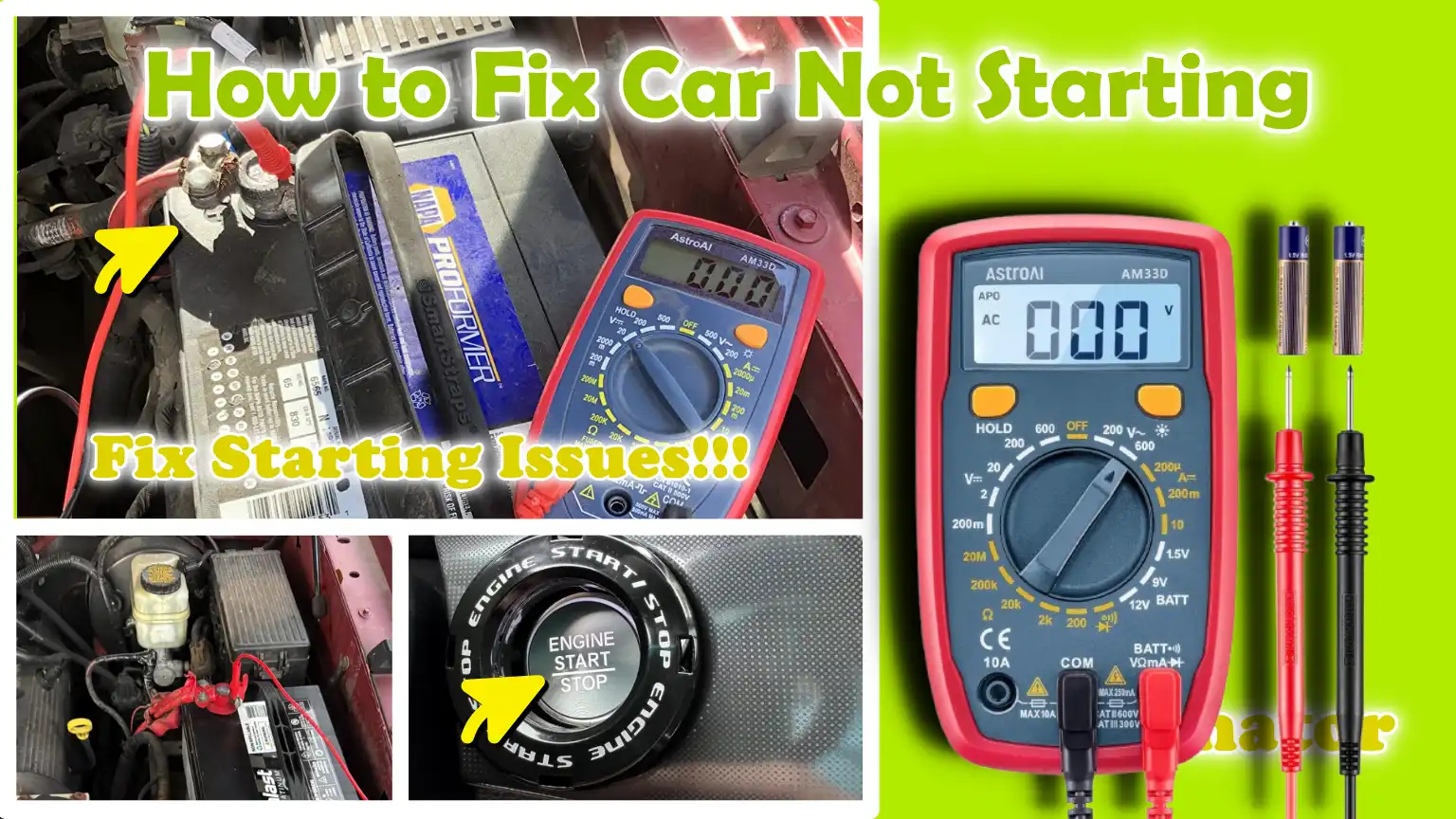
Written By: Dean Shali
Fact Checked By: Sabré Cook
Reviewed By: Tamara Warren
If you’re turning the key on and nothing is happening at all, then it is simply tells you that issues are with battery, starter, fuel system or the ignition component itself.
Yes, it is frustrating as hell and it can literally happen without any kind of warning signs even if the vehicle worked perfectly the day before it happened.
So, understand this: modern cars actually relies on the several systems working together for the engine to start finally such as: battery, ignition system, fuel delivery system, electronic sensors and starter motor as well.
And, whenever you turn the key or press the start button, then it is the battery that sends the electrical power to the starter motor, which later turns the engine while the ignition systems works to create the necessary spark and the fuel system works to deliver the fuel to the engine.
That’s why, if any one of these components fails or loses its ability to power up, then the engine may crank slowly, make the clicking sounds or not responds at all.
Also, you need to know that according to the automotive service data, a weak battery is responsible for a large percentage of no-start vehicle situations, but the problems could be: loose battery cables, a failing starter, clogged fuel filters, faulty ignition coils or even a security systems issue can also prevent your car from starting nicely.
This is the reason, we have come up with this guide about How to Fix Car Not Starting, so that you can easily diagnose the problem with some simple checks and usage of basic tools.
Now, Time to Understand About the Three Main Starting Problems
Before fixing a car that won’t start, it’s important to understand the type of starting problem.
Most starting problems fall into three main categories: the engine won’t crank at all, the engine cranks but won’t start, or the car makes a clicking noise when trying to start.
Each situation usually indicates a different mechanical or electrical problem.
A typical car starting system consists of a battery, starter motor, ignition system, fuel delivery system and several electronic sensors.
When you turn the key or press the start button, the battery sends electrical power to the starter motor, which draws fuel and air into the cylinders, causing the engine to spin, while the ignition system creates a spark to ignite the fuel mixture.
If any part of this process malfunctions, the car may exhibit different symptoms that help identify the underlying problem.
Learning to recognize these symptoms is one of the most useful ways to detect a problem early and avoid unnecessary part replacement.
1. Car Won’t Crank at All
A car that won’t crank at all usually has the most obvious symptoms: when you turn the key or press the start button, nothing happens and the engine doesn’t rev.
In many cases, there’s no sound from the engine area, although sometimes dashboard lights may illuminate.
This problem usually means that power isn’t reaching the starter motor.
One of the most common causes is a fully discharged or bad battery, as the battery provides the high electrical current needed to crank the engine.
Loose or worn battery terminals can also prevent power flow, even if the battery itself is fine.
Other possible causes include a faulty ignition switch, a bad starter relay, a blown fuse, or a problem with the neutral safety switch that prevents the car from starting unless the transmission is in park or neutral.
In some modern vehicles, malfunctions in the anti-theft or immobilizer system can also prevent the starter from engaging.
Because the starter motor requires a lot of power, even minor connection problems can prevent the engine from cranking.
2. Car Cranks But Won’t Start
When a car cranks but won’t start, it means the starter motor is working and the engine is turning, but the engine never starts on its own.
Drivers often hear the engine revving normally, yet the car won’t start.
This usually means the problem lies with the fuel delivery, ignition, or engine timing, rather than the battery or starter.
An engine needs three basic things to start: fuel, air and a properly timed spark.
If the fuel pump fails, the engine won’t receive gasoline, so it will crank without firing.
A clogged fuel filter can also restrict fuel flow and prevent starting.
Ignition problems are another common cause, such as worn spark plugs, a bad ignition coil, or a faulty crankshaft position sensor that prevents the engine computer from triggering a spark.
In modern cars, electronic sensors play a crucial role in engine starting and if the engine control module doesn’t receive the correct signals, it can prevent the fuel injectors or ignition system from functioning.
Although the engine may make a normal sound when cranking, it may fail to start without the proper fuel and spark conditions.
3. Clicking Sounds When Starting
Clicking sounds when trying to start a car are another common symptom that often indicate an electrical problem in the starting system.
This sound can be a single sharp click or multiple sharp clicks coming from the engine bay.
This typically occurs when the starter motor isn’t receiving enough electrical power to start the engine.
The most common cause is a weak or slightly discharged battery, which still has enough power to activate the starter relay but not enough to turn the starter motor.
Corroded battery terminals or loose cables can also damage the electrical circuit, reducing power reaching the starter.
In some cases, the clicking sound may come from a bad starter solenoid that fails to properly connect the starter gear to the engine’s flywheel.
Although the car may seem close to starting, the engine will not crank until the battery power and electrical connections are strong enough to properly operate the starter motor.
Understanding this symptom helps drivers quickly check the condition of the battery, cable connections and starter parts.
What Are The Quick Safety Checks Before Solving This Issue
If your car won’t start, it’s important to perform some simple safety checks before attempting any mechanical troubleshooting.
Often, the cause of a car not starting isn’t a major mechanical fault, but rather minor and easily overlooked issues.
Modern vehicles are designed with numerous safety systems that prevent the engine from starting under certain conditions to protect the driver, passengers and the vehicle.
For example, vehicles with automatic transmissions are designed to only start the engine when the gear selector is in the correct position.
The steering lock mechanism can also block the ignition system if pressure is applied to the steering wheel.
Furthermore, modern cars rely heavily on electronic keys and key fobs that communicate with the vehicle’s security system and if the key’s signal is weak, the car may refuse to start.
Electrical accessories, such as headlights, interior lights, or the car’s infotainment system, can also drain the battery so much that the engine won’t start.
Performing these quick checks first helps drivers rule out simple problems before moving on to more detailed mechanical diagnostics.
1. Make sure the car is in park or neutral
One of the most basic but essential checks is to make sure the car is in the correct gear position before starting.
Automatic cars are designed with a safety feature called a neutral safety switch, which prevents the engine from starting unless the transmission is in park or neutral.
This feature was introduced to prevent vehicles from suddenly shifting forward or backward when the engine starts.
If the gear selector is in drive or reverse, the car’s computer will prevent the starter motor from engaging.
Sometimes the gear indicator may show park but not fully lock due to a worn shifter cable or slight misalignment.
In such cases, pushing the gear lever firmly into park or trying to start the car in neutral can sometimes solve the problem.
In vehicles with manual transmissions, the clutch pedal usually needs to be fully depressed before the engine starts, as the car’s safety system detects whether the clutch is engaged.
2. Check if the steering wheel is locked
Another common cause of a car not starting is a locked steering wheel.
Most vehicles have a built-in steering lock mechanism that activates when the key is removed from the ignition.
This feature is designed to prevent theft, as it locks the steering wheel when the car is parked and disables the ignition system.
Sometimes, the steering wheel locks after the engine is turned off or if the front wheels are pushed to the side.
When this happens, the ignition key may not turn at all or the start button may not work.
Pressure on the steering column locks the ignition mechanism, preventing the car from starting.
In many cases, gently turning the steering wheel left or right while turning the key can release pressure and unlock the ignition system.
This simple step often resolves the problem without any repairs.
3. Verify the Key Fob Battery
In modern vehicles that use push-button start systems, the key fob plays a crucial role in starting the engine.
The key fob contains a small electronic chip that communicates wirelessly with the car’s security system.
When the driver presses the start button, the car checks for the correct key signal.
If the battery inside the key fob is weak or completely dead, the car may not recognize the key and the engine may not start for safety reasons.
The driver may see warning messages such as “Key not found” or “Replace key battery” on the dashboard.
Replacing the small coin-cell battery inside the key fob is usually a quick and inexpensive solution.
Many vehicles also have a backup method where the key fob can be placed near the start button or steering column so that the car can still detect the chip even if the battery is low.
4. Turn off electrical accessories
Electrical accessories inside the vehicle can also affect whether the car starts properly.
Parts like headlights, cabin lights, heated seats, air conditioning systems and infotainment screens draw power from the car’s battery.
If many accessories are left on when the engine is off, the battery’s charge may become so low that it won’t be able to provide the high electrical current needed to start the engine.
Starting a car requires a lot of power because the starter motor must rotate the engine’s heavy internal components before the combustion process begins.
If the battery voltage drops too low, the starter motor may not start or may only make a clicking sound.
Turning off all non-essential electrical accessories reduces the load on the battery and ensures that power continues to reach the starter motor.
Checking this simple step can help drivers determine whether a starting problem is related to battery power or a larger mechanical issue.
How to Fix Car Not Starting – Yes Fast & Working Methods
If a car won’t start, it’s much easier to diagnose the problem if it’s checked in the correct order.
Instead of randomly replacing parts, a step-by-step troubleshooting approach helps drivers identify the root cause of the problem.
In most vehicles, the starting process begins with the battery, which provides the electrical power needed to activate the starter motor and other vital systems.
If the battery doesn’t provide enough voltage or current, the starter motor won’t be able to turn the engine and the car won’t start.
A typical car battery used in modern vehicles is a 12-volt lead-acid battery designed to store electrical energy and release a lot of power when starting the engine.
This power is specially important because the starter motor must rotate heavy engine parts like the pistons, crankshaft and valves before normal combustion can begin.
When a car refuses to start, the battery should always be one of the first parts to check, as it accounts for a large percentage of starting problems.
A thorough check of the battery, its voltage levels and the condition of its terminals can quickly determine whether the problem is due to low power.
How to Check the Car Battery
The car battery is one of the most important parts of a vehicle’s starting system, as it provides the electricity needed to start the engine.
When you turn the key or press the start button, the battery sends a large burst of electricity to the starter motor, which then revs the engine and initiates combustion.
A typical car battery is a 12-volt lead-acid battery that stores electricity using a chemical reaction between lead plates and an electrolyte solution.
If the battery doesn’t provide enough voltage or current, the starter motor won’t be able to crank the engine properly.
Therefore, battery problems are one of the most common causes of a car not starting.
In many cases, the battery weakens due to age, exposure to extreme temperatures, prolonged inactivity, or leaving electrical equipment running while the engine is off.
Most car batteries typically last three to five years, depending on driving habits and weather conditions.
Understanding how to identify battery problems and perform simple checks can help drivers quickly determine whether starting problems are electrically related.
1. Signs of a Bad or Weak Battery
A weak or discharged battery usually shows several clear warning signs before it fails completely.
One of the most common symptoms is slow engine cranking, where the engine revs very slowly when trying to start the car.
Drivers may also notice dimming of headlights, dimming of interior lights, or resetting of dashboard electronics when the ignition is turned.
Another common symptom is a loud clicking sound when turning the key, which occurs when the battery has enough power to activate the starter relay but not enough to engage the starter motor.
In some cases, the vehicle may not respond at all when the key is turned.
These signs occur because the battery cannot provide the high electrical current required by the starter motor.
If the car starts normally after a jump-start, this is also a sure sign that the battery is weak or discharged.
2. How to Test Battery Voltage
Testing the battery voltage is the easiest and most reliable way to determine if the battery is working.
This can be done using a digital multimeter, which measures the electrical voltage at the battery terminals.
When the engine is off, a fully charged battery typically has a voltage of around 12.6 volts.
If the reading is around 12.4 volts, the battery may be slightly discharged but still usable.
A reading of 12 volts or less usually means the battery doesn’t have enough charge to properly start the engine.
When the car’s engine is running, the voltage should typically rise to around 13.7 to 14.7 volts as the alternator recharges the battery.
If the voltage remains low while the engine is running, it may be a problem with the charging system rather than the battery.
Regularly checking the battery voltage helps detect problems before the battery is completely damaged.
3. Check for Corrosion on the Battery Terminals
Another important step when inspecting the battery is to check the battery terminals and cable connections.
Over time, corrosion can form around the metal terminals where the battery cables connect.
This corrosion usually appears as a white, blue, or green powdery substance around the terminals.
It forms due to a chemical reaction between battery acid and surrounding metal parts.
Even a small amount of corrosion can cause electrical resistance, reducing the flow of electricity between the battery and the starter motor.
When this happens, the starter cannot generate the power needed to start the engine.
Loose battery cables can cause similar problems by disrupting the electrical connections.
Carefully cleaning the terminals and tightening the cable connections can restore proper electrical flow and often resolve starting problems without replacing any parts.
4. When to Recharge or Replace the Battery
If the battery voltage is low, but the battery is still fairly new and in good condition, recharging it may provide enough power to start the vehicle normally.
This can be done by using a battery charger or by jump-starting the car with another vehicle and letting the alternator recharge the battery while driving.
However, if the battery frequently loses charge, struggles to maintain voltage, or is more than a few years old, replacing it may be the best option.
A battery that cannot hold a charge properly will continue to cause starting problems and may eventually fail completely.
Replacing an old or failing battery ensures the starting system continues to receive the necessary power and helps prevent future accidental failures.
How to Check the Battery Cables and Connections
Battery cables and electrical connections play a vital role in the car’s starting system, as they deliver electrical power from the battery to the starter motor and other essential components.
Even if the battery is fully charged, loose, corroded, or blocked electrical connections can cause the engine to fail to start.
Battery cables are designed to carry very high electrical current, specially when the starter motor is turning the engine.
Starting a vehicle requires a very high current flow, often hundreds of amps for a short period of time, which means the cables and terminals must provide a clean and strong connection.
If there is a blockage in this electrical pathway, the starter motor may not receive enough power to turn the engine.
Over time, normal wear, vibration from driving, exposure to moisture and chemical reactions around the battery can weaken these connections.
Therefore, checking the battery cables and their contact points is an important step in determining whether the car will start.
1. Loose or Corroded Terminals
Loose or corroded battery terminals are one of the most common causes of vehicle starting problems.
Battery terminals are the metal connection points where battery cables connect to the battery posts.
If these connections become loose, electrical current cannot flow properly from the battery to the rest of the vehicle.
When the starter motor requires a high current, a loose terminal can also interrupt power supply.
Corrosion can also form around battery terminals due to a chemical reaction between battery acid and surrounding metal.
This corrosion typically appears as a white, blue, or green powdery deposit around the battery posts and cable clamps.
This deposit acts as a blockage that reduces electrical flow, leading to symptoms such as slow engine operation, clicking noises, or the engine failing to start at all.
In many cases, simply fixing a clean and tight connection can solve the problem without replacing any components.
2. Cleaning Battery Corrosion Safely
Cleaning battery corrosion is an essential maintenance step that helps restore proper electrical flow between the battery and the vehicle’s electrical system.
Because corrosion is caused by a chemical reaction involving battery acid, it should be handled with caution to avoid contact with skin or eyes.
Before cleaning, the vehicle should be turned off and the battery cables disconnected to prevent accidental electrical contact.
To reduce the risk of short circuits, the negative cable is usually removed first.
Once the cables are disconnected, corrosion around the battery posts and cable clamps can be cleaned with a simple mixture of baking soda and water, which helps neutralize the acidic residue.
Gently scrubbing the affected areas with a brush can remove the buildup and reveal clean metal surfaces.
After cleaning, the terminals should be thoroughly dried to prevent further corrosion from moisture.
Removing corrosion ensures smooth power flow from the battery to the starter and other electrical components.
3. Tightening the Connections Properly
After cleaning the battery terminals, it’s important to properly reconnect and tighten the battery cables.
A secure connection ensures that electrical current flows smoothly from the battery to the starter motor.
When reconnecting the battery, the positive cable is usually connected first, followed by the negative cable.
The cable clamps should fit tightly around the battery posts so they don’t move when touched.
Loose connections can create electrical resistance, reducing the amount of power reaching the starter motor and other systems.
This resistance can also accumulate heat at the connection points, causing cable damage over time.
Properly tightened connections allow the battery to deliver its full power during the starting process.
By ensuring that the cables are clean, secure and free of corrosion, drivers can eliminate one of the most common causes of car starting problems and improve the reliability of the entire electrical system.
How to Test the Starter Motor
The starter motor is a powerful electric motor that plays a vital role in starting a car’s engine.
When the driver turns the ignition key or presses the start button, electrical power from the battery is transmitted to the starter motor through a component called the starter solenoid.
The starter motor then engages a small gear with the engine’s flywheel and begins rotating the engine to inject fuel and air into the cylinders and initiate combustion.
This process lasts only a few seconds, but requires high electrical output and a properly functioning starter motor.
If the starter motor fails or weakens, the engine will not crank properly and the vehicle will not start.
Because the starter motor is used every time the vehicle is started, it gradually deteriorates over time due to heat, mechanical stress and electrical load.
Many starter motors can last 100,000 to 150,000 miles, but their lifespan can vary depending on driving conditions and maintenance.
Learning to recognize starter motor problems can help drivers detect starting problems and avoid unnecessary repairs.
1. Symptoms of a Bad Starter
A bad starter motor typically exhibits several symptoms that indicate it is failing.
One of the most common symptoms is that the engine won’t crank at all when the driver turns the key, even if the dashboard lights and electrical system appear normal.
In other cases, the engine may crank very slowly or erratically because the starter motor is having trouble turning the engine.
Drivers may also experience intermittent starting problems, where the car sometimes starts normally but sometimes doesn’t.
This occurs because worn parts inside the starter motor, such as brushes or electrical contacts, cause them to operate less effectively.
Another possible symptom is a grinding noise during startup, which can occur when the starter gear isn’t properly engaging the engine’s flywheel.
These symptoms usually indicate a bad starter motor or electrical problems.
2. Listening for Clicking
Listening carefully while trying to start the car can provide important clues about the condition of the starter motor.
A loud clicking sound when turning the key often means the starter solenoid is engaging, but the starter motor itself isn’t rotating.
This can occur if the starter motor is worn out or isn’t receiving enough power from the battery.
A loud clicking sound can also occur when the battery voltage is too low to properly power the starter motor.
In this situation, the starter relay repeatedly attempts to engage the starter, but the battery doesn’t provide enough current, so it can’t keep it engaged.
The location of the clicking sound can also help identify the problem.
If the sound comes from the engine or near the starter area, it may indicate a starter problem, while clicking sounds from the fuse box may indicate a relay problem.
Paying attention to these sounds helps narrow down the possible causes of starting problems.
3. Tapping the Starter Trick – Temporary Fix
In some cases, a worn starter motor can be temporarily fixed with a simple method, sometimes called the tapping method.
This method involves gently tapping the starter motor body with a small hammer or wrench-like tool while someone else turns the ignition key.
This action loosens internal parts that may be stuck due to wear or heat.
Inside the starter motor, the carbon brushes and electrical contacts must move freely so that electrical current can pass through the motor.
If these parts become stuck or are not properly grounded, the starter may stop working.
Tapping the starter can sometimes move these parts just enough to restore electrical contact and allow the motor to turn the engine.
However, this method is only a temporary solution and should not be considered a permanent repair, as it may indicate that the starter motor is already failing.
4. When the Starter Needs Replacement
If the starter motor exhibits symptoms such as a frequent clicking noise, occasional difficulty starting, slow cranking, or the engine not cranking at all, it usually needs to be replaced.
Over time, constant electrical load and mechanical movement wear down the internal components of the starter motor.
Components such as the starter solenoid, brushes, armature and internal wiring can wear out after thousands of start cycles.
When these components wear out, the starter motor can no longer generate the power needed to start the engine.
Replacing the starter motor restores proper engine operation and smooth cranking.
Although replacing the starter requires mechanical work, early detection can prevent situations where the car suddenly fails to start in inconvenient or unsafe locations.
Understanding the role of the starter motor and recognizing the signs of malfunction helps drivers maintain a reliable starting system.
How to Check the Fuel System
The fuel system is one of the essential systems that helps a car’s engine start and run properly.
For the engine to start, the correct mixture of fuel and air must reach the cylinders, where combustion occurs.
When the driver turns the key or presses the start button, the fuel pump sends gasoline from the fuel tank through the fuel lines to the engine, where fuel injectors spray the correct amount of fuel into the combustion chamber.
The engine control module carefully manages this process to ensure the correct fuel mixture for starting the engine.
If the engine doesn’t receive enough fuel or if the fuel delivery process is disrupted, the engine may crank normally but won’t start.
Many modern vehicles rely on electronically controlled fuel pumps and fuel injection systems, which provide very precise fuel delivery, but this also means that even minor malfunctions can prevent the engine from starting.
Problems like an empty fuel tank, a faulty fuel pump, or a clogged fuel filter can prevent the engine from receiving the necessary fuel.
Understanding how these parts work helps drivers determine whether starting problems are fuel-related.
1. Make sure there’s fuel in the tank
If a car won’t start, the simplest but most important check is to make sure there’s actually fuel in the tank.
While this may seem obvious, fuel gauges can sometimes give inaccurate readings due to a faulty sensor or electrical problem.
The fuel level sensor inside the tank measures the amount of fuel and sends this information to the dashboard gauge.
However, if the sensor malfunctions, the gauge may show an incorrect fuel level.
In some cases, the driver may believe there’s fuel left even when the tank is empty.
Without fuel, the engine may not start, even if the starter motor is turning the engine normally.
Adding some fuel to the tank is an easy way to eliminate this possibility.
If the vehicle starts immediately after adding fuel, the problem was likely due to an empty tank or an inaccurate fuel gauge reading.
2. Symptoms of a Bad Fuel Pump
The fuel pump is responsible for moving gasoline from the fuel tank to the engine at the correct pressure.
In most modern vehicles, the fuel pump is an electric pump located inside the fuel tank.
When the ignition is turned on, the pump activates briefly to build pressure in the fuel system and quickly start the engine.
If the fuel pump fails, the engine may crank but will not receive the fuel needed for combustion.
A common symptom of fuel pump failure is that the engine cranks normally but will not start.
Drivers may also experience a sudden loss of power while driving, difficulty starting the engine after a short idle, or a sudden engine shutdown.
Fuel pumps can deteriorate over time due to heat, fuel contamination, or prolonged use.
Because the pump runs continuously whenever the engine is running, the electric motor and its internal components can eventually fail after years of operation.
3. Fuel Pump Sound Test
An easy way to check if the fuel pump is working is to turn on the ignition and perform a basic sound test.
In many vehicles, the fuel pump makes a slight humming or buzzing sound for a few seconds when the key is turned to the “On” position before the engine starts.
This sound usually comes from the rear of the vehicle where the fuel tank is located.
Driving for a while builds fuel pressure in the fuel line, which helps the engine start quickly.
If this sound is not heard at all, it could mean the fuel pump is faulty.
The absence of sound could be due to a bad fuel pump, a blown fuel pump fuse, or a faulty fuel pump relay.
Listening for this sound helps determine if the fuel system is properly supplying fuel to the engine.
4. Fuel Filter Clogged Problems
The fuel filter is another vital component of the fuel system, removing dirt, rust and other impurities from gasoline before it reaches the engine.
Clean fuel is essential because modern fuel injectors have very small holes that can easily become clogged with debris.
Over time, the fuel filter can become clogged as it collects dirt from the fuel supply.
When the filter becomes severely clogged, it can reduce the amount of fuel supplied to the engine.
This reduced fuel flow can cause engine starting difficulties or even complete engine failure.
Drivers may also experience symptoms such as poor engine performance, a decrease in power during acceleration, or difficulty starting the vehicle after prolonged parking.
Replacing a clogged fuel filter restores proper fuel flow and helps maintain fuel system efficiency.
Regular fuel filter maintenance can also prevent future starting problems and improve the engine’s overall performance.
How to Check the Ignition System
The ignition system is one of the most important systems that helps a car’s engine start and run smoothly.
To start the engine, a spark is needed to ignite the air and fuel mixture inside the engine cylinder.
This spark must be timed to push the combustion pistons and generate power for the vehicle.
The ignition system is responsible for generating and delivering this spark.
In modern vehicles, the system consists of several essential parts, including the spark plug, ignition coil, sensors and ignition switch, which activate the entire starting process.
When the driver turns the key or presses the start button, the ignition system, in conjunction with the engine control module, sends an electrical signal and creates high voltage for the spark plug.
If any part of this system fails, the engine may crank normally but will not start because the fuel inside the cylinder cannot ignite.
Ignition problems are a common reason why a car cranks but won’t start and understanding how the ignition system works can help drivers recognize the symptoms and easily diagnose the problem.
1. Bad Spark Plugs
Spark plugs are small but vital components that create the electric spark needed to ignite the fuel and air mixture inside the engine cylinder.
Each spark plug sits on top of the cylinder and produces a high-voltage spark that initiates the combustion process.
During normal driving, spark plugs fire thousands of times every minute when the engine is running.
Due to this constant activity, they gradually wear out over time.
As spark plugs age, the electrode tips can become worn, dirty, or accumulate carbon deposits from fuel combustion.
When this happens, the spark can become weak or uneven, preventing the engine from starting properly.
Drivers may experience symptoms such as hard starting, poor engine performance, poor fuel efficiency, or engine misfires.
If the spark plugs are excessively worn or damaged, the engine may crank but never start because the fuel inside the cylinder cannot ignite.
Regularly checking and replacing spark plugs helps ensure reliable engine starting and good combustion.
2. Bad Ignition Coil
The ignition coil is responsible for generating the high-voltage electricity needed to create a spark at the spark plug.
A car battery provides only 12 volts, which is insufficient to create a spark in the engine.
The ignition coil acts like a small transformer, increasing this voltage to thousands of volts so that the spark plugs can ignite the fuel mixture.
In many modern cars, each cylinder has its own ignition coil, mounted directly above the spark plug.
If an ignition coil fails, the spark plug connected to that coil will not receive the high voltage needed to create a spark.
Without this spark, the fuel and air mixture inside the cylinder cannot ignite, which can lead to engine failure or improper engine performance.
Symptoms of a bad ignition coil can include engine misfires, rough running, reduced engine power, or a car that cranks but won’t start.
Ignition coils can fail due to heat, vibration, electrical overload, or normal wear and tear from years of use.
3. Ignition Switch Problems
The ignition switch is the component that initiates the vehicle’s starting process when the driver turns the key or presses the start button.
It’s typically located on the steering column or integrated into the vehicle’s push-button start system.
When turned on, the ignition switch sends electrical signals to various systems, such as the starter motor, ignition system, fuel system and engine control module.
If the ignition switch is defective or worn internally, it may not send the correct signals to these systems.
Because of this, the car may not start even if the battery and other parts are working properly.
Drivers may experience symptoms such as dashboard lights not coming on, the starter motor not engaging, or a lack of spark even when the engine cranks.
In some cases, poor contacts within the switch can cause the ignition key to feel loose or be difficult to turn.
As the ignition switch controls many electrical circuits in the vehicle, any malfunction in this part can interfere with the starting process and prevent the engine from running.
Correctly diagnosing ignition switch problems helps ensure proper repairs without replacing unnecessary parts.
How to Check the Alternator
The alternator is a vital part of the car’s electrical system, responsible for generating electricity when the engine is running and keeping the battery fully charged.
When the engine starts, the alternator begins generating electricity using a rotating magnetic field that converts mechanical energy from the engine into electrical energy.
This electricity is used to power various parts of the vehicle, including the headlights, dashboard electronics, air conditioning system, sensors and battery charging.
Without a properly functioning alternator, the battery will quickly lose its charge as it will power all electrical systems without being recharged.
Although the alternator doesn’t directly start the engine, it plays an essential role in maintaining the battery’s power level.
If the alternator fails or weakens, the battery will gradually discharge and may eventually lose its ability to start the car.
Understanding how an alternator works and recognizing the signs of failure can help drivers detect electrical problems that impact starting reliability.
1. Signs of a Bad Alternator
Before a bad alternator completely fails, there are often several clear warning signs.
A common sign is dim or flickering headlights, specially when the engine is running at low speeds or when electrical accessories are on.
Drivers may also notice a battery warning light on the dashboard while driving.
This light usually indicates that the battery is not receiving the proper charging voltage from the alternator.
Other symptoms may include dim power windows, dim interior lights, malfunctioning electronic systems, or strange electrical behavior in the vehicle.
In more severe cases, the engine may stall while driving because the electrical system is no longer receiving adequate power.
As the alternator is responsible for maintaining the battery charge, a bad alternator can quickly drain the battery, even if the battery is new.
These symptoms often appear gradually as parts inside the alternator, such as bearings, voltage regulators, or diodes, begin to deteriorate.
2. Difference Between Alternator Failure and Battery Failure
Although alternator problems and battery problems may present similar symptoms, they affect the vehicle differently.
Battery failure typically occurs when the battery cannot store or deliver the electrical energy needed to start the engine.
Symptoms may include slow cranking, a clicking sound when trying to start, or complete electrical failure.
On the other hand, alternator failure typically occurs when the engine is already running, as the alternator is responsible for generating electricity once the car starts.
When the alternator fails, the vehicle will continue to run for a while using the battery’s stored energy, but as the electrical parts continue to draw power, the battery will gradually lose charge.
Eventually, the battery voltage becomes too low for driving, which can cause the engine to stall or fail to start the next time the driver tries to start the car.
Understanding this difference helps drivers determine whether the problem lies with the battery or the charging system.
3. How Alternator Problems Can Prevent a Vehicle from Starting
Although the alternator doesn’t directly start the engine, alternator problems can cause vehicle starting problems over time.
When the alternator isn’t producing enough power, the battery can’t recharge properly when the engine is running.
This means the battery gradually loses its stored energy with each drive.
After several trips, the battery may become so weak that it can’t provide the electrical current needed to power the starter motor.
At this point, the vehicle may not start or may make a clicking sound when the key is turned.
Drivers may mistakenly believe the battery is the only problem, but replacing the battery without repairing the alternator won’t fix the problem because the new battery will also lose its charge.
Checking the alternator and ensuring it’s delivering the correct charging voltage helps maintain battery health and ensures the vehicle has enough power to start reliably.
How to Check the Starter Relay and Fuses
Starter relays and fuses are essential electrical components that protect and control the flow of electricity in a car’s starting system.
When the driver turns the ignition key or presses the start button, electrical signals travel through several circuits before reaching the starter motor.
The starter relay acts as an electrical switch, allowing a small amount of current from the ignition system to control the much higher current flowing from the battery to the starter motor.
This design helps protect the vehicle’s electrical system and ensures the starter motor receives the necessary electrical power to crank the engine.
Fuses are also included in the system to protect wiring and electrical components from damage caused by short circuits or excessive electrical current.
If a fuse blows or the starter relay stops working properly, the electrical signal may never reach the starter motor, meaning the engine won’t crank even if the battery is fully charged.
Because these parts are so small and inexpensive, checking them is an important step in diagnosing a car that won’t start.
1. Fuse Box Location
Most vehicles have one or more fuse boxes that organize and protect the electrical circuits throughout the car.
The main fuse box is usually located near the battery in the engine compartment, while a second fuse box may be located inside the vehicle under the dashboard or near the driver’s side panel.
The fuse box contains numerous smaller fuses and relays that control various electrical systems, such as the headlights, fuel pump, ignition system and starter circuit.
Each fuse is designed to protect a specific circuit; if too much electrical current flows through it, the connection will break.
A diagram on the fuse box cover or in the vehicle’s owner’s manual usually shows the exact location of the starter relay and fuses associated with the starting system.
Locating the correct fuse box and identifying the correct parts is the first step in checking whether the starting problem is caused by a simple electrical protection failure.
2. Symptoms of a Blown Fuse
A blown fuse can disrupt the electrical circuit powering the starter system, preventing the engine from cranking when the key is turned.
A fuse contains a thin metal strip that melts when a high electrical current passes through the circuit.
This safety feature prevents damage to wiring and electrical components, but it also stops the flow of electricity to the affected system.
When a starter fuse blows, the driver may notice that the car is unresponsive when trying to start.
Dashboard lights may still illuminate because they are connected to a different electrical circuit, but the starter motor will not receive power.
In some cases, the driver may hear a faint clicking sound from the relay, but the engine will not start.
Checking the fuse can often reveal the problem, as if it’s bad, the metal strip inside the fuse will appear broken or burnt.
Replacing the fuse can repair the electrical circuit and restore the starting system.
3. Replacing the Starter Relay
The starter relay is another important component that helps control the electrical power sent to the starter motor.
When the ignition key is turned, the relay receives a small electrical signal that activates an internal switch.
This switch then allows a large amount of current to flow directly from the battery to the starter motor.
If the relay fails, the internal contacts may not close properly, meaning the starter motor will not receive the power needed to start the engine.
A bad relay can cause symptoms such as a clicking sound without the engine starting, intermittent starting problems, or no response when trying to start the car.
Replacing the starter relay is often a simple process because it usually plugs directly into the fuse box.
The electrical circuit can be repaired by removing the old relay and installing a new one with the same specifications.
Ensuring that the relay is working properly helps ensure that the starter motor receives the correct electrical signal whenever the driver attempts to start the vehicle.
How to Verify the Immobilizer or Anti-Theft System
Modern vehicles are equipped with electronic security systems designed to prevent theft and unauthorized use.
One of the most common systems is the immobilizer, which works by communicating with a small electronic chip inside the car key or key fob.
When the driver inserts the key into the ignition or presses the start button, the car’s computer checks for the correct digital signal from the key.
If the signal matches a code stored in the car’s security system, the engine starts.
However, if the system doesn’t recognize the key or detects an incorrect signal, it will block the starting process for security reasons.
This means that the starter motor, fuel system, or ignition system may be disabled, even if all other mechanical parts of the car are functioning normally.
Because of this design, a problem with the immobilizer or anti-theft system can sometimes appear to be a serious mechanical issue, when the actual problem is simply related to key recognition or electronic communication.
Understanding how this system works can help drivers quickly identify security-related starting problems.
1. Security Light on the Dashboard
The easiest way to identify an immobilizer problem is to check the security indicator light on the vehicle’s dashboard.
Most modern cars have a small light resembling a key, lock symbol, or security icon that indicates the status of the anti-theft system.
Under normal conditions, this light flashes briefly when the car starts and turns off when the system recognizes the key.
However, if the immobilizer system detects a problem, the security light may flash or flash repeatedly.
A flashing security light often means the system is unable to verify the identity of the key, preventing the engine from starting.
In some vehicles, the engine may crank but then immediately stall due to the immobilizer blocking the fuel or ignition system.
Paying attention to the security light can help determine if the starting problem is related to the vehicle’s anti-theft system and not the battery, starter, or fuel system.
2. Key Recognition Problems
Key recognition problems are another common reason why the immobilizer system may prevent the engine from starting.
Modern car keys and key fobs typically contain a small electronic device called a transponder chip.
Whenever the key is used to start the vehicle, this chip sends a unique identification code to the car’s computer.
If the transponder chip is damaged or the key fob’s battery is weak, the car may not receive a clear signal from the key.
Because of this, the immobilizer system may assume an unauthorized key is being used and prevent the engine from starting.
In some cases, drivers may also experience problems when they use a duplicate key that is not properly programmed into the vehicle’s security system.
Environmental factors, such as strong electronic interference or a faulty key antenna inside the steering column, can also interfere with communication between the key and the vehicle.
When the car cannot recognize the correct key signal, the starting process will be halted as a precaution.
3. Resetting the Immobilizer System
Sometimes the immobilizer system may need to be reset if it becomes temporarily confused or loses communication with the key.
This can sometimes be due to a weak battery, electrical repairs, or a software glitch in the vehicle’s electronic control module.
In some cases, simply locking and unlocking the car with the key fob can reset the security system and allow the car to recognize the key again.
Another method sometimes used is to leave the ignition key in the “on” position for a while to allow the system to reconnect with the transponder chip.
For vehicles with push-button start systems, placing the key fob near the start button or in a designated backup location inside the car can also help the system detect the key signal.
If the immobilizer system continues to prevent the car from starting, professional diagnostic tools may be needed to reprogram the key or reset the vehicle’s security module.
Understanding these methods can help drivers determine whether the problem is related to the anti-theft system rather than a mechanical defect in the vehicle.
How to Check Engine Sensors
Modern vehicles rely heavily on electronic sensors to control engine starting and operation.
These sensors continuously send vital information to the engine control module, which is the computer that manages fuel injection, ignition timing and many other engine functions.
During the starting process, the engine computer needs accurate signals from several sensors to determine when to deliver fuel and when to create a spark to ignite the fuel mixture.
If any of these sensors fail or send incorrect data, the computer may not allow the engine to start because it cannot safely control the combustion process.
The two most important sensors involved in engine starting are the crankshaft position sensor and the camshaft position sensor.
These sensors help the computer understand the correct position and movement of engine components so it can synchronize fuel delivery and spark timing.
When these sensors fail or provide weak signals, the engine may crank normally but refuse to start because the computer cannot determine the correct timing for combustion.
1. Crankshaft Position Sensor Failure
The crankshaft position sensor is one of the most important sensors in the engine management system.
It monitors the position and rotational speed of the crankshaft, the main component that converts piston movement into rotational motion, which powers the vehicle.
The sensor detects small changes in magnetic or electrical signals as the crankshaft rotates and sends this information to the engine control module.
Using this data, the computer determines the correct timing for fuel injection and spark generation.
If the crankshaft position sensor fails, the engine computer loses track of the crankshaft’s position and cannot properly control the ignition system.
Because of this, the engine may crank when the starter motor is engaged, but it won’t start because the spark plugs and fuel injectors aren’t firing at the right time.
In some cases, a faulty crankshaft sensor can cause intermittent starting problems, where the engine sometimes starts but sometimes fails.
Heat, vibration and normal wear can gradually damage the sensor or its wiring, resulting in unreliable signals that prevent the engine from starting.
2. Camshaft Sensor Problems
The camshaft position sensor, along with the crankshaft position sensor, provides complete information about the engine’s internal timing.
The crankshaft sensor measures the rotation of the engine’s lower components, while the camshaft sensor tracks the position of the camshafts, which control the opening and closing of the engine’s intake and exhaust valves.
This information allows the engine computer to determine which cylinder is properly primed for fuel injection and ignition.
In modern engines that use advanced fuel injection systems, proper timing is crucial for proper combustion and optimal engine performance.
If the camshaft sensor fails or sends incorrect signals, the engine computer will be unable to properly coordinate fuel injection and ignition timing.
This can cause the engine to crank without starting, stall, or stall suddenly.
Some vehicles may start even with a faulty camshaft sensor, but performance may be reduced or fuel efficiency may decrease until the problem is corrected.
3. How Sensors Affect Engine Starting
Engine sensors play a vital role in the starting process because they provide the engine computer with real-time data needed to properly manage combustion.
When the driver attempts to start the car, the engine control module rapidly gathers information from sensors such as the crankshaft sensor, camshaft sensor, coolant temperature sensor and airflow sensor.
Using this data, the computer calculates how much fuel should be injected and when the spark plugs should fire.
If a critical sensor fails or sends an incorrect signal, the computer may disable the fuel or ignition system to prevent engine damage.
This safety strategy may make it appear as if the vehicle has a mechanical problem, when the actual problem is related to electronic sensor data.
Because modern vehicles rely heavily on sensor information, diagnosing a starting problem often requires checking sensor signals and scanning the vehicle’s computer for stored error codes.
Understanding the role of these sensors helps drivers identify why electronic components can sometimes prevent the engine from starting, even when the battery and starter motor are functioning normally.
Learn, How to Jump-Start a Car
Jump-starting a car is one of the most common and effective emergency methods that drivers should know, as it can quickly restore power to a vehicle with a weak or dead battery.
When a battery loses its charge, it can no longer provide the strong electrical current needed to operate the starter motor, preventing the engine from cranking.
Jump-starting involves temporarily drawing power from another vehicle’s battery to start the engine.
Once the engine starts, the car’s alternator begins generating electricity and recharges the battery while the engine is running.
Most modern vehicles use a 12-volt electrical system, making them safe to jump-start from another vehicle with the same voltage.
Jump-starting involves transferring electrical energy from a working battery to a depleted battery by connecting the positive and negative terminals of the two batteries with heavy-duty jumper cables.
Although this process is simple, it must be performed with caution because car batteries store a lot of electricity and sparks can occur if connections are made incorrectly.
Understanding the proper tools, procedures and safety precautions ensures a safe and effective jump-start process.
1. Essential Tools
Jump-starting a car requires a few simple tools, which are usually found in an emergency vehicle kit.
The most important tool is a set of jumper cables, which are thick, insulated wires designed to carry high electrical current between two batteries.
These cables usually have strong metal clamps at both ends that connect to the battery terminals.
The thickness of the cable is important because the starter motor requires high electrical current to start the engine.
A second vehicle with a fully charged battery is also required to provide the necessary power for a jump-start.
In some situations, a portable jump starter can be used in place of the second vehicle.
A portable jump starter contains a rechargeable battery pack that can provide enough power to start a car without the assistance of another driver.
Having access to these tools makes it possible to quickly and safely restore battery power when a car won’t start due to a discharged battery.
2. Jump-Starting Process
The jump-start process involves transferring electrical energy from a charged battery to a weak battery, enabling the starter motor to operate.
First, both vehicles must be parked close enough so that the jumper cables can reach both batteries, ensuring they don’t touch each other.
The engines must be turned off before connecting the cables.
The positive cable is connected to the positive terminal of the dead battery and then to the positive terminal of the charged battery.
Next, the negative cable is connected to the negative terminal of the charged battery.
The final connection is usually made to a solid metal surface on the engine block or frame of the car with the dead battery, rather than directly to the negative terminal of the battery.
This reduces the chance of sparks near the battery.
After the cables are connected, the engine of the assisting vehicle is started and allowed to run for a few minutes so that the electrical power can begin charging the weakened battery.
After waiting a while, the driver can attempt to start the vehicle with the discharged battery.
If the engine starts properly, the jumper cables can be carefully removed in the reverse order of connection.
3. Safety Precautions
Although jump-starting a car correctly is generally safe, certain precautions should always be taken to prevent accidents or damage to the vehicle’s electrical system.
Car batteries contain chemicals that can produce flammable hydrogen gas, which means sparks should be avoided near the battery.
For this reason, the final jumper cable connection is usually made away from the battery to reduce the risk of fire.
Drivers should also ensure that the jumper cable clamps do not touch each other when connecting them, as this could cause a short circuit.
It’s important to ensure that both vehicles use the same voltage system, which is typically 12 volts for most passenger vehicles.
Connecting batteries with different voltages can damage electrical components.
Drivers should also check the battery for cracks, leaks, or serious damage before attempting a jump-start, as damaged batteries can be unsafe.
Following these safety precautions ensures that the jump-start procedure safely restores power to the vehicle and that the driver can restart the engine without damaging the electrical system.
Read More:
How to Diagnose the Problem Using Simple Tools
Diagnosing why a car won’t start doesn’t always require advanced mechanical knowledge or expensive equipment.
Many common starting problems can be diagnosed using simple diagnostic tools that are readily available and easy to use.
Modern vehicles rely on electrical systems, sensors and computers to manage the starting process, which means many problems can be diagnosed by checking voltage levels or reading diagnostic information stored in the vehicle’s computer.
Simple tools like multimeters and OBD-II scanners allow drivers to gather vital information about the condition of the battery, electrical circuits and engine management system.
These tools help identify whether the problem is related to low battery voltage, a faulty sensor, or other electronic issues.
Using basic diagnostic equipment not only helps identify the root cause of a problem but also prevents unnecessary replacement of parts that may still be functioning properly.
Learning to use these tools can make troubleshooting faster, safer and more accurate.
1. Using a Multimeter
A multimeter is one of the most useful diagnostic tools for checking a vehicle’s electrical system.
It is a small electronic device designed to measure voltage, electrical resistance and current in a circuit.
In automotive troubleshooting, multimeters are often used to measure voltage levels in the battery and electrical connections.
Because the starting system relies on proper electrical flow from the battery to the starter motor, measuring voltage can quickly determine whether the battery and cables are functioning properly.
To test a battery with a multimeter, the probes are placed on the positive and negative battery terminals.
The multimeter then displays a voltage reading, which indicates the battery’s charge level.
Multimeters can also be used to test electrical continuity in wires, relays and fuses, helping to identify broken circuits or faulty electrical connections.
This tool provides accurate information about a vehicle’s electrical health and is commonly used by professional mechanics as well as drivers performing basic troubleshooting.
2. Using an OBD-II Scanner
An OBD-II scanner is another essential tool for diagnosing problems in modern vehicles.
OBD-II stands for On-Board Diagnostics, a standard computer system installed in most vehicles manufactured after the mid-1990s.
This system continuously monitors engine performance, the emissions system and various electronic components.
When the vehicle’s computer detects a problem, it stores a diagnostic trouble code in its memory.
An OBD-II scanner can be connected to the vehicle’s diagnostic port, which is usually located under the dashboard near the driver’s seat.
Once connected, the scanner communicates with the engine control module and retrieves stored error codes.
These codes indicate which component or system is causing the problem.
For example, the scanner may detect a fault in a sensor, ignition component, or fuel delivery system, which could be preventing the engine from starting.
By reading these codes, drivers and mechanics can narrow down the potential causes of starting problems and focus on the correct vehicle component.
3. Checking the Battery Voltage
When a car won’t start, checking the battery voltage is one of the most important diagnostic steps because the battery provides the electrical power needed for the entire starting system.
A healthy car battery typically produces about 12.6 volts when the engine is off and fully charged.
If the voltage drops below about 12.4 volts, the battery may be slightly discharged, reducing its ability to supply the high current required for the starter motor.
When the voltage drops to about 12 volts or less, the battery may not have enough energy to start the engine.
After the engine starts, the voltage should typically rise to between 13.7 and 14.7 volts as the alternator begins recharging the battery.
If the voltage doesn’t rise when the engine is running, there may be a problem with the alternator or charging system.
Regularly checking the battery voltage helps detect electrical problems early and ensures that the battery and charging system are functioning properly.
Common Mistakes When Car Is Not Starting
When a car won’t start, many drivers immediately assume there’s a major mechanical problem.
However, in many cases, the problem is caused by simple electrical issues, weak connections, or basic maintenance problems that are easy to fix.
One of the biggest challenges in diagnosing a starting problem is that many different parts work together during the starting process, including the battery, starter motor, ignition system, fuel system and electronic sensors.
If even one of these parts fails, the engine may not start.
Because of this difficulty, people sometimes make mistakes when trying to fix the problem themselves.
These mistakes can lead to wasted money, unnecessary replacement of good parts and constant frustration when the real problem isn’t fixed.
Understanding the most common mistakes people make when trying to fix a car that won’t start can help drivers approach the problem more logically and identify the root cause more quickly.
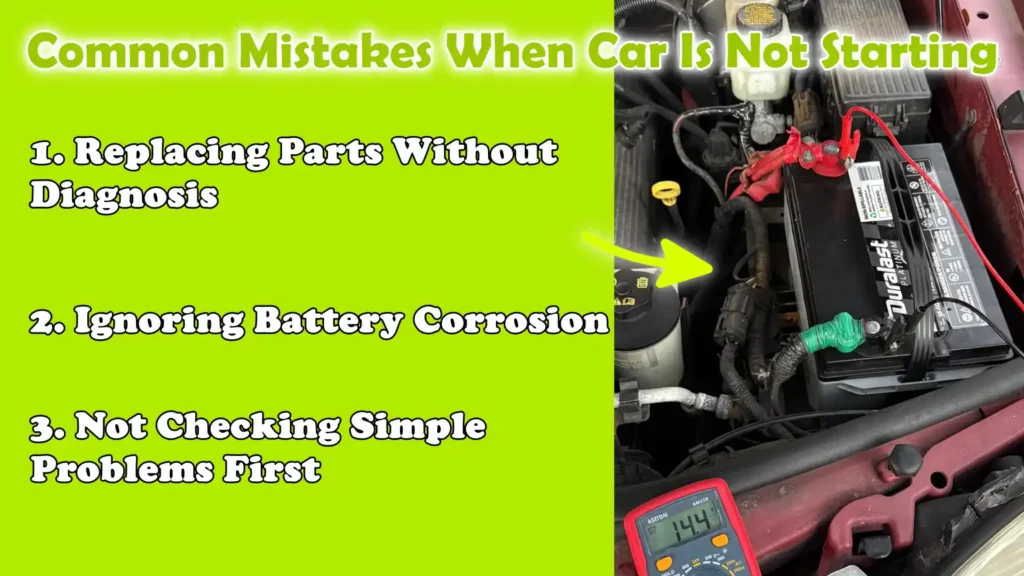
1. Replacing Parts Without Diagnosis
One of the most common mistakes people make when trying to fix a car that won’t start is replacing parts without first determining the root cause.
For example, many drivers assume the battery or starter motor is bad, so they immediately replace these parts.
While the battery and starter are common causes of starting problems, they aren’t the only ones.
Loose electrical connections, blown fuses, faulty relays, faulty sensors, or fuel system problems can also cause similar symptoms.
Replacing parts without proper testing can result in unnecessary expense and may not even solve the problem.
Professional mechanics typically follow a step-by-step diagnostic process that includes checking battery voltage, inspecting electrical connections, scanning the vehicle’s computer for error codes and verifying the functionality of essential parts before replacing anything.
Taking the time to properly diagnose the problem helps ensure that only faulty parts are repaired or replaced.
2. Ignoring Battery Corrosion
Another common mistake is ignoring corrosion around the battery terminals.
Battery corrosion occurs when a chemical reaction occurs between battery acid and the metal terminals.
This buildup often appears as a white, blue, or green powdery substance around the battery posts and cable clamps.
Although corrosion may seem minor, it can create electrical resistance that prevents the flow of electricity from the battery to the starter motor and other components.
Because the starter motor requires a high electrical current to start the engine, even a small amount of corrosion can prevent the car from starting.
Many drivers overlook this problem because the battery may still appear to be working and the dashboard lights may still be on.
However, the electrical connections may not be strong enough to provide the high current needed during startup.
Cleaning the battery terminals and ensuring that the cables are tightly connected can often restore proper electrical flow and fix the problem without replacing any parts.
3. Not Checking Simple Problems First
A third common mistake is skipping basic checks and immediately assuming the problem is complex.
In many cases, minor problems can prevent the car from starting, even if all major components are working properly.
For example, if the transmission is not fully in park or neutral, if the steering wheel is locked, or if the key fob battery is weak in vehicles with push-button start systems, the car may not start.
Drivers may also overlook basic problems such as an empty fuel tank, loose battery cables, or a blown fuse in the starter circuit.
These minor problems can prevent the engine from starting easily, but people often ignore them because they assume the cause must be something more serious.
Starting with simple checks allows drivers to quickly identify common problems and then move on to more complex mechanical or electrical diagnostics.
This logical approach saves time and helps ensure the true cause of the starting problem is correctly identified.
Read More:
When You Should Call a Mechanic?
While many car starting problems can be diagnosed and fixed with basic tools and simple checks, there are some situations where professional help is needed.
Modern vehicles have complex electrical systems, computerized engine controls and advanced mechanical parts that require specialized knowledge and equipment for proper repair.
If drivers still experience starting problems after checking the battery, electrical connections, fuel system and ignition components, the problem may be a deeper mechanical or electronic fault.
Professional mechanics use advanced diagnostic tools such as professional scan tools, electrical testing equipment and service manuals that provide detailed technical data for specific vehicle models.
These tools help them identify hidden problems in the engine management system, wiring circuits, or internal engine components.
Calling a qualified mechanic at the right time can prevent further damage to the vehicle and ensure the problem is accurately diagnosed and repaired safely.
1. Specific Signs of Engine or Electrical Problems
Certain warning signs indicate that starting problems may be related to a more serious engine or electrical system issue.
For example, if you hear strange scraping, knocking, or metal scraping sounds when trying to start the engine, this could indicate mechanical damage to the engine or starter assembly.
Another sign of a serious electrical problem is repeatedly blown fuses or a strong burning smell coming from the engine compartment, which could indicate faulty wiring or a short circuit.
Drivers may also see multiple warning lights on the dashboard at the same time, which could indicate a malfunction in the vehicle’s electronic control module.
If the vehicle suddenly stalls while driving and then fails to start, the problem may be related to major components such as the fuel pump, engine sensors, or the engine control module.
These problems are often difficult to diagnose without specialized testing equipment, so a professional inspection is recommended.
2. When DIY Fixes Don’t Work
Many drivers try to fix starting problems by performing common do-it-yourself checks like jump-starting the battery, tightening battery cables, or replacing simple parts like spark plugs or fuses.
While these steps often fix the basic problem, sometimes problems persist even after these repairs.
When a vehicle won’t start even after repeated attempts, it could be a sign of a more serious problem that requires professional diagnosis.
Modern vehicles rely on complex electronic systems that communicate with each other through the vehicle’s computer network.
If any of these systems malfunction, advanced diagnostic tools may be required to determine the exact cause.
Mechanics can connect professional scanning equipment to the vehicle’s onboard computer to read detailed diagnostic data and detect hidden defects that may not be visible during a basic inspection.
Seeking professional help at this stage can save time and avoid unnecessary replacement parts.
3. Consider Cost
Cost is another important consideration when deciding whether to fix a car problem yourself or call a professional mechanic.
In some situations, attempting repeated repairs without a proper diagnosis can be more expensive than initially seeking professional help.
For example, replacing multiple parts, such as the battery, starter, or sensors, without identifying the root cause of the problem can quickly escalate repair costs.
Professional mechanics typically follow a structured diagnostic process that helps pinpoint the exact problem before replacing any components.
This approach often reduces unnecessary expenses by repairing or replacing only the faulty part.
Furthermore, mechanics can identify problems that could cause future vehicle starting problems, allowing them to address these issues before they cause more serious damage.
Understanding when to seek professional help helps drivers avoid wasted time, reduce repair costs and ensure the vehicle is repaired correctly.
How to Maintain and Prevent Car Not Starting Problem In Future
Not only this, there’s scientific research on the automotive batteries that shows that the gradual capacity loss is actually one of the primary reasons that vehicles fails to start at all, even when the dashboard electronics appears normal, a weak battery may not provide that much current to crank the engine, that shows that it is really important to perform regular battery test and preventive maintenance tasks as well.[¹]
1. Regular Battery Testing
Regular battery testing is one of the most important ways to prevent car breakdowns.
A typical car battery typically lasts three to five years, but its performance gradually declines over time.
The battery provides the electrical power needed to start the engine by sending energy to the starter motor and ignition system.
If the battery is weak, the engine may crank slowly or not start at all.
Regular battery testing helps detect problems before the battery suddenly fails.
You can check the battery voltage using a digital multimeter, a simple and inexpensive tool.
A healthy battery typically reads around 12.6 volts with the engine off.
If the voltage drops below around 12.4 volts, the battery may be losing its charge and if it drops closer to 12.0 volts, it may already be weak or damaged.
Many auto repair experts recommend testing the battery every few months, specially before long trips or bad weather.
Keeping battery terminals clean and ensuring tight connections also helps maintain proper electrical flow.
Regular battery testing reassures drivers that the starting system is functioning properly and greatly reduces the risk of unexpected starting problems.
2. Keeping the Fuel System Clean
Keeping the fuel system clean is another important preventative measure that helps ensure a smooth start every time.
The fuel system consists of vital components such as the fuel tank, fuel pump, fuel filter, fuel lines and fuel injectors.
These components work together to deliver the correct amount of fuel to the engine for combustion.
Over time, dirt, rust and carbon deposits can accumulate in the fuel system.
When this happens, fuel flow can be obstructed, making it difficult to start, impairing engine performance, or even preventing it from starting at all.
For example, a clogged fuel filter can prevent fuel from reaching the engine, while dirty fuel injectors can prevent fuel from spraying properly.
Experts generally recommend changing the fuel filter according to the manufacturer’s maintenance schedule and occasionally using a good-quality fuel system cleaner, which helps remove deposits from the injectors and fuel lines.
Using clean, high-quality fuel and running the tank sparingly can also reduce the amount of debris entering the system.
When the fuel system is clean, the engine receives a proper fuel supply, resulting in reliable ignition and easy starting.
3. Checking Electrical Connections
Regularly checking electrical connections is a simple yet very effective way to prevent starting problems.
Modern vehicles rely heavily on electrical systems and even the slightest disruption to electrical flow can prevent the engine from starting.
The starting system consists of many electrical parts, including the battery, starter motor, ignition switch, relays, fuses and wiring harness.
If any of these connections become loose, dirty, or damaged, electrical current cannot reach the starter motor properly.
Corrosion on battery terminals is one of the most common causes of starting problems.
It appears as a white or blue powdery deposit on the metal terminals and can obstruct electrical flow.
Drivers should occasionally inspect the battery terminals, ground wires and visible wiring connections for corrosion, looseness, or damage.
Cleaning the terminals with the correct battery cleaning solution or a mixture of baking soda and water can restore good contact.
Tightening loose connections also helps maintain electrical power.
Maintaining strong electrical connections ensures proper power flow from the battery to the starter and ignition system, significantly improving starting reliability.
4. Avoid Winter Starting Problems
Starting a car in cold weather can be difficult, so it’s crucial to take preventative measures before winter.
Low temperatures slow down the chemical reactions within the battery, reducing its power-generating capacity.
Furthermore, engine oil thickens in cold weather, making it more difficult to start the engine.
Because of these two factors, the starter motor has to work harder during the winter months.
To avoid problems, drivers should ensure the battery is fully charged and in good condition before cold weather sets in.
Using the right engine oil for winter temperatures can also make a significant difference, as thinner winter-grade oil flows more easily and reduces engine cranking.
Keeping the fuel tank at least half full helps prevent moisture buildup and freezing of fuel lines.
In very cold areas, some vehicles also benefit from engine block heaters, which warm the engine before starting.
These simple maintenance steps help reduce stress on the battery and starter motor, ensuring smooth engine starts even in very cold conditions.
Proper winter preparation significantly reduces the chances of facing that frustrating situation where your car refuses to start on a cold morning.
Conclusion – How to Fix Car Not Starting
Now, you have knowledge about this and it is true that car that refuses to start feels like it could have major mechanical failure, but in reality many starting problems comes from the small and easily fixable issues within the battery, fuel system or some electrical connections as well.
Every vehicle relies on three key components to start properly: a strong battery and electrical system, a regular fuel supply and a properly functioning ignition system.
When any of these systems malfunction, the engine may crank slowly, struggle to start, or fail to start at all.
By understanding how these basic systems work, drivers can calmly understand the problem and diagnose it step-by-step instead of guessing.
Many starting problems are caused by simple causes like a weak battery, loose electrical connections, corrosion on the battery terminals, an empty fuel tank, or a faulty starter motor.
These problems are often inexpensive and can sometimes be fixed with simple tools like a multimeter or OBD-II scanner.
Regular maintenance is crucial to preventing starting problems.
Periodically testing the battery, keeping electrical connections clean, replacing the fuel filter on time and paying attention to warning signs like slow cranking or clicking sounds can help drivers identify problems early.
It’s always easier and cheaper to take preventative measures rather than dealing with a sudden breakdown.
Modern vehicles also have diagnostic systems that store fault codes, making it easier to identify problems before they become serious.
However, if a problem seems complicated or doesn’t resolve with basic checks, it’s best to seek help from a qualified mechanic.
Professional technicians have specialized diagnostic equipment and experience, allowing them to identify deeper electrical or engine problems quickly.
Now, that’s all from this guide about How to Fix Car Not Starting, so you can ask related questions by now.
Frequently Asked Questions
FAQ 1: What are the most common causes of a car not starting?
One of the most common causes of a car not starting is a weak or faulty battery. The battery provides the electrical power needed to turn the starter motor and start the engine. If the battery is old, discharged, or defective, the engine may not crank at all or may crank very slowly. Another common cause is a faulty starter motor, which is the part responsible for turning the engine when the key is turned or the start button is pressed. Fuel system problems can also prevent a car from starting. If the fuel pump is not working, if the fuel filter is clogged, or if there is no fuel in the tank, the engine will not receive the fuel needed for combustion. Additionally, ignition system problems, such as bad spark plugs or ignition coils, can prevent the engine from starting because the fuel inside the cylinders cannot ignite properly. Electrical problems, such as a blown fuse, faulty wiring, or corrosion on the battery terminals, can also interfere with the power needed to start the car.
FAQ 2: How do I know if my car battery is dead?
A bad or weak battery usually has several clear warning signs. When you try to start the car, the engine may run very slowly or you may only hear a clicking sound from the starter. Dashboard lights may appear very dim and electronic systems like power windows or interior lights may not function properly. Sometimes, the car may not respond at all when you turn the key. A reliable way to check the battery’s condition is to use a digital multimeter. A fully charged car battery typically reads about 12.6 volts with the engine off. If the voltage is much lower than this, the battery may be weak or discharged. In many cases, jump-starting the car may start it briefly, which is another sign that the battery is the real problem. However, if the battery repeatedly loses charge, it may need to be replaced.
FAQ 3: What should I check first if my car won’t start?
When a car won’t start, the first thing to do is check the battery, as it’s responsible for supplying power to the entire starting system. Look for signs like dim lights, slow cranking, or a clicking sound when trying to start the engine. You should also check the battery terminals for corrosion or loose connections. After checking the battery, confirm that there’s enough fuel in the car’s tank. Sometimes the problem is simply an empty fuel tank or a faulty fuel gauge. The next step is to listen carefully while starting the car. If the engine cranks but won’t start, the problem could be in the fuel system or ignition system. If the engine won’t crank at all, the starter motor or electrical system could be the culprit. Starting with these simple checks can help identify the problem quickly and without unnecessary repairs.
FAQ 4: Can a bad starter prevent a car from starting?
Yes, a bad starter motor can prevent a car from starting altogether. The starter motor is responsible for starting the engine when you turn the ignition key or press the start button. If the starter motor is faulty, the engine won’t start, meaning the combustion process won’t begin. A common sign of a faulty starter is that the engine won’t start and you hear a clicking sound when you try to start the car. In some cases, the dashboard lights may be normal, but the engine remains quiet. A starter motor malfunction can be caused by worn internal parts, electrical faults, or poor connections. Over time, heat and repeated use can damage the parts inside the starter. If the starter motor is confirmed to be faulty, it usually requires repair or replacement by a mechanic.
FAQ 5: How can I diagnose problems starting my car at home?
Diagnosing problems starting at home usually involves observing how the car behaves when you try to start it. If the engine starts slowly or won’t start at all, the battery is often the first component to check. You can use a multimeter to measure the battery voltage and determine if it’s properly charged. It’s also important to check for corrosion or loose connections at the battery terminals. If the engine cranks normally but won’t start, the problem may be in the fuel or ignition system. Listening for the fuel pump while turning the key to the ignition position can help confirm whether fuel is flowing to the engine. Another helpful tool is an OBD-II scanner, which can read diagnostic trouble codes stored in the vehicle’s computer. These codes can provide clues to engine sensor problems, ignition problems, or fuel system issues. With careful observation and a few basic tools, many starting problems can be diagnosed at home.
References:
[1] BU-905a: Testing Starter Batteries in Vehicles
https://www.batteryuniversity.com/article/bu-905a-testing-starter-batteries-in-vehicles
Hello Folks, Dean Shali here to help you out to solve the problems with your lovely vehicle, as i have lots of experience and knowledge about automotive industry as i woks directly with the customers and repair vehicles and i love to help the people to keep their cars safe and running smoothly.