
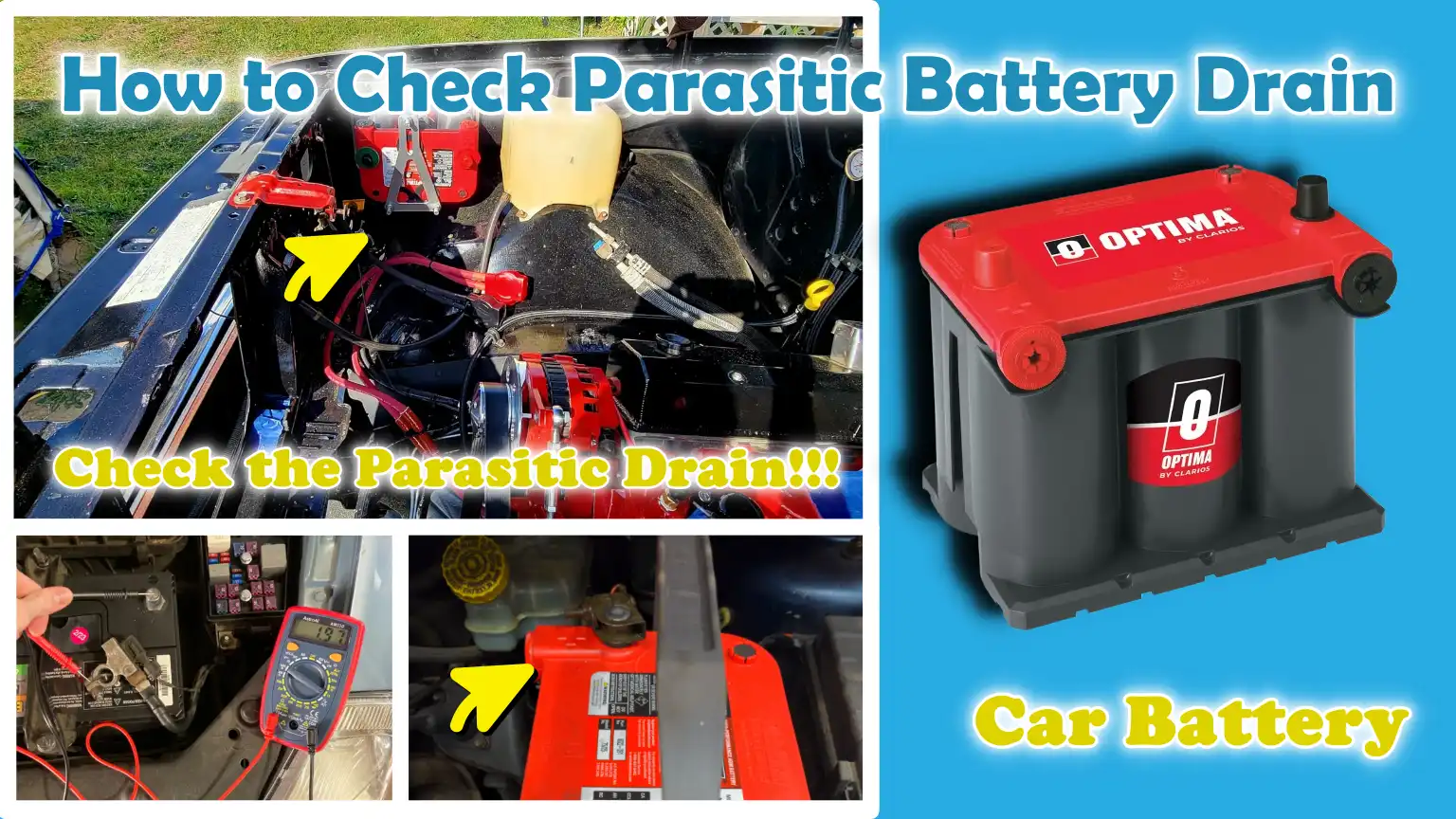
Written By: Dean Shali
Fact Checked By: Sabré Cook
Reviewed By: Tamara Warren
Actually, parasitic battery drain is one of the most common causes of unexpected dead batteries specially in the vehicles that comes with advanced electronics and aftermarket accessories as well.
So, if your vehicle have dozens of electronics systems such as: security modules, clocks, onboard computers and memory functions as well that literally to draw small amounts of power even when the engine is completely turned off.
And, this small amount of power usage is known as “Parasitic Battery Draw”, as in most of the vehicles it normally ranges between the 20 and 50 milliamps.
But, if your vehicle have highly faulty components, damaged wiring or an aftermarket accessory continues to pull excessive current, then it can even lead to what is known as Parasitic Battery Drain.
Basically, there are common reasons can be seen as your vehicle has this drawback: stuck relays, interior lights that remains on, malfunctioning control modules or faulty alternator diodes are among the most of the common causes of this problem as well.
Understand, What is Actually Known as Parasitic Battery Drain?
Parasitic battery drain is an electrical problem in vehicles in which certain parts continue to use the car’s battery even after the engine is turned off.
This slow, steady loss of power can eventually drain the battery, making the car unstartable.
Many drivers discover this problem when their battery drains overnight or after parking the car for a while, even if the battery is new and fully charged.
Understanding parasitic drain is important because it helps prevent frequent jump-starts, premature battery replacements and hidden electrical problems that can affect other car systems.
Detecting and correcting parasitic battery drain can save both time and money and keep the car reliable.
1. Definition of Parasitic Draw
Parasitic draw is the small amount of electrical current that flows through the battery to power some of the vehicle’s systems when the ignition is off.
These systems may include the car’s clock, security alarm, onboard computer, infotainment memory and some sensors.
Generally, parasitic draw is very small and harmless to the battery.
It’s measured in milliamps (mA) and is designed to maintain essential electronic functions.
Problems arise when this draw becomes excessive due to faulty parts, faulty wiring, stuck relays, or aftermarket devices, causing the battery to drain faster than expected.
2. Normal vs Excessive Battery Drain
Normal parasitic draw in most vehicles is typically between 20 and 50 milliamps, which is not enough to significantly impact the battery in a short period of time.
Excessive battery drain occurs when the draw exceeds this range, often reaching 100 milliamps or more, which can completely discharge a healthy battery within a day or two.
Common causes of excessive current draw are problems like faulty relays, burned-out interior lights, defective modules, or poorly installed aftermarket accessories.
Monitoring current draw with a multimeter helps distinguish between normal and abnormal current and determine whether a battery problem is caused by the electrical system or the battery itself.
3. Why are there small electrical loads even when the car is off?
Even when the car is off, some electrical systems remain active to maintain vehicle function.
These include security systems that monitor doors and windows, clocks and memory settings for infotainment and navigation, tamper or impact detection sensors and computer modules that store diagnostic information.
This low current consumption is normal and necessary for proper vehicle function upon restart.
Modern cars with more electronic features naturally have slightly higher parasitic draw, but unless a component is damaged, they remain within safe limits.
Understanding these small loads helps car owners understand that not every use of the battery while parked is a problem, but monitoring and testing is necessary to detect any abnormal drain.
Know, Common Symptoms of Having Parasitic Battery Drain
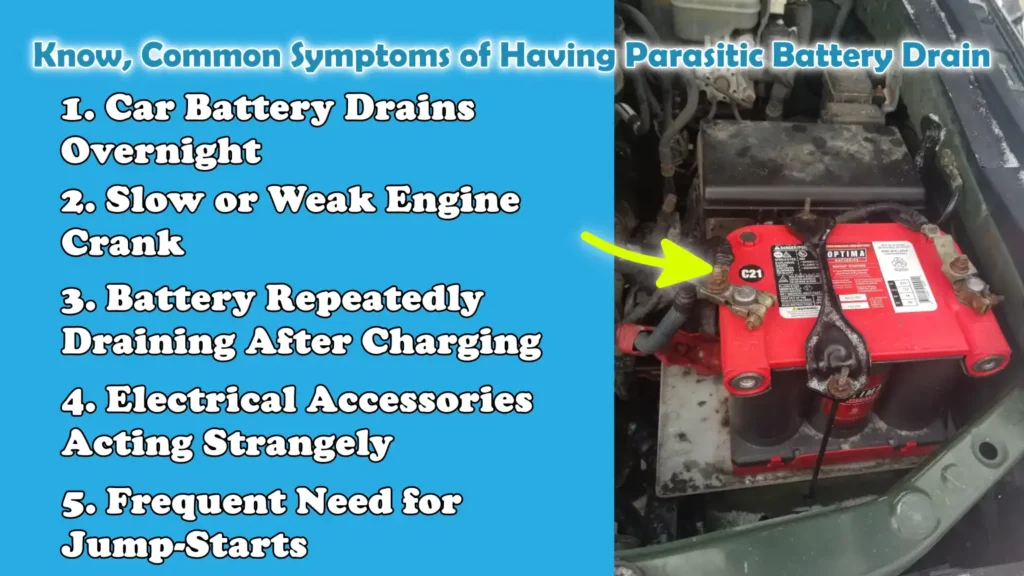
Parasitic battery drain can slowly weaken your car battery over time, often without you even noticing it.
Because modern vehicles contain many electronic systems, a hidden electrical drain can silently use power even when the car is parked.
Recognizing these signs early can prevent stranded vehicles, frequent battery replacements and unexpected repair costs.
Each symptom provides important clues to identify parasitic drain and take necessary steps to correct it.
1. Car Battery Drains Overnight
The most obvious sign of parasitic battery drain is when a fully charged battery loses all its power overnight.
This happens because an electrical component continues to draw current even when the car is off, eventually completely discharging the battery.
If your car starts fine in the evening but fails the next morning without any other mechanical problems, this is a sure sign of hidden parasitic drain in the electrical system.
2. Slow or Weak Engine Crank
Weak or slow engine cranking occurs when the battery doesn’t have enough power to crank the starter motor to full speed.
Even if the battery isn’t completely drained, parasitic drain can reduce its voltage, causing the engine to crank slowly or struggle to start.
This symptom is often more pronounced in cold weather because cold temperatures reduce battery efficiency, making any hidden drain more noticeable.
3. Battery Repeatedly Draining After Charging
If the battery repeatedly drains even after charging or replacing it, this is another clear sign of parasitic drain.
A healthy battery should hold a charge for at least several days.
When the battery continues to lose its charge rapidly, it means that one or more electrical components are drawing too much power when the car is off.
This repeated discharge not only shortens battery life but can also affect other sensitive electronic systems in the vehicle.
4. Electrical Accessories Acting Strangely
Odd behavior in electrical accessories, such as interior lights suddenly dimming, dashboard indicators flickering, or infotainment memory resetting, can indicate something is wrong with the electrical system.
Bad modules, faulty relays, or improperly installed aftermarket devices can continue to draw power even when the ignition is off.
These problems often accompany parasitic drain and provide diagnostic clues.
5. Frequent Need for Jump-Starts
The need to frequently jump-start the vehicle is one of the most common signs of parasitic battery drain.
When the battery can’t hold enough charge to start the car after idling, it forces the driver to rely on jump-starting or external charging.
Repeatedly relying on jump-starts is not normal and indicates an internal electrical problem that must be found and corrected to prevent long-term damage to the battery and starter system.
Very Important to Know – Common Causes of Parasitic Battery Drain
Parasitic battery drain occurs when the vehicle’s electrical parts continue to draw power even after the engine is off.
This can gradually weaken the battery, require frequent jump-starts and shorten the life of both the battery and other electrical systems.
Understanding the most common causes helps car owners identify potential problems and fix them before the battery is permanently damaged.
1. Interior or Glove Box Lights Burning
Interior lights, including those in the glove box, trunk and dome lights, are designed to automatically turn off when the doors are closed.
However, a stuck switch, a faulty door sensor, or a bulb that stays burned out can keep these lights on, continuously drawing power from the battery.
Even a small current of a few hundred milliamps from a glove box or trunk light can discharge a good battery in a day or two.
Checking that all interior lights are properly turned off is the easiest way to eliminate common causes of parasitic drain.
2. Bad Relays
Relays are small electrical switches that control high-current circuits using a low-current signal.
A bad relay can remain energized even when the ignition is off, causing a continuous flow of current in a circuit that should be inactive.
Common relays involved in parasitic drain include those for the fuel pump, lights, or ignition system.
A bad relay can silently drain the battery overnight without any visible signs, making it a common cause of excessive parasitic drain.
3. Aftermarket Accessories – Dash Cams, Alarms & Stereos
Aftermarket devices such as dash cams, alarm systems and stereo amplifiers can contribute to parasitic battery drain if they are not installed correctly or do not have the correct shutdown circuits.
Many of these devices are designed to operate even when the car is off, which can cause the battery to discharge faster than expected.
Improper wiring, hidden power connections, or constant standby modes in these accessories are often overlooked, making them a common cause of unexplained battery problems.
4. Short Circuits or Bad Wiring
Faulty or worn wiring in a vehicle can inadvertently create electrical pathways called short circuits.
These short circuits allow current to flow continuously, even when it’s not needed and can quickly drain the battery.
Wiring defects can be caused by wear, rats, or improper replacement.
Identifying and repairing faulty wiring is essential to prevent parasitic drain and further electrical problems, such as blown fuses or damaged parts.
5. Bad Alternator Diode
The alternator is responsible for charging the battery when the engine is running and it contains diodes that prevent current from flowing back into the alternator when the car is off.
A bad diode can allow electricity to flow in the reverse direction, causing the battery to continuously drain even when the engine is not running.
Symptoms of a bad alternator diode include battery drain, flickering lights and sometimes strange noises from the alternator.
Replacing the bad diode or alternator is essential to restore the battery to proper functioning.
6. Control Modules Not Entering Sleep Mode
Modern vehicles contain several control modules that manage systems such as engine management, infotainment, security and climate control.
These modules are designed to enter a low-power sleep mode when the car is off, but software glitches, malfunctions, or incorrect wiring can prevent them from entering sleep mode.
When a control module is active, it continuously draws power from the battery, causing parasitic drain.
Locating a faulty module in sleep mode often requires a multimeter, careful monitoring and sometimes professional diagnostic tools.
Tools
| Tool | Why It Is Needed | How to Use It |
|---|---|---|
| Digital Multimeter | A multimeter measures the amount of electrical current being drawn from the battery. It is the main tool for determining whether there is a parasitic drain and how much current is being drawn. | Set the multimeter to measure amperes. Disconnect the negative battery terminal and connect the meter in series between the battery and the cable. Observe the reading to see if the current draw is within normal limits. |
| Fuse Puller or Needle-Nose Pliers | Helps remove fuses safely without damaging them. Fuses should be removed one by one to identify which circuit is causing the drain. | Once the multimeter is connected, use a fuse puller or pliers to gently pull each fuse from its socket. Observe the current reading: a drop indicates the drain circuit. |
| Wrench or Socket Set | It is important to safely disconnect the battery terminals. Connecting the multimeter in series requires disconnecting the batteries without shorting anything. | Use the correct size wrench or socket to loosen the bolt on the negative battery terminal. Carefully remove the cable before connecting the multimeter. |
| Vehicle Wiring Diagram – Optional | Shows which circuit each fuse or component is connected to. This helps identify the correct circuit and troubleshoot quickly, specially in modern cars with complex electronics. | Refer to the diagram to trace the circuit, locate relays and understand which fuses control which systems. This helps better identify the exact source of parasitic drain. |
Make Sure the Safety Before Testing The Parasitic Battery Drain
Testing for parasitic battery drain involves working with the vehicle’s electrical system and it’s important to take proper safety precautions to prevent injury or damage to the car.
Even though most car electrical systems operate at low voltage, improper use can cause sparks, short circuits, or damage to sensitive electronic modules.
Taking safety precautions ensures accurate readings and protects both the tester and the vehicle’s electrical system.
1. Turn Off All Electronics
Before starting the test, all electronic devices and accessories in the car, such as lights, air conditioning, infotainment systems and charging devices, should be turned off.
Leaving any electronics on can cause inaccurate readings on the multimeter and make it difficult to identify the actual parasitic drain.
Ensuring everything is off also reduces the risk of accidental sparks or electrical overloads during testing.
2. Remove the Ignition Key
The ignition key must be removed from the ignition switch to prevent any circuits from being accidentally activated.
In many vehicles, some systems remain slightly active even when the key is in the “On” or “Accessory” position, which can interfere with parasitic drain measurement.
Removing the key ensures that the car’s electrical system is in its normal “Off” state for proper testing.
3. Close all door and hood switches
Doors, trunk and hood often contain switches that control interior lighting or security systems.
If any of these doors or panels are open, the lights may remain on, causing incorrect current draw.
Closing all doors, trunk and hood ensures that all connected circuits are inactive and the multimeter will only measure the correct parasitic drain.
4. Wait for the vehicle’s systems to enter sleep mode
Modern vehicles have control modules and computer systems that remain operational for a few minutes after the engine is turned off.
These systems need time to enter “sleep mode,” allowing their current draw to return to its normal low level.
Waiting 10 to 20 minutes, or as directed by the vehicle manufacturer, ensures that the measurement reflects the actual parasitic drain, not temporary activity from modules that are still shutting down.
What is Normal Parasitic Draw?
Parasitic draw is a small amount of electrical current drawn from a car’s battery to keep essential systems running even when the vehicle is off.
Every vehicle has a normal level of parasitic draw, which is necessary to maintain functions like the clock, security system, onboard computer memory and electronic modules.
Understanding what normal parasitic draw looks like helps car owners distinguish between proper power usage and excessive drain, which can damage the battery or cause the car to fail to start.
Accurately measuring parasitic draw is essential for accurately diagnosing battery problems.
1. Normal Draw: 20–50 milliamps (mA)
In most vehicles, normal parasitic draw is between 20 and 50 milliamps.
This small amount of current is harmless and allows essential electronic systems to function while consuming minimal power.
Anything less than 20 milliamps is often considered minor, while anything consistently over 50 milliamps may indicate abnormal drain that requires investigation.
Measuring the draw with a multimeter can clearly determine if any hidden electrical loads are affecting the battery.
2. Older Vehicles vs Modern Vehicles
Older vehicles with fewer electronic systems typically have much lower parasitic draw, sometimes only 10 to 20 milliamps, as they lack advanced modules, infotainment systems and security electronics.
However, modern vehicles rely on multiple control modules, sensors and memory systems, which naturally increase the acceptable parasitic draw to the 20–50 milliamp range.
It’s important to consider the vehicle’s age and design when interpreting readings, as what’s normal for a modern car may be excessive for an older model.
3. How long does it take for a battery to drain at different draw levels?
The time it takes for a parasitic draw to completely discharge a battery depends on both the battery’s capacity and the amount of current being drawn.
For example, a healthy 50-amp-hour battery with a normal draw of 30 milliamps can last several weeks without excessive discharge.
However, if a faulty component increases the draw to 200 milliamps, the same battery can completely drain in 24 to 48 hours.
Understanding this relationship helps car owners anticipate potential problems and prioritize inspection of high-drain circuits before the battery is permanently damaged.
How to Check Parasitic Battery Drain – Easy and Straightforward Method
Checking for parasitic battery drain is a very careful process that involves measuring the electrical current flowing through the battery when the car is off.
Performing this test correctly helps identify hidden drains that could be causing sudden battery drain.
And this is the full working process, car owners can safely and accurately determine which circuit or component is drawing excessive power.
It’s important to understand each step for accurate results and to prevent damage to the vehicle’s sensitive electronics.
How to Turn Off and Prepare the Vehicle
Before checking for parasitic battery drain, it’s important to ensure the vehicle is completely off.
Leaving the car active or in accessory mode can result in inaccurate readings, as some circuits may still be drawing power.
1. Remove the Keys
The first step is to remove the ignition key from the ignition switch.
Many vehicles have systems that remain slightly active even when the key is in the “On” or “Accessory” position, such as the fuel pump, infotainment memory and control module.
Removing the key ensures that all these systems are completely inactive and the multimeter will only measure the actual parasitic draw.
2. Turn off lights and accessories
All interior and exterior lights, including headlights, dome lights, glove box lights and any electronic accessories such as stereo systems, chargers, or GPS devices, should be turned off.
Even small devices can draw enough current when turned on to interfere with the test and produce inaccurate results.
Ensuring everything is off protects the vehicle’s electrical system and helps obtain an accurate measurement of battery draw.
3. Let electronic modules go to sleep
Many modern vehicles have electronic control modules that remain on for several minutes after the engine is turned off.
These modules manage systems such as security, climate control and engine diagnostics.
They need time to enter low-power “sleep mode” to reduce their current draw to normal levels.
Waiting 10 to 20 minutes, depending on the vehicle, ensures that the measurement reflects true parasitic drain, rather than temporary activity caused by a system shutdown.
Properly putting the module into sleep mode is crucial for accurate results and preventing misdiagnosis of battery health.
Disconnect the Negative Battery Cable
Disconnecting the battery is an essential step when testing for parasitic battery drain.
This allows you to safely connect the multimeter in series with the battery to measure current without causing a short circuit or damaging the vehicle’s electrical system.
Proper battery handling is crucial because car batteries store a lot of electrical energy, which can cause sparks or injury if handled incorrectly.
1. Why the Negative Terminal is Used
The negative battery terminal is used for disconnection because most vehicles’ electrical systems are grounded to the chassis.
Disconnecting the negative terminal while connecting the multimeter prevents current from flowing through the vehicle’s metal frame.
This reduces the risk of a sudden short circuit and protects both the person performing the test and the vehicle’s sensitive electronics.
Working with the negative terminal is safer than disconnecting the positive terminal, which can create a direct path to ground and cause sparks or damage.
2. How to Disconnect Safely
To safely disconnect the negative battery cable, first ensure the vehicle is completely off, all electronics are off and the key is removed from the ignition.
Use the correct size wrench or socket to loosen the bolt on the negative terminal clamp.
Carefully lift the cable away from the battery post, ensuring it doesn’t touch any metal parts of the car.
Set the cable aside so it doesn’t accidentally touch the terminal again.
Ensuring this step is done safely protects you from electric shock and prevents short circuits while preparing to measure parasitic battery drain.
How to Set the Multimeter to Measure Amperes
Measuring parasitic battery drain requires a multimeter that can read electrical current in amperes or milliamperes.
Properly setting the multimeter is essential for accurate readings and to prevent damage to both the tool and the vehicle’s electrical system.
Using the wrong setting or connecting the leads incorrectly can blow fuses in the multimeter, give inaccurate readings, or even short circuit the car.
1. Choosing the Right Range
Most multimeters have multiple current measurement ranges.
To test for parasitic draw, which is usually very small, it’s important to choose a range that can accurately detect milliamps.
Typically, you should set a multimeter to the lowest amp range, handling at least 10 amps, depending on the model, to ensure sensitivity.
Some digital multimeters have a dedicated milliamp (mA) setting specifically for measuring small current flows, such as parasitic drain.
Choosing the right range ensures you can see small changes in battery draw and detect abnormal currents that could drain the battery.
2. Connecting the Test Leads Properly
To accurately measure current, the multimeter must be connected in series with the battery and the disconnected negative cable.
Connect one test lead to the negative battery post and the other lead to the battery cable you removed earlier.
This setup allows all the current from the battery to pass through the multimeter, providing an accurate draw reading.
It’s important to ensure the leads are properly connected and don’t touch any metal parts of the car, which could cause a short circuit.
Proper lead connections provide a safe, accurate and reliable measurement of parasitic battery drain.
How to Connect the Multimeter in Series
Connecting the multimeter in series is an essential step in accurately measuring parasitic battery drain.
Voltage is measured at two points, but current must pass through the meter.
Connecting the multimeter in series ensures that all current from the battery passes through the device, providing an accurate reading of how much power is being drawn when the car is off.
A proper series connection ensures safety and accuracy, preventing damage to the multimeter or the vehicle’s electrical system.
1. Connect the Probe to the Battery Terminal
To begin, connect a test probe to the negative battery terminal where the cable was removed.
This probe will serve as a path for current to flow through the multimeter.
Ensuring a secure and stable connection at this point is crucial, as a loose connection can cause fluctuating readings, false indications of high drain, or even sparking.
Connecting the probes securely helps maintain consistent measurements and ensures a safe testing process.
2. Connect the Second Probe to the Battery Cable
The second probe of the multimeter should be connected to the disconnected negative battery cable.
This completes a series circuit, allowing all current normally flowing through the vehicle’s electrical system to pass through the meter.
To avoid short circuits, it’s important to ensure the probes don’t touch any metal parts of the car.
Once both probes are securely connected, the multimeter will display the actual current draw, allowing you to determine whether the battery is draining normally or experiencing excessive parasitic drain.
How to Check the Current Reading
After connecting the multimeter in series with the battery, the next step is to check the current reading displayed on the device.
This reading indicates how much electrical current is being drawn from the battery when the car is off.
Carefully monitoring the current helps determine whether the draw is within the normal range or whether there is excessive parasitic drain that requires further investigation.
1. Initial high readings are normal
When first connecting a multimeter, it’s common to see high current readings.
This is because some control modules and electronic systems in the car remain active for some time after the ignition is turned off.
These systems may include the engine control module, infotainment memory, security system and climate control module.
Initially, high readings are normal and don’t necessarily indicate a problem.
Understanding this helps avoid unnecessary worry or misdiagnosis during testing.
2. Wait for the module to enter sleep mode
To get an accurate measurement of parasitic battery drain, it’s important to wait for the vehicle’s electronic modules to enter sleep mode.
In modern vehicles, it can take 10 to 20 minutes, sometimes longer, for all systems to completely shut down.
Once the modules enter sleep mode, the current readings should stabilize at a low level, typically within the normal range of 20 to 50 milliamps for most vehicles.
Waiting ensures that a short period of activity from the modules doesn’t cause falsely high readings and allows for a more accurate assessment of whether the battery is draining abnormally.
How to Identify if excessive current is being drawn
Once the multimeter readings stabilize and all electronic modules have entered sleep mode, the next step is to determine whether the current is within the normal range or excessively high.
Identifying parasitic draw is crucial because prolonged high drain can cause a healthy battery to discharge quickly, leading to repeated jump-starts and damage to other electrical components in the vehicle.
A clear comparison with the normal value helps determine if there is an internal electrical problem that needs further investigation.
1. Compare the reading to the acceptable range
For most modern vehicles, acceptable parasitic draw is typically between 20 and 50 milliamps.
In older vehicles with fewer electronics, normal draw can be as low as 10 to 20 milliamps.
Once the reading stabilizes, compare it to these standard ranges to determine if it is too high.
A reading significantly higher than the upper limit indicates that one or more components are drawing excessive current, which could drain the battery in a short time.
Identifying abnormal draw helps the car owner or technician identify the specific circuit, relay, or accessory causing the problem and steps can be taken to correct the problem before permanent damage to the battery occurs.
How to Locate the Circuit Causing the Drain
When the multimeter shows that the parasitic draw is higher than normal, the next step is to identify which circuit or component is responsible.
Locating the source of the drain allows car owners to diagnose the problem, prevent further discharge of the battery and repair or replace the faulty part.
Modern vehicles contain many fuses, relays and electronic devices, so a systematic approach is essential to locating the source of the high current draw.
1. Remove Fuses One by One
The most effective way to identify a parasitic drain is to remove fuses one by one while observing the multimeter reading.
Each fuse controls a specific circuit, such as the interior lights, fuel pump, or control module.
When a fuse is pulled and the current drops significantly, it indicates that the circuit protected by that fuse is responsible for the high drain.
This method helps car owners narrow down problem circuits without guesswork and reduces the risk of unnecessary replacement or repair.
By systematically testing each fuse, you can accurately and safely identify the source.
2. Check Relays
Relays are small switches that control high-current circuits using a low-current signal.
A relay that remains on even when turned off can draw constant current, leading to parasitic battery drain.
After identifying a suspect circuit through fuse testing, it’s important to check all relays connected to that circuit.
Faulty relays may appear normal from the outside, but may be damaged internally, causing the circuit to remain on even when the ignition is off.
Testing or replacing these relays is often necessary to stop the drain and restore battery performance.
3. Check Aftermarket Devices
Aftermarket electronic devices such as alarm systems, GPS trackers, dash cams and stereo amplifiers can significantly contribute to parasitic battery drain if they are not wired correctly or lack the proper shut-off mechanism.
These devices often continue to draw power even when the vehicle is off, specially if they were installed without considering standby current limits.
Checking aftermarket devices includes checking their power connections, ensuring they are completely off when the car is not running and disconnecting or adjusting them if necessary.
Properly checking and repairing these devices can eliminate a major cause of battery drain and improve overall vehicle reliability.
How to Fix Parasitic Battery Drain
Once the source of parasitic battery drain is identified, it’s important to take the right steps to correct it so that the battery doesn’t fail repeatedly and the vehicle’s electrical system remains safe.
Addressing the problem promptly not only restores normal battery function but also extends battery life and keeps all electronic systems reliable.
Depending on the cause, the repair process may involve replacing parts, repairing wiring, or adjusting aftermarket devices.
1. Replace a Faulty Relay or Switch
A relay or switch that remains on can continuously draw power from the battery.
Replacing a faulty relay or switch stops the unwanted current flow and restores normal electrical operation.
Using the correct replacement parts specified for the vehicle is essential to ensure proper function and prevent future electrical problems.
Replacing these parts is often a straightforward solution that immediately corrects excessive parasitic drain.
2. Repair faulty wiring
Faulty or worn wiring can cause short circuits or unintentional current paths, leading to continuous battery drain.
Repairing wiring involves locating the faulty part, removing any corrosion or worn insulation and re-establishing the correct connections using the correct tools and materials.
Properly repaired wiring ensures that power only goes where it’s needed, prevents further battery drain and reduces the risk of electrical fires or damage to other components.
3. Remove problematic aftermarket accessories
Aftermarket devices such as alarm systems, GPS trackers, dash cams, or stereo amplifiers can continuously draw power if they are not installed properly or lack the proper shut-off features.
Removing these devices or rewiring them properly can prevent excessive current consumption.
If the device is essential, ensuring it has a low standby current or a proper power management system helps prevent parasitic drain while keeping the accessory running.
4. Replace a Bad Alternator Diode
A bad alternator diode can allow current to flow back into the alternator even when the engine is off, draining the battery.
Replacing the diode or alternator restores normal charging and prevents excessive current flow.
Detecting a bad diode often requires a multimeter or professional testing and timely replacement can prevent recurring battery problems and keep the alternator functioning properly.
5. Reset or Replace a Bad Control Module
Electronic control modules that cannot go into sleep mode may continue to draw power even when the car is off.
Resetting these modules by disconnecting the battery for a short time or performing a software reset can sometimes restore proper operation.
If a module is permanently damaged, it may need to be replaced.
Ensuring all modules are working properly helps stabilize parasitic draw, protect the battery and keep the vehicle’s electronic systems functioning properly.
How to Fix Parasitic Battery Drain By Using a Test Light
Although a digital multimeter is the most accurate tool for measuring parasitic battery drain, a test light can be used as an alternative in some situations.
This method allows car owners or technicians to quickly identify high-drain circuits without measuring the exact current in milliamps.
When current flows through the circuit, the test light illuminates, indicating that power is being drawn from the battery.
1. How to Test with a Test Light
To check for parasitic drain with a test light, connect the clip of the test light to the negative battery terminal and touch the probe to the battery cable you removed.
If the light flashes rapidly, it means current is flowing through the circuit.
Next, remove fuses one by one while observing the light.
When the light dims or goes off, the circuit connected to that fuse is causing the drain.
This method doesn’t provide accurate milliamp measurements, but it can help identify problem circuits, specially in vehicles where a multimeter isn’t available.
2. When is this method useful?
Using a test light is specially useful for quick diagnostics or when you need to see which circuits are drawing the most power.
This is useful for older vehicles with simple electrical systems or for quick repairs to multiple circuits.
However, this method is less accurate than a multimeter, so it can’t detect small parasitic draws that can become harmful over time.
It’s best used as an initial diagnostic tool to identify high-draw circuits before detailed measurements or repairs.
Know, How Long Does it Take for Parasitic Drain to Discharge a Battery?
Parasitic battery drain can discharge a battery slowly or rapidly, depending on the amount of current drawn and the battery’s capacity.
Understanding how long it takes for parasitic drain to damage a battery helps vehicle owners anticipate problems and fix them before they become uncontrollable.
By combining the battery’s capacity with the measured current draw, an estimate can be made of how long it will take for the battery to fully discharge.
1. Example Calculation
For example, a typical car battery has a capacity of 50 amp-hours (Ah).
If the parasitic draw is 50 milliamperes (0.05 amps), dividing 50 Ah by 0.05 amps gives 1,000 hours, or approximately 41 days, for the battery to fully discharge.
If the parasitic draw increases to 200 milliamperes (0.2 amps), the same battery will be completely drained in 250 hours, or a little over 10 days.
These calculations show that even a small increase in current draw can significantly reduce the usable life of a parked battery.
Understanding this relationship helps drivers plan inspections and repairs before the battery is completely depleted.
2. Factors Affecting Battery Discharge
Many factors can affect how quickly parasitic drain drains a battery.
Battery age and condition are key factors, as older batteries have reduced capacity and are more susceptible to discharge.
The ambient temperature also plays a role; cold weather reduces a battery’s ability to hold a charge, while excessive heat can accelerate chemical reactions that shorten battery life.
Battery type and efficiency, as well as any pre-existing electrical problems, can also affect discharge time.
Identifying these factors helps vehicle owners make informed decisions about maintenance, testing frequency and early detection of excessive parasitic draw.
Read More:
- How to Replace a Starter Motor
- How to Check Car Battery Health with a Multimeter
- How to Fix Car Not Starting
Understand, When You Should Go for the Professional Help
While many cases of parasitic battery drain can be diagnosed and fixed with careful observation and basic testing, some situations require the expertise of a professional technician.
Attempting to fix a complex electrical problem without the proper knowledge or tools can cause further damage, waste time, or even pose a safety hazard.
Knowing when to call a professional ensures that the vehicle’s electrical system is properly diagnosed and repaired, protecting both the battery and other sensitive components.
1. Complex Electrical Problems
If parasitic drain is caused by multiple circuits, hidden wiring problems, or frequent blown fuses, the problem can be too complex to handle safely without experience.
Complex electrical problems often require specialized diagnostic tools, knowledge of the vehicle’s wiring diagrams and careful troubleshooting to determine the root cause.
A professional technician can diagnose and repair these problems quickly, preventing long-term damage to the battery and ensuring the car continues to run smoothly.
2. Computer Module Failure
Modern vehicles rely on several electronic control modules to manage engine performance, security, climate control and infotainment systems.
When these modules fail to sleep or become internally damaged, they can draw excessive power even when the car is off.
Diagnosing and repairing a faulty control module often requires specialized software, programming tools, or replacement modules that most car owners don’t readily have.
In such cases, professional assistance is needed to restore the battery to proper functioning and prevent parasitic battery drain.
3. Intermittent Battery Drain
Sometimes, parasitic battery drain isn’t continuous, but rather intermittent, making it difficult to detect with normal testing.
Intermittent drains can be caused by wiring that only shorts under specific conditions, relays that occasionally trip, or aftermarket devices that suddenly turn on.
Diagnosing these intermittent problems requires repeated testing, monitoring tools and experience in pattern recognition.
A professional technician has the skills and equipment to accurately diagnose intermittent drains, ensuring a reliable and long-lasting solution.
How to Prevent Parasitic Battery Drain
Preventing parasitic battery drain is essential for maintaining the reliable and long life of a vehicle’s battery and electrical system.
By following a few simple steps, car owners can reduce the risk of sudden battery failure, avoid frequent jump-starts and protect sensitive electronics.
Preventive measures include reducing unnecessary power consumption, monitoring the electrical system and keeping the battery in good condition.
Also, there’s practical diagnostic overview that shows that the small parasitic current around 20 to 25 mA are typicall in a parked vehicle can be seen and it is completely normal, so if the measurements consistently goes above the 100mA then it is the something which we can say abnormal drain, yes there are some common causes such as: there could be wiring issues, electronic accessories malfunction and modules can be malfunction as well, which is why you need to be really carefully measure and perform the inspection techniques.[¹]
1. Turn off interior lights
Interior lights, including dome lights, glove box lights, trunk lights and dashboard lights, can continue to draw power if left on accidentally.
Always ensure these lights are off when the doors are closed and check for stuck switches or faulty sensors.
Even small lights that remain on can slowly drain the battery over time, specially in vehicles that are not driven frequently.
Getting into the habit of turning off interior lights helps prevent unnecessary parasitic drain.
2. Check Aftermarket Accessories
Aftermarket devices such as dash cams, alarm systems, GPS trackers and stereo amplifiers can contribute to parasitic battery drain if they remain powered even when the vehicle is off.
Periodically check these devices to ensure they have proper shut-off circuits or are wired to reduce standby current.
Disconnecting or adjusting accessories that draw more power when the car is off can significantly reduce unwanted battery discharge.
3. Maintain Battery Health
A healthy battery is less sensitive to parasitic drain and can withstand lower current draws without rapidly losing charge.
Regularly check battery terminals for corrosion, ensure tight connections and keep the battery fully charged.
Replacing old or weak batteries before they deteriorate can prevent situations where even normal parasitic draw becomes a problem.
Battery maintenance is a key factor in preventing both sudden failures and long-term electrical problems.
4. Perform Periodic Electrical Inspections
Regular inspections of the vehicle’s electrical system help detect potential parasitic drains before they cause serious problems.
This includes checking fuses, relays, wiring and connectors for wear, damage, or corrosion.
Early detection of problems allows for timely repairs, reducing the risk of sudden battery failure.
Periodic inspections and monitoring battery performance are an effective way to keep the vehicle’s electrical system in good condition and prevent recurring parasitic drain problems.
Conclusion – How to Check Parasitic Battery Drain
Basically, parasitic battery drain can impact the overall vehicle’s electrical system, that’s why you shouldn’t ignore this.
It’s important for every vehicle owner to understand how to detect, diagnose and correct excessive drain, as even a small amount of electrical current left unchecked can eventually cause the vehicle to stall.
By understanding the normal range of parasitic drain, recognizing common symptoms and using the right testing tools, such as a multimeter or test light, car owners can identify hidden electrical problems before they become serious.
Regular inspections, proper battery maintenance and attention to aftermarket accessories are practical ways to prevent future drains.
Correcting problems promptly, whether by replacing faulty relays, repairing faulty wiring, or consulting a professional for more serious electrical issues, ensures battery reliability, smooth vehicle operation and prevents costly repairs.
Ultimately, being proactive about parasitic battery drain is an investment in the longevity of the vehicle’s electrical system and overall driving reliability.
So, that’s all from this guide about How to Check Parasitic Battery Drain, even if you still have questions then you can comment that bastard down below.
Frequently Asked Questions
FAQ 1: What is parasitic battery drain?
Parasitic battery drain is a small electrical current that flows through a car’s battery even when the car is off. Modern cars contain electronics such as clocks, security systems and control modules that constantly use power. Normally, this draw is very low and safe, but if a component or circuit draws too much power, it can slowly discharge the battery and cause problems starting the car.
FAQ 2: How do I know if my car has parasitic battery drain?
There are several common symptoms of parasitic drain. The battery may drain overnight even when fully charged, or the engine may crank slowly when you try to start the car. You may need to jump-start your car frequently and sometimes electrical accessories such as lights, stereo, or dashboard displays may behave strangely. These symptoms indicate that a circuit or component is drawing too much power.
FAQ 3: Why does parasitic battery drain occur?
Parasitic drain can occur for a variety of reasons. Leaving interior lights, glove box lights, or trunk lights on can drain the battery. A faulty relay or switch can retain energy and continue drawing power. Aftermarket devices like dash cams, alarms, or stereo amplifiers can also contribute if they’re not wired properly. Bad wiring, short circuits, or a bad alternator diode and control module can also be responsible.
FAQ 4: How can I check for parasitic battery drain?
The most reliable way to check for parasitic drain is to use a digital multimeter set to measure amps. First, turn off the car, remove the key and let the electronic modules sleep. Disconnect the negative battery cable and connect the multimeter in series between the battery and the cable. After the module has completely entered sleep mode, check the current reading. If the reading exceeds the normal range of 20–50 milliamps, excessive drain is occurring. A test light can also be used to check for high-draw circuits.
FAQ 5: How long does it take for parasitic drain to discharge a battery?
This time depends on the battery’s capacity and the amount of current being drawn. For example, a typical 50 amp-hour battery with a normal parasitic draw of 50 milliamps can last for over a month without excessive discharge. However, if the draw increases to 200 milliamps, the same battery may discharge in over ten days. Battery age, condition and weather also affect how quickly a battery discharges.
FAQ 6: Can I fix parasitic battery drain myself?
Some parasitic drain problems can be fixed by car owners. Replacing faulty relays or switches, repairing faulty wiring, removing or rewiring aftermarket devices, or replacing faulty alternator diodes can all be effective. A brief reset of the control module may also help. However, complex problems, intermittent drains, or control module malfunctions are best handled by professional technicians.
FAQ 7: What are normal parasitic draw values?
In most modern vehicles, normal parasitic draw is between 20 and 50 milliamps. In older vehicles with simpler electronics, the draw may be lower, around 10 to 20 milliamps. Any reading significantly higher than these levels indicates an abnormal drain that needs investigation. Understanding normal values helps distinguish between harmless current and a real battery-draining problem.
FAQ 8: How can I prevent parasitic battery drain in the future?
Some simple habits to prevent draining include: always turn off interior lights, check that aftermarket accessories are wired correctly and maintain your battery by keeping terminals clean and fully charged. Regularly checking fuses, relays and wiring can help identify problems before they become serious. Periodic monitoring of the battery and electrical system ensures vehicle reliability and reduces the risk of sudden battery failure.
References:
[1] Parasitic Draw Test with a Multimeter
https://testmeterpro.com/parasitic-draw-test-with-a-multimeter/
Hello Folks, Dean Shali here to help you out to solve the problems with your lovely vehicle, as i have lots of experience and knowledge about automotive industry as i woks directly with the customers and repair vehicles and i love to help the people to keep their cars safe and running smoothly.