
Written By: Dean Shali
Fact Checked By: Sabré Cook
Reviewed By: Tamara Warren
Transmission Fluid is the real hero behind efficiently working transmission system, as this fluid actually is responsible for lubricating the moving parts, that reduces friction, cools internal components and that’s how it ensures smooth gear shifts every time you drive.
But, just like other man-made things: over the period of time and repetition of usage, this transmission fluid can break down due to the heat, contamination and normal wear as well; that literally leads to the serious problems such as: slipping gears, delayed shifting, overheating and even you can see complete transmission failures if not checked and maintained the fluid at the right time.
As well as, automotive maintenance data shows that the transmission repairs are among the most of the expensive fixes in a car, as it literally costs up to thousands of dollars from your pocket, even though most of the time issue can be prevented with simple routine checks that you gonna learn below.
And, this is the guide about How to Check Transmission Fluid, so that you can check this in No Time with this easy to follow process that even complete beginner can perform.
Now, At First You Should Know: What is Transmission Fluid?
Transmission fluid is a specialized type of liquid that helps your vehicle’s transmission system operate smoothly, efficiently and without damage.
Inside the transmission, whenever you drive, numerous metal components move, rotate and rub against one another.
This fluid minimizes that friction, assists in transmitting power from the engine to the wheels and maintains the stability of the entire system, even under conditions of high pressure and heat.
Without the correct transmission fluid, these components can wear out quickly, overheat and fail; for this reason, it is considered one of the most critical fluids in any vehicle.
It also facilitates gear shifting, enabling your car to change gears without any jerking or delay, thereby ensuring a safe and comfortable driving experience.
1. Definition and Purpose
Transmission fluid can be understood as playing a dual role: it functions as both a lubricant and an operating fluid that facilitates various processes within the transmission.
Its primary objectives are to reduce wear between moving parts, dissipate heat to prevent overheating and, in automatic systems, to act as a hydraulic fluid that assists in precise and timely gear shifting.
Simply put, it keeps everything inside the transmission clean, cool and protected.
Over time, this fluid can degrade or lose its effectiveness due to heat and contamination; therefore, regular inspection is essential to maintain optimal performance.
2. Types of Transmission Fluid
Automatic Transmission Fluid (ATF)
Automatic Transmission Fluid, commonly known as ATF, is used in vehicles equipped with an automatic transmission.
This type of fluid is specifically formulated to function as a hydraulic fluid; this means it assists in shifting gears automatically without requiring driver intervention.
It also lubricates internal components and helps keep the system cool, even under high-temperature conditions.
When in good condition, ATF typically appears red or pink in color, making it easy to identify during inspections.
As automatic transmissions rely heavily on fluid pressure, maintaining the correct level and quality of ATF is crucial to prevent gear slippage and delayed shifting.
Manual Transmission Fluid
Manual Transmission Fluid is used in vehicles where the driver manually shifts gears.
Unlike automatic systems, this fluid focuses primarily on lubrication and heat dissipation rather than hydraulic functions.
It is generally thicker than ATF and is designed to protect gears, bearings and shafts from wear caused by constant contact.
In some vehicles, depending on the manufacturer’s design, gear oil or motor oil may also be used as an alternative to traditional transmission fluid.
Keeping this fluid clean and at the proper level ensures smooth gear shifting and extends the lifespan of the transmission.
CVT Fluid
CVT fluid is used in Continuously Variable Transmissions (CVTs), which do not have fixed gears like traditional transmission systems.
Instead, they rely on belts and pulleys to increase the vehicle’s speed seamlessly and without interruption.
CVT fluid is specifically engineered to meet the unique pressure and friction requirements of this particular system.
It establishes the precise amount of grip between components while simultaneously minimizing wear and heat generation.
Using the correct CVT fluid is critical, as employing the wrong type can adversely affect the vehicle’s performance or result in severe damage.
3. How It Lubricates, Cools and Protects Transmission Components
Transmission fluid functions in several essential ways to safeguard your vehicle.
First, it creates a thin protective film between metal parts, thereby reducing direct contact and preventing wear and tear.
Second, it absorbs and dissipates the heat generated during vehicle operation, preventing the transmission from overheating, particularly during long journeys or periods of heavy use.
Third, it helps maintain the cleanliness of the system by flushing away small particles and debris from sensitive components, ensuring that everything continues to operate smoothly.
In automatic transmissions, it also generates the hydraulic pressure necessary for shifting gears, ensuring that gear changes occur smoothly and precisely.
Collectively, these functions make transmission fluid indispensable to the vehicle’s performance, longevity and overall reliability.
Why Is Checking Transmission Fluid Important?
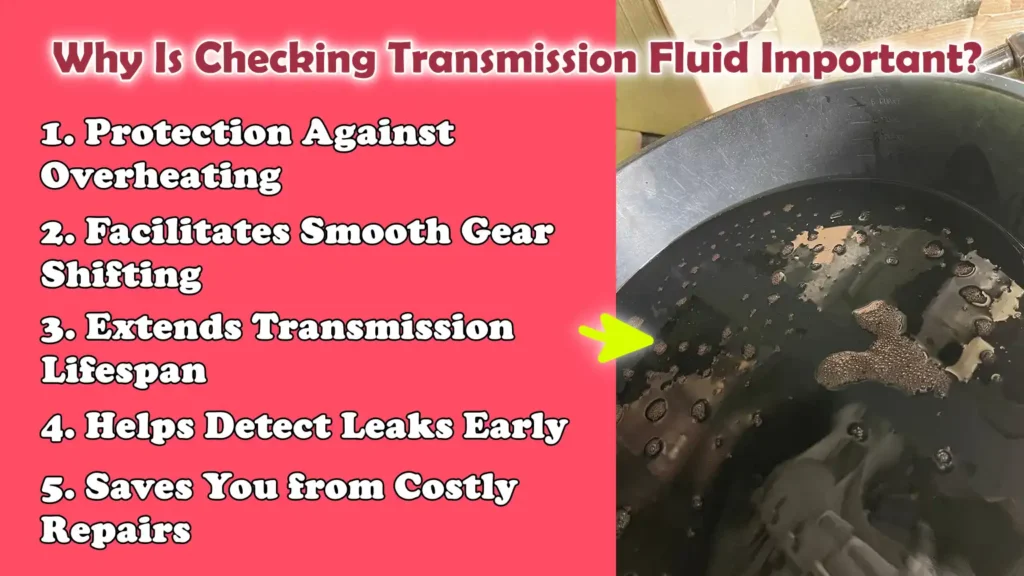
Regularly checking your transmission fluid is the simplest, yet most effective, way to protect your vehicle from serious and costly damage.
The transmission is a complex system containing numerous moving parts; these components rely on clean fluid, maintained at the proper level, to function correctly.
When the fluid level drops or the fluid becomes contaminated, the entire system ceases to operate properly, often without any immediate warning.
Many major transmission failures do not occur suddenly; rather, they develop gradually as a result of neglecting the condition of the fluid.
By checking the fluid in a timely manner, you can identify early warning signs such as: discoloration, a burning odor, or low fluid levels, and take action to address minor issues before they escalate into major damage.
This simple habit not only improves performance but also enhances reliability and safety while driving.
1. Protection Against Overheating
Transmission fluid plays a crucial role in regulating the internal temperature of the transmission.
Every time your vehicle is in motion, friction between the metal components generates heat; without the proper fluid, this heat can rapidly rise to dangerous levels.
When the fluid level is low or the fluid has degraded, it loses its capacity to absorb and dissipate heat, causing the transmission to overheat.
Overheating is a leading cause of transmission failure, as it can damage internal components and further compromise the effectiveness of the fluid.
Regular fluid checks ensure that the fluid remains at the correct level and is capable of keeping temperatures under control, particularly during long journeys or in heavy traffic conditions.
2. Facilitates Smooth Gear Shifting
The ease of gear shifting depends heavily on both the quality and the level of the transmission fluid.
In automatic vehicles, the fluid helps generate the necessary hydraulic pressure to facilitate timely gear changes; whereas in manual systems, it ensures proper lubrication for smooth gear engagement.
If the fluid level is low or the fluid is contaminated, you may faced issues such as delayed shifting, jerking, or slipping gears.
These problems not only compromise driving comfort but also place undue stress on the transmission system.
By performing regular fluid checks, you can maintain consistent, optimal performance and avoid these common issues, thereby ensuring that your vehicle responds smoothly every time you accelerate or shift gears.
3. Extends Transmission Lifespan
A well-maintained transmission can last for many years, but its longevity depends significantly on the condition of the fluid contained within it.
Clean fluid, maintained at the proper level, minimizes friction, prevents wear and tear and keeps internal components functioning efficiently.
Conversely, if the fluid is neglected, it can lead to increased metal-to-metal contact, excessive heat generation and the gradual deterioration of gears and bearings.
Regular checks allow you to monitor the fluid’s condition and replace it when necessary, thereby significantly extending the lifespan of the transmission.
This simple maintenance step can postpone, or even completely prevent, the need for major repairs or part replacements.
4. Helps Detect Leaks Early
Under normal operating conditions, transmission fluid does not deplete rapidly; therefore, a drop in fluid levels is often an indication of a leak.
These leaks may originate from seals, gaskets, or transmission lines; although they may be minor initially, they tend to worsen over time.
If a leak goes undetected, the fluid level can drop critically low, creating a risk of severe damage.
By performing regular fluid checks, you can spot abnormal drops in fluid levels or observe fluid leaks around the vehicle, allowing you to address the issue before it escalates into a serious problem.
Early detection makes repairs easier, faster and less expensive.
5. Saves You from Costly Repairs
Transmission repairs are among the most expensive maintenance tasks a car owner may ever face; due to the complexity of the system, such repairs often come with a hefty price tag.
However, many of these costly issues can be avoided through simple, regular checks of the transmission fluid.
By identifying problems such as low fluid levels, contamination, or premature wear and tear, you can resolve them at a minimal cost before they evolve into major mechanical failures.
Spending just a few minutes checking your transmission fluid can prevent major breakdowns, reduce repair bills and provide you with the peace of mind that comes from knowing your vehicle is in good working order.
Common Signs of Transmission Fluid Problems
When transmission fluid is low, dirty, or not functioning correctly, your vehicle often provides clear warning signs; however, many drivers overlook these signals until the problem becomes severe.
Transmission fluid is responsible for the vehicle’s smooth operation, cooling and the protection of internal components; therefore, when its condition deteriorates, your vehicle’s performance is affected almost immediately.
These signs may initially seem minor and easy to overlook, but they generally worsen over time and, if left unaddressed, can lead to costly damage.
Understanding these symptoms in simple terms can help you take immediate action such as: checking the fluid, and prevent major transmission failure.
1. Gear Slippage
Gear slippage is one of the most common and noticeable signs of a transmission fluid issue.
This occurs when your vehicle suddenly shifts gears on its own or struggles to remain in the correct gear while driving.
You may experience a loss of power, particularly when accelerating, or you might notice that the engine is revving louder than usual, yet there is no corresponding increase in speed.
The cause is typically low or degraded fluid, which fails to maintain the proper pressure or lubrication necessary to engage the gears correctly.
If left unaddressed, gear slippage can lead to severe wear and damage to internal components over time.
2. Delayed or Jerky Shifting
When transmission fluid is not in good condition, your car may take longer than usual to shift gears, or you may experience a sudden jerk or jolt during a gear shift.
This phenomenon is referred to as ‘delayed or jerky shifting’ and becomes particularly noticeable when you begin driving from a complete standstill or when changing speeds.
In automatic vehicles, the fluid regulates gear shifting; therefore, if the fluid level is low or the fluid is dirty, the system may fail to respond promptly or smoothly.
In manual vehicles, shifting gears may become stiff or difficult due to poor lubrication.
By regularly checking the fluid, you can identify this issue early on and restore your vehicle’s smooth performance.
3. Burning Odor
A burning smell emanating from your vehicle is often a strong warning sign that the transmission fluid is overheating or deteriorating.
Healthy transmission fluid helps regulate temperature; however, as it ages or becomes contaminated, it loses this capability.
Excessive heat can cause the fluid to burn, emitting a pungent and unpleasant odor.
This is a serious issue, as overheating can damage seals, clutches and other internal components.
Checking the fluid immediately upon detecting this odor can help you confirm the problem and take action before further damage occurs.
4. Strange Noises – Grinding or Whining Sounds
Unusual noises such as: grinding, whining, or humming sounds, may indicate that the transmission fluid is failing to provide adequate lubrication.
These sounds often result from metal components rubbing against one another due to low fluid levels or poor fluid quality.
In an automatic transmission, you may hear a whistling sound, whereas in a manual transmission, a grinding noise while shifting gears is more common.
These sounds should never be ignored, as they often indicate excessive friction and wear and tear within the system.
Checking the fluid can help determine whether the issue stems from a low fluid level or from the fluid being in poor condition.
5. Fluid Leaks Under the Car
A transmission fluid leak is another clear indication that your system requires immediate attention.
If you notice spots of red, pink, or dark-colored fluid beneath your parked car, it could signal a leak within the transmission system.
Leaks can be caused by worn seals, damaged lines, or loose connections; even a minor leak can lead to a drop in fluid levels over time.
As transmission fluid is not consumed like fuel, any decrease in its level, no matter how slight, typically points to an underlying issue.
Regularly checking for leaks and monitoring fluid levels can help you detect and resolve problems early on.
6. Dashboard Warning Lights
Modern vehicles are equipped with sensors that monitor transmission performance and fluid condition, alerting you via warning lights on the dashboard.
These lights may indicate overheating, pressure-related issues, or general transmission malfunctions.
While not all warning lights directly point to fluid-related problems, they often signal that something is amiss and requires immediate attention.
Ignoring these warnings can lead to serious complications; therefore, it is essential to check the transmission fluid.
Pay timely attention to the warning lights.
Tools
| Tool / Material | How to Use It | Why It Is Needed |
|---|---|---|
| Clean cloth or paper towel | Use this to wipe the transmission dipstick before and after checking the fluid level. Additionally, use it to clearly observe the color of the fluid. | This ensures an accurate reading and allows you to verify whether the fluid is clean, dirty, or burnt. |
| Gloves – Optional | Wear gloves before opening the hood or handling the dipstick or fluid. | This protects your hands from hot engine components, dirt and used transmission fluid, all of which can be harmful. |
| Funnel – If Topping Up | If the fluid level is low, insert a funnel into the dipstick tube and slowly pour in the transmission fluid. | This prevents spills and ensures that the fluid flows directly into the transmission without creating a mess. |
| Owner’s manual | Consult this document to identify the correct dipstick location and fluid type specific to your vehicle. | It provides accurate instructions and fluid specifications, thereby preventing the use of incorrect fluid, which could otherwise damage the transmission. |
Know Basic Safety Precautions Before You Begin During Checkup of Transmission Fluid
Before checking the transmission fluid, it is crucial to observe certain basic safety rules, this is essential both for your personal safety and to ensure that you obtain an accurate reading.
The transmission system operates under conditions of extreme heat and pressure; therefore, if performed carelessly, even a routine check can be hazardous.
Many people overlook safety protocols, potentially exposing themselves to burn injuries, inaccurate fluid readings, or risks associated with a moving vehicle.
Devoting a few minutes to proper preparation ensures that the procedure remains safe, straightforward and reliable.
These precautions are simple to follow, yet they play a vital role in preventing accidents and errors while checking fluid levels.
1. Park the Vehicle on Level Ground
Before checking the transmission fluid, always park your vehicle on a level and uniform surface.
This is critical because the fluid inside the transmission remains evenly distributed only when the vehicle is situated on a flat surface.
If the vehicle is parked on a slope or uneven terrain, the fluid may shift to one side; this can result in an inaccurate reading, making it appear as though the fluid level is either excessively high or dangerously low.
An incorrect reading could lead to either overfilling or underfilling the fluid, both of which can cause significant damage to the transmission.
Parking on level ground ensures that you obtain a precise and reliable measurement.
2. Engage the Parking Brake
Engaging the parking brake is an essential safety measure that prevents the vehicle from moving while you are checking the fluid level.
As certain inspection procedures require the engine to remain running, there is always a slight risk that the vehicle could roll away if it is not properly secured.
Engaging the parking brake locks the wheels in place, adding an extra layer of safety, a precaution that is particularly crucial when you are working alone.
This simple step helps ensure your safety and keeps the vehicle stable throughout the entire process.
3. Keep the Engine Running – For Most Automatic Vehicles
In most automatic vehicles, the transmission fluid level should be checked while the engine is running, as the fluid circulates throughout the system when the vehicle is in operation.
When the engine is turned off, the fluid settles, resulting in an inaccurate reading on the dipstick.
Keeping the engine running allows the fluid to reach its normal operating level, thereby providing you with a correct and precise measurement.
However, it is essential to consult your vehicle’s owner’s manual, as instructions may vary for specific models.
4. Be Cautious of Hot Engine Components
After the engine has been running, many components under the hood, including the engine block, transmission parts and surrounding metal surfaces, become extremely hot.
Touching these parts without taking full precautions poses a risk of burns or injury.
It is crucial to work slowly, avoid direct contact with hot surfaces and focus your attention solely on the specific areas you need to access.
Remaining mindful of the heat ensures your safety while working and helps prevent accidental injuries during the process.
5. Wear Gloves When Necessary
Wearing gloves is a simple yet beneficial precaution that protects your hands from dirt, heat and used transmission fluid.
Transmission fluid can sometimes be dirty or contain fine particles that you wouldn’t want on your skin.
Gloves also provide a better grip when handling the dipstick or tools, specially if they are oily or slippery.
Although wearing gloves is not strictly necessary, it makes the process cleaner, safer and more comfortable, specially for beginners.
How to Check Transmission Fluid – Easy Baby Steps
Checking transmission fluid is a simple yet essential task that allows you to assess the condition of your vehicle’s transmission system.
Performing this check correctly is crucial to obtaining an accurate reading, as minor errors such as: checking the fluid at the wrong temperature or taking a reading with a dirty dipstick, as it can lead to misleading results.
When executed properly, this process enables you to confirm the fluid level, evaluate its condition and determine whether it requires a top-up or a complete replacement.
Carefully following each step ensures that your transmission continues to operate smoothly, avoids overheating and remains protected against long-term damage that could eventually necessitate costly repairs.
1. Warm Up the Engine
Before checking the transmission fluid, it is essential to let the engine run for approximately five to ten minutes so that it reaches its normal operating temperature.
When transmission fluid heats up, it expands and circulates, providing an accurate and reliable reading of the fluid level.
If you check the fluid while the engine is cold, the level may appear lower than it actually is, leading to incorrect conclusions.
Warming up the engine also ensures that the fluid has circulated throughout all internal components, making it easier to accurately assess its true condition.
2. Locate the Transmission Dipstick
The transmission dipstick is typically situated near the engine and is designed to allow you to easily check the fluid level.
It is often located toward the rear of the engine bay and its handle may be a different color than that of the engine oil dipstick.
Identifying the correct dipstick is crucial; If you mistake this for the engine oil dipstick, you will obtain an inaccurate reading.
Your vehicle’s owner’s manual can assist you in locating the correct spot and ensuring that you are checking the appropriate component.
3. Remove and Clean the Dipstick
Once you have located the dipstick, carefully pull it out and wipe it clean using a cloth or a paper towel.
This step removes any residual fluid adhering to the dipstick, which could otherwise interfere with your reading.
Cleaning the dipstick ensures that the subsequent reading you take is clear and accurate.
It also provides an opportunity to observe the initial condition of the fluid such as: its color and odor, which can offer early indications regarding its overall health.
4. Reinsert and Withdraw Again
After cleaning the dipstick, fully reinsert it into its tube and then withdraw it once more to accurately check the fluid level.
This second reading is the most precise because the dipstick is now coated with fresh fluid drawn directly from the transmission system.
Skipping this step may result in a reading that is neither clear nor accurate; therefore, it is essential to always reinsert and recheck the dipstick before making any determinations regarding the fluid level.
5. Check the Fluid Level
When you withdraw the dipstick for the second time, carefully observe the markings on it; typically, these are labeled “Full” and “Low,” or feature similar indicators.
Ideally, the fluid level should fall between these markings, that is, within the designated range.
If the fluid level drops below the lowest mark, it indicates that the transmission fluid is low and may require topping up.
Conversely, if the level is excessively high, it can lead to issues such as increased pressure and reduced performance.
Maintaining the fluid level within the correct range is crucial to ensure that the vehicle operates smoothly and remains reliable over the long term.
6. Check the Condition of the Fluid
In addition to checking the level, it is also essential to inspect the condition of the transmission fluid.
Healthy fluid is typically bright red or pink in color and possesses a slightly sweet or neutral scent.
If the fluid appears dark brown or black, it generally signifies that it is old, contaminated, or degraded.
A burnt odor is a definitive sign that the fluid has overheated and is no longer providing the necessary protection to the transmission.
Paying attention to these details helps you determine whether the fluid is still serviceable or if it needs to be replaced to prevent damage.
7. Add Fluid If Necessary
If the fluid level is low, you should add the specific type of transmission fluid recommended by your vehicle’s manufacturer.
Using the wrong type of fluid can cause severe damage; therefore, it is critical to follow the instructions provided in the owner’s manual.
Pour the fluid slowly and use a funnel to prevent spills and avoid overfilling.
After adding a small amount of fluid, re-check the level to ensure it falls within the correct range.
Overfilling the fluid can be just as detrimental as having too little; therefore, adding it carefully and gradually is the best approach.
How to Check Transmission Fluid Without a Dipstick
In many modern vehicles, manufacturers have eliminated the traditional dipstick and designed the transmission as a sealed system.
This does not imply that the fluid should never be checked or replaced; rather, it signifies that the process is more controlled and not as straightforward for the average user.
These sealed systems are engineered to minimize contamination, maintain proper pressure and ensure optimal performance over the long term; however, checking the fluid level and condition in these systems requires more precise methods.
Instead of relying on a visual estimate using a dipstick, this procedure often necessitates monitoring the fluid at the correct operating temperature, ensuring the vehicle is positioned in a specific manner and accessing particular components.
Understanding how these systems function can help you determine whether you can safely check the fluid yourself or if it would be more advisable to seek the assistance of a professional.
1. Many Modern Vehicles Feature Sealed Systems
Modern sealed transmissions are designed to minimize exposure to air, dust and moisture, elements that can degrade transmission fluid over time.
By eliminating the dipstick, manufacturers mitigate the risks associated with improper fluid checks, overfilling, or the use of the incorrect type of fluid.
These systems are often calibrated to operate within a specific, narrow range of fluid levels and temperatures; while this enhances their efficiency, it also renders them more sensitive.
While this design enhances durability and minimizes the likelihood of maintenance errors, it also implies that checking fluid levels is no longer a simple visual task; rather, it has evolved into a process demanding greater caution and precision.
2. Checking via the Fill Plug
In vehicles lacking a dipstick, the transmission fluid is typically checked through a fill plug, or inspection plug, located on the transmission housing.
This plug is often situated on the underside of the vehicle, meaning that safely lifting the vehicle may be necessary to access and remove it.
When the plug is opened under the correct conditions, a small amount of fluid may trickle out if the fluid level is adequate.
If no fluid emerges, the fluid level may be low.
This method is contingent upon the precise positioning of the vehicle and proper timing; therefore, strictly adhering to the correct steps is crucial to avoid obtaining inaccurate readings or wasting fluid.
3. Utilizing a Specific Procedure
Checking transmission fluid in sealed systems often necessitates following a specific procedure prescribed by the vehicle manufacturer.
This may involve warming the transmission to a specific temperature, keeping the engine running and shifting through various gears before checking the fluid level.
In some instances, specialized tools or diagnostic equipment may be required to accurately measure the fluid temperature.
These steps are essential because transmission fluid expands when heated and even slight variations in temperature can affect the reading.
Adhering to the correct procedure ensures that the fluid level is measured accurately and safely.
4. When to Consult a Mechanic
If you are unsure about this procedure or do not possess the proper tools, it is best to consult a qualified mechanic to check the transmission fluid in a sealed system.
Professional technicians possess the necessary experience, equipment and expertise to perform the inspection correctly, thereby eliminating the risk of any potential damage to the transmission.
This becomes even more critical if you observe warning signs, such as difficulty shifting gears, unusual noises, or fluid leaks.
Attempting to check or service the fluid without proper knowledge can result in incorrect fluid levels or contamination, potentially leading to serious and costly problems.
Seeking professional assistance ensures that your transmission remains in good condition and operates reliably.
Common Mistakes to Avoid During Checkup Of Transmission Fluid
When checking transmission fluid, several minor errors can lead to inaccurate readings or even cause damage to the transmission system.
These mistakes often occur because the procedure appears deceptively simple; however, the transmission is a sensitive system that relies on precise fluid levels, the correct type of fluid and accurate inspection methods.
Even a minor oversight can impact performance, generate excessive heat, or lead to long-term internal wear within the transmission.
By understanding these common mistakes in advance, you can avoid costly problems and ensure that your fluid check results are reliable and useful.
1. Checking Fluid When the Engine Is Cold – Unless Otherwise Specified
One of the most common mistakes is checking the transmission fluid while the engine is cold, particularly in vehicles where the engine must be warmed up beforehand.
Transmission fluid expands when heated and circulates throughout the entire system while the vehicle is in operation; this operating condition is essential for obtaining an accurate reading.
If you check the fluid while it is cold, the level may appear lower than its actual level, leading you to add unnecessary fluid.
This can result in overfilling, which may subsequently have a negative impact on performance.
Always follow the specific procedure outlined for your vehicle, as requirements may vary across different models; however, most automatic transmissions should be checked while they are warm.
2. Using the Wrong Type of Fluid
Using the wrong type of transmission fluid is a serious error that can result in immediate or long-term damage.
Every vehicle is designed to operate with a specific type of fluid, formulated with the precise viscosity, additives and thermal resistance required for that particular system.
If you use the wrong fluid, it may fail to provide adequate lubrication or pressure, leading to shifting difficulties (such as gears sticking), gear slippage and accelerated wear.
In some cases, this can even cause damage to seals and internal components.
Before adding or changing transmission fluid, always consult your vehicle’s owner’s manual to ensure you identify the exact type of fluid required.
3. Overfilling the Transmission
Filling the transmission with too much fluid is just as harmful as having too little.
Excess fluid can create excessive turbulence inside the transmission, causing the fluid to foam; this reduces its ability to properly lubricate and cool the system.
Foamy fluid contains air bubbles that disrupt proper pressure levels, potentially leading to shifting irregularities, overheating and internal damage.
It can also increase internal system pressure, thereby heightening the risk of leaks or seal failure.
To avoid this, always add fluid gradually and constantly monitor the fluid level to ensure it remains within the specified range.
4. Ignoring the Fluid’s Color and Odor
Many people focus solely on the fluid level while overlooking its condition, a major mistake.
Transmission fluid provides vital clues regarding the health of the system through its color and odor.
In good condition, the fluid is typically bright red or pink and possesses a mild odor; conversely, dark, brown, or black fluid often indicates contamination or wear.
A burnt smell is a definitive sign of overheating and internal damage.
Ignoring these warning signs can cause problems to worsen over time.
Always take a moment to carefully inspect the fluid, as this can help you detect potential issues early on.
5. Ignoring the Owner’s Manual
Ignoring the owner’s manual is another common mistake that can lead to confusion and improper procedures.
Every vehicle comes with specific instructions for checking the transmission fluid, including whether or not the engine should be running, the correct type of fluid to use and the proper method for taking a measurement.
Without this information, you run the risk of taking incorrect steps, using the wrong fluid, or misinterpreting the results.
The owner’s manual provides accurate and reliable information tailored specifically to your vehicle, making it an essential reference for safe and effective maintenance.
How Often Should You Check Your Transmission Fluid?
To ensure the smooth operation of your vehicle and to avoid sudden mechanical issues, checking your transmission fluid at the appropriate times is crucial.
Unlike fuel, transmission fluid is not consumed; however, it gradually degrades due to contamination caused by heat, pressure and general wear and tear.
Over time, it loses its ability to effectively lubricate, cool and protect internal components; if left unchecked, this can negatively impact the vehicle’s performance and lead to significant damage.
Regular checks allow you to monitor both the fluid level and its condition, enabling you to take necessary corrective measures before minor issues escalate into major problems.
Incorporating this into your vehicle’s regular maintenance schedule enhances reliability, improves drivability and extends the lifespan of the transmission.
Even, there’s study in Tribology International, that clearly shows that the degraded transmission fluid loses its protective additives and actually changes in viscosity, that’s how it increases the internal friction and wear within the system, also these changes can accelerate the transmission component wear that makes the regular checks and timely fluid replacement really important to long-term performance and reliability as well.[¹]
1. Recommended Intervals – Every 30,000 to 60,000 km
Generally, most vehicles require their transmission fluid to be checked at regular intervals, typically every 30,000 to 60,000 kilometers, although the specific range may vary depending on the vehicle manufacturer.
This timeframe is based on how long the fluid can effectively retain its protective properties under normal driving conditions.
Even if your vehicle appears to be running smoothly, checking the fluid within these recommended intervals helps detect early signs of degradation, contamination, or low fluid levels.
Although some modern vehicles may feature longer service intervals, regular checks remain essential, as the condition of the fluid can still deteriorate due to heat and usage.
2. Depends on Driving Conditions
How often you should check your transmission fluid depends largely on your specific driving habits and the conditions in which you operate your vehicle.
Demanding driving conditions such as: heavy traffic, frequent stop-and-go driving, driving in extreme heat, towing heavy loads, or driving on rough terrain, all place significant stress on the transmission, causing it to overheat.
Due to this additional strain, the transmission fluid can degrade more rapidly than usual.
In such situations, checking the fluid more frequently than the standard recommended intervals is a prudent step to ensure it remains in good condition and at the proper level.
3. Depends on Vehicle Type
Different types of vehicles feature different transmission systems and each system has its own specific maintenance requirements.
Automatic transmissions, manual transmissions and Continuously Variable Transmissions (CVTs), all utilize different types of fluids and each fluid possesses its own unique properties.
Some vehicles are equipped with a dipstick for easy inspection, while others feature sealed systems that require specialized procedures to check.
Due to these differences, the recommended schedule for checking the fluid can also vary.
To determine how often the fluid should be checked and the correct procedure for doing so, always consult your vehicle’s specifications.
4. Signs Indicating an Immediate Check is Needed
Occasionally, if your vehicle exhibits certain warning signs, you may need to check your transmission fluid sooner than your scheduled maintenance intervals.
These signs include slipping gears, delayed or jerky shifting, unusual noises, fluid leaks, or a burning smell.
Even the slightest change in your vehicle’s driving behavior could indicate a fluid-related issue.
By checking the fluid immediately upon noticing these symptoms, you can quickly identify the problem and prevent further damage.
Taking prompt action not only safeguards the transmission but also saves you time and repair costs in the long run.
When to Change Transmission Fluid
Changing transmission fluid at the right time is crucial to ensure that your transmission continues to function properly and to protect it from serious damage.
Over time, transmission fluid degrades due to constant exposure to heat and pressure, as well as contamination by tiny metal particles generated by normal wear and tear within the system.
As the fluid ages, it loses its ability to lubricate, cool and protect the moving parts.
This can lead to problems such as overheating, excessive friction and improper gear operation.
Unlike engine oil, transmission fluid often provides clear warning signs when it needs to be replaced; recognizing these signs allows you to take action before costly repairs become necessary.
1. Dark or Dirty Fluid
The clearest indication that transmission fluid needs to be changed is a change in its color and clarity.
Fresh transmission fluid is typically bright red or pink and appears clear and transparent.
Over time, it may darken due to heat and contaminants resulting from internal wear and tear.
If the fluid appears brown, black, or cloudy, it signifies that it has lost its effectiveness and is no longer adequately protecting the transmission.
Dirty fluid may also contain tiny particles that increase friction and accelerate the wear and tear of internal components.
Changing the fluid at this stage helps restore proper lubrication and can prevent further damage.
2. Burning Smell
A burning odor emanating from the transmission fluid is a strong warning sign that it has overheated and has begun to degrade.
Healthy fluid helps regulate temperature; however, as it ages or is subjected to heavy workloads, it loses its ability to effectively control heat.
This causes the fluid to degrade and develop a burnt odor.
Continued use of burnt fluid can damage the transmission’s seals, clutches and other internal components.
If you detect this odor while checking the fluid, it is crucial to replace it as soon as possible to prevent more serious problems.
3. Manufacturer Recommendations
Vehicle manufacturers provide specific guidelines regarding transmission fluid replacement based on the design and requirements of the transmission system.
These recommendations are carefully formulated through rigorous testing and are intended to ensure long-term performance and reliability.
Some vehicles may require fluid replacement at shorter intervals, while others may have longer service intervals.
Adhering to the manufacturer’s instructions ensures that you use the correct type of fluid and replace it at the appropriate time, thereby minimizing the risk of damage caused by improper maintenance.
4. Replacement Based on Mileage
In addition to condition-based inspections, transmission fluid should also be replaced based on mileage intervals.
Depending on driving conditions and the type of transmission, many vehicles recommend replacing the fluid every 40,000 to 100,000 kilometers.
Even if the fluid appears to be in good condition visually, prolonged use can diminish some of its protective properties.
Regularly replacing the fluid based on mileage ensures that the transmission always contains fresh fluid, thereby maintaining optimal lubrication and cooling capabilities.
This proactive step facilitates the smooth operation of the gears, enhances functionality and significantly extends the lifespan of the transmission system.
Read More:
- How to Check Coolant Level
- How to Replace a Radiator Fan
- How to Fix a Coolant Leak
- How to Fix Car Overheating
- How to Flush a Radiator
Cost of Checking and Replacing Transmission Fluid
Understanding the costs associated with checking and replacing transmission fluid helps you better plan your vehicle’s maintenance and avoid unexpected expenses.
Transmission systems are complex and their repairs can be costly; however, regular fluid checks and timely replacements are relatively inexpensive measures that can prevent major damage.
The total cost depends on whether you perform the work yourself or visit a mechanic, the type of transmission installed in your vehicle and the quality of fluid required.
By investing a small amount in regular maintenance, you can avoid hefty repair bills in the future.
1. Cost of Doing It Yourself – Very Low
Checking transmission fluid at home is one of the most economical aspects of vehicle maintenance.
It typically requires only a few basic items, such as a clean cloth and, if necessary, a small amount of transmission fluid to top off the level.
The primary expense involved is purchasing the correct fluid, which is generally inexpensive compared to other vehicle maintenance costs.
As this process requires no specialized tools or technical expertise, most vehicle owners can perform it themselves and save money on labor charges.
By performing regular self-checks, you can monitor the condition of the fluid without incurring any significant costs.
2. Cost of Having a Mechanic Check It
If you prefer to enlist the help of a professional, a mechanic can inspect your transmission fluid and identify any associated issues.
The cost of this inspection is typically moderate and may vary depending on the service center and the type of vehicle.
In many cases, mechanics include a fluid check as part of a standard vehicle inspection.
Although this option is more expensive than performing the inspection yourself, it provides you with an expert’s opinion and helps uncover hidden issues you might otherwise overlook such as: minor leaks or early signs of wear and tear.
3. The Cost Range of Fluid Replacement
Replacing transmission fluid costs more than simply inspecting it; however, it is significantly cheaper than repairing or replacing a damaged transmission.
The cost depends on the type of vehicle, the volume of fluid required and whether you opt for a simple “drain-and-refill” (draining the old fluid and adding new) or a complete fluid flush (a thorough cleaning of the entire system).
Automatic transmissions and modern systems may require larger volumes of fluid and specialized servicing, which can increase the overall cost.
Nevertheless, even in the most expensive scenarios, fluid replacement serves as a preventive measure that safeguards the transmission and ensures the vehicle continues to run smoothly.
4. How Timely Inspections Save Money
Regularly checking your transmission fluid can result in significant financial savings over time.
Timely inspections allow you to detect issues such as: low fluid levels, contamination, or overheating, before they cause serious damage.
Addressing minor issues such as: topping off the fluid or fixing a small leak, is far less expensive than repairing a major transmission failure.
As transmission repairs are among the most costly vehicle repairs, making regular, simple fluid checks a habit is a wise decision; it protects your vehicle and minimizes long-term expenses.
These are the Pro Tips for Beginners
Maintaining your transmission fluid is not a difficult task, but doing it correctly makes a significant difference to your vehicle’s performance and the longevity of its transmission.
Beginners often make minor mistakes because they are unaware of just how sensitive a transmission system is regarding fluid quality, fluid levels and maintenance timing.
By adopting a few practical and proven tips, you can avoid common issues, enhance your car’s performance and minimize the risk of costly repairs.
These tips are easy to implement and are grounded in how transmission systems actually function under real-world driving conditions.
1. Always Use the Fluid Recommended by the Manufacturer
Using the correct transmission fluid is one of the most critical aspects of vehicle maintenance.
Every transmission is designed to operate with a specific type of fluid, one that possesses the precise viscosity, additives and thermal resistance required for that particular system.
This helps the system maintain proper lubrication, fluid pressure and cooling efficiency.
If you use the wrong fluid, it may fail to adequately protect internal components, potentially leading to shifting difficulties (rough shifting), gear slippage, or damage to seals and other parts.
Always consult your vehicle’s owner’s manual to ensure you are using the exact fluid recommended by the manufacturer, as this guarantees safe and efficient operation.
2. Maintain a Regular Maintenance Schedule
Adhering to a regular schedule for checking and changing your transmission fluid ensures that the system remains in good condition over time.
Due to the effects of heat and regular use, transmission fluid gradually degrades, even if no immediate, obvious problems are apparent.
By checking the fluid at regular intervals, you can monitor its level and condition and take necessary steps before it becomes excessively dirty or ineffective.
Adopting a consistent maintenance routine also keeps you informed about the overall health of your vehicle, thereby reducing the risk of sudden issues arising while driving.
3. Check for Leaks Frequently
Transmission fluid leaks are a common problem; they can lead to low fluid levels and, if left unaddressed, cause serious damage.
As transmission fluid is not consumed like fuel, any drop in its level typically indicates a leak somewhere within the system.
Checking for fluid stains underneath your vehicle and regularly monitoring the fluid level can help you detect leaks in their early stages.
Fixing a minor leak is usually simple and inexpensive; however, ignoring it can lead to major transmission problems that may be very costly to repair.
4. Do Not Ignore Early Warning Signs
When there is a malfunction in your vehicle’s transmission or the condition of its fluid deteriorates, there are often clear warning signs.
These signs may include slipping gears, delayed shifting, unusual noises, or a burning smell.
Although these symptoms may initially seem minor, they typically indicate that the fluid is low, contaminated, or overheating.
Ignoring these early warnings can exacerbate the problem and ultimately result in severe damage to the vehicle.
By paying attention to these signs, and immediately checking the transmission fluid as soon as they appear, you can address issues in a timely manner and ensure that your vehicle continues to run smoothly and without interruption.
Conclusion – How to Check Transmission Fluid
Now, you know that with just a few minutes of checking transmission fluid can literally prevent from expensive vehicle repairs and you can then fix if you caught that problem early.
The transmission is a complex system that relies on perfectly clean fluid to function correctly, and this fluid must be filled to the proper level.
This fluid does far more than simply lubricate components; it regulates heat, minimizes wear and tear, facilitates gear shifting and helps prevent internal damage.
When the fluid level drops or its quality deteriorates, problems begin to arise throughout the entire system; early symptoms often include difficulty shifting gears, slipping gears, strange noises, or a burning smell.
Ignoring these symptoms can lead to overheating and severe mechanical failure, which is precisely why regular checks are so crucial.
Fortunately, checking transmission fluid requires neither specialized technical knowledge nor expensive, specialized tools.
By following the correct procedures, you can easily monitor both the fluid level and its condition right at home, allowing you to take the necessary steps to address minor issues before they escalate into major problems.
Knowing what healthy fluid looks like, and when to top it up or replace it, along with adhering to the specific maintenance guidelines prescribed for your vehicle, can significantly enhance both your car’s performance and its reliability.
Furthermore, conducting regular checks enables you to detect fluid leaks early, prevent unnecessary strain on the transmission and ensure that your vehicle operates at its full potential under all driving conditions.
Now, that’s it from this guide about How to Check Transmission Fluid, also you can comment for more information.
Frequently Asked Questions
FAQ 1: What happens if the transmission fluid level drops too low?
When the transmission fluid level drops, your car may begin to experience specific performance-related issues, as the transmission cannot function properly without an adequate supply of fluid. You may face problems such as slipping gears, delayed acceleration, or jerking sensations when shifting gears. This occurs because the fluid is responsible for generating internal pressure, providing lubrication and keeping the transmission cool. Without sufficient fluid, metal components can grind against one another, generating heat and potentially causing damage to the parts. If this issue is not addressed immediately, the transmission could fail completely and repairing it can be extremely expensive.
FAQ 2: Can I check the transmission fluid myself at home?
Yes, checking the transmission fluid at home is quite simple and requires no special tools or expertise specially for vehicles equipped with a dipstick. You simply need to follow the correct procedure: allow the engine to warm up slightly, locate the dipstick and check both the fluid level and its condition. It is crucial to consult your vehicle’s owner’s manual, as some newer vehicles do not have a dipstick and utilize a different method for checking the fluid level. For most vehicles, this is a straightforward maintenance task that can be completed in just a few minutes.
FAQ 3: What color should transmission fluid be?
In good condition, transmission fluid is typically bright red or pink in color and it appears clear and transparent. This indicates that the fluid is in good shape and is effectively protecting the transmission. If the fluid turns dark brown, black, or cloudy, it indicates that it has degraded and now requires replacement. In addition to a dark color, if the fluid also emits a burnt odor, it is a definitive sign that the fluid has overheated and is no longer performing its function effectively. Checking the color of the fluid is the simplest method for assessing its condition.
FAQ 4: How often should I check my transmission fluid?
Generally, transmission fluid should be checked every 30,000 to 60,000 kilometers; this interval depends on your specific vehicle and the typical road conditions in which you drive. However, if you frequently drive in heavy traffic, in extreme heat, or while towing heavy loads, you may need to check it more often, as such conditions can cause the fluid to degrade more rapidly. It is also a good idea to check the fluid whenever you notice any warning signs such as: jerking during gear shifts or unusual noises. Regular checks allow you to detect potential problems early on and help maintain your transmission in proper working order.
FAQ 5: Can I drive with degraded transmission fluid?
Driving with degraded transmission fluid is not advisable, as it can cause premature damage to your transmission. When the fluid becomes dirty, burnt, or degraded, it is unable to properly lubricate or cool the system. This can result in excessive heat, increased friction and wear and tear on internal components. Initially, you may only notice minor issues such as: difficulty shifting gears; but over time, this damage can become severe. To avoid costly repairs, it is always best to inspect and replace degraded fluid as soon as possible.
FAQ 6: What does a burning smell coming from the transmission fluid indicate?
A burning smell typically indicates that the transmission fluid has overheated significantly and has begun to degrade. This can occur when the fluid is old, the fluid level is low, or it is unable to handle the internal heat generated within the transmission. Excessive heat diminishes the fluid’s ability to protect internal components, potentially leading to severe damage. If you detect a burning smell, it is crucial to inspect the fluid immediately and replace it if necessary. Ignoring this warning sign can result in transmission failure.
FAQ 7: Is overfilling the transmission fluid harmful?
Yes, overfilling the transmission fluid can lead to serious problems. When the fluid level becomes excessive, the increased agitation inside the transmission can cause the fluid to foam. This foamy fluid contains air bubbles, which compromise its ability to provide lubrication and maintain proper hydraulic pressure. Consequently, you may experience issues such as difficulty shifting gears, excessive heat and even damage to seals and internal components. It is essential to always keep the fluid level within the specified range.
References:
[1] Influence of a transmission oil degradation on physico-chemical properties and tribological performance
https://www.sciencedirect.com/science/article/abs/pii/S0301679X23008721
Hello Folks, Dean Shali here to help you out to solve the problems with your lovely vehicle, as i have lots of experience and knowledge about automotive industry as i woks directly with the customers and repair vehicles and i love to help the people to keep their cars safe and running smoothly.