Written By: Dean Shali
Fact Checked By: Sabré Cook
Reviewed By: Tamara Warren
The proper “KNOWLEDGE” is literally the difference between a smart car buyer and a regretful purchase.
Because, buying a used car is one of the few decisions where a single choice can quietly shape your finances for years to come.
But, most of the people don’t actually reliaze that a car begins losing their value the moment it leaves the dealership, which is why used cars can offer incredible saving, sometimes 20% to 40% less than a similar new model.
And, also you nee to understand that: not every used car is a good deal.
Along with this, there are many vehicles on the market that literally carries hidden issues like: poor maintenance, accident damage or even altered mileage as well, so these problems don’t always shows up during a quick look.
Not only this, there’s studies and industry data that consistently shows that unexpected repairs and lack of proper inspection are among the top reasons of buyers regret their purchase later on.
That’s why, in this guide you’ll learn How to Buy a Used Car that includes structured process, checking history reports, inspecting their key components and comparing fair market prices as well.
First, Determine Your Budget
Establishing your budget before purchasing a used car is the most crucial step, as it determines not only what you can afford to buy today but also how comfortable your financial situation will remain in the future.
Many buyers focus solely on the car’s purchase price while overlooking the total cost of ownership, an oversight that often leads to stress later on as expenses begin to mount.
A well-structured budget prevents you from overspending, safeguards your savings and ensures that your car remains an asset rather than becoming a financial burden.
Research on auto finance and consumer spending indicates that buyers who establish a clear budget prior to purchasing are far less likely to overpay or face difficulties in repaying their loans.
When you clearly understand your financial limits, you are able to make better decisions, negotiate with greater confidence and avoid making impulsive, emotionally driven purchases.
1. Total Budget vs Monthly Affordability
Your “Total Budget” represents the maximum amount you are willing to spend on a car, whereas your “Monthly Affordability” refers to the specific sum you can comfortably pay each month without negatively impacting your daily lifestyle.
Many people make the mistake of choosing a car solely based on the allure of low monthly installments; however, this approach can mask the true cost, as loans taken out over longer terms often entail paying significantly more interest over time.
Conversely, focusing exclusively on the total purchase price, without considering the burden of monthly installments, as it can lead to cash-flow difficulties.
The optimal strategy lies in striking a balance between these two factors.
You should choose a car with a price tag that aligns with your current savings or financing plan, while also ensuring that the monthly installment repayment schedule remains manageable for you, even in the face of unforeseen circumstances, such as a job change or a financial emergency.
2. Factor in Hidden Costs
The true cost of a car extends far beyond its initial purchase price; overlooking hidden expenses is one of the most common reasons why buyers face financial difficulties after acquiring a vehicle.
These additional costs can be anticipated and should always be incorporated into your budget right from the start.
Clearly understanding these expenses helps you avoid sudden financial setbacks and ensures that you are fully prepared for the responsibilities associated with car ownership.
Insurance
Insurance is an essential and recurring expense that depends on various factors, such as the car’s value, its age, safety features and your driving history.
Insurance premiums are typically higher for more expensive or high-performance cars, whereas insuring safer and more reliable models is often less costly.
Many buyers neglect to investigate insurance costs before purchasing a car, which can result in monthly expenses that are significantly higher than anticipated.
Estimating insurance costs in advance provides you with a clearer picture of the true cost of car ownership.
Registration
Paying registration fees is mandatory for legally operating your vehicle and these fees can vary depending on your location and the type of vehicle you have purchased.
Even when buying used cars, transfer fees and administrative costs must be paid before the vehicle’s ownership can be officially transferred into your name.
Although this may seem like a one-time expense, it adds to your initial outlay and should be planned for in advance to avoid any delays or complications after the purchase.
Maintenance
The biggest, and often overlooked, expense associated with owning a used car is maintenance.
Unlike new cars, used vehicles may require more frequent servicing, such as oil changes, brake replacements, tire replacements and battery maintenance.
Reliable brands and well-maintained cars typically incur lower maintenance costs, whereas neglected vehicles can quickly become expensive to repair.
Industry data indicates that regular maintenance not only enhances safety but also extends the car’s lifespan, resulting in financial savings in the long run.
Taxes
Taxes constitute another significant expense; they vary based on local regulations and the vehicle’s value.
These may include sales tax levied at the time of purchase and in some cases, an annual road tax or ownership tax.
Although taxes are often calculated as a fixed percentage, they can significantly increase the total cost of the vehicle specially if you are purchasing a high-end model.
Incorporating taxes into your budget ensures that you are financially prepared to cover the full cost of the purchase.
3. Rule of Thumb: 20% Down Payment and No More Than 15% of Monthly Income
A commonly suggested financial guideline is to make a down payment of at least 20 percent and to keep your total car-related monthly expenses within 15 percent of your monthly income.
Making a larger down payment reduces the loan amount, lowers interest costs and provides you with greater financial stability.
Keeping monthly expenses within a safe limit ensures that you can comfortably make payments without compromising on your essential expenditures such as: housing, food and savings.
Financial experts endorse this approach because it strikes a balance between spending capacity and long-term financial health, allowing you to enjoy your car without any financial stress.
How to Determine What Type of Car You Need
Choosing the right type of car isn’t just about which vehicle looks good or is fun to drive; it is fundamentally about how well the car fits into your daily life and how effectively it meets your actual needs.
Many buyers regret their decisions because they select a car based on style or trends rather than on its practical utility.
A car that might be perfect for one person could be completely unsuitable for another.
Research within the automotive market indicates that buyers who clearly define their usage requirements before selecting a car tend to be more satisfied in the long run and incur lower costs for fuel, maintenance and repairs.
When you have a clear understanding of your needs, you avoid spending money on features you won’t use and you also steer clear of potential future issues such as: a lack of space, poor fuel efficiency, or high operating costs.
1. Daily Commuting vs Long-Distance Travel vs Family Use
Your primary objective for purchasing a car should guide your decision-making process right from the start.
If you drive primarily for daily errands or short trips within the city, a small, fuel-efficient car is generally the best option, as it is easy to maneuver in traffic, simple to park and economical to maintain.
If you frequently embark on long-distance highway journeys, you will need a vehicle that offers superior comfort, remains stable even at high speeds and delivers good fuel efficiency over long distances.
In the case of family use, space and comfort become paramount, particularly regarding room for passengers and luggage.
A car that might seem perfect for a single individual could feel cramped and uncomfortable for a family.
Gaining a clear understanding of how you intend to use the car on a daily basis helps you avoid purchasing a vehicle that does not align with your lifestyle.
2. Sedan vs SUV vs Truck vs Hatchback
Different car body styles are designed for different purposes and choosing the right vehicle can make a significant difference in terms of comfort, cost and utility.
Sedans are renowned for their smooth ride, excellent fuel efficiency and comfortable seating, making them ideal for daily commuting and long-distance travel.
SUVs feature higher ground clearance, more interior space and a commanding road presence, making them well-suited for rough terrain and family use; however, they typically entail higher fuel and maintenance costs.
Trucks are built for heavy-duty tasks such as: hauling cargo and towing, making them invaluable for specific requirements, though they may not be the most practical choice for daily city driving.
Hatchbacks are compact, easy to maneuver and budget-friendly.
Consequently, they are a popular choice in urban areas where space constraints and traffic congestion are common issues.
Selecting the appropriate body type ensures that your vehicle is perfectly suited to your environment and the demands of your daily lifestyle.
3. Fuel Type: Petrol, Diesel, Hybrid, Electric
The type of fuel your vehicle consumes has a direct impact on your operating costs and the overall ownership experience.
Petrol-powered vehicles typically run more quietly and offer a smoother ride, making them a preferred choice for short-distance travel; however, fuel expenses can accumulate over time.
Diesel vehicles are more fuel-efficient for long-distance travel and offer better mileage; conversely, they may entail higher maintenance costs and are not always the best option for short-distance, intra-city commuting.
Hybrid vehicles combine a petrol engine with an electric motor, thereby enhancing their fuel efficiency and reducing fuel consumption; for this reason, they prove to be an excellent middle ground.
Electric vehicles run entirely on electricity and incur very low running costs; however, they depend on the availability of charging infrastructure and their upfront purchase price can be somewhat higher.
By selecting the appropriate fuel type based on how much and how far you drive, you can save a significant amount of money over time.
4. Features to Prioritize
Focusing on the right features is crucial, as not every feature adds tangible value to your driving experience.
Many buyers are drawn to new technologies or luxurious amenities, yet they often overlook the fundamentals that truly matter.
Prioritizing essential features ensures that your vehicle remains safe, efficient and reliable for many years to come.
Safety
Safety should always be your top priority, as it directly protects you and your passengers.
Features such as airbags and anti-lock braking systems help mitigate the risk of serious injury during accidents.
Modern safety systems are designed based on years of research and real-world crash data and they have proven effective in saving lives.
Even in an older car, the presence of basic safety features can make a significant difference in emergency situations.
Fuel Efficiency
Fuel efficiency impacts how much you spend every time you drive.
A car that consumes less fuel to cover the same distance can save you a substantial amount of money over the course of months and years.
This becomes even more critical if you drive regularly or cover long distances.
Choosing a fuel-efficient car not only reduces your expenses but also makes car ownership more sustainable in the long run.
Reliability
Reliability refers to how well a car performs over time without frequent breakdowns or the sudden need for repairs.
A dependable car saves you money, reduces stress and ensures that you can rely completely on your vehicle precisely when you need it most.
Studies within the automotive industry consistently demonstrate that reliable vehicles incur lower maintenance costs and retain higher resale values.
Choosing a car known for its durability and consistent performance is one of the most prudent decisions any buyer can make.
How to Do Research Reliable Models
Researching reliable car models before purchasing a used car is the most prudent step, as it directly impacts your post-purchase expenses and determines how stress-free your car ownership experience will be.
Many buyers focus solely on price or aesthetics; however, long-term data from the automotive industry reveals that a car’s true reliability is the primary factor determining whether it proves to be an economical asset or a perpetual drain on your finances.
A reliable model is one that performs consistently well over time, experiences fewer malfunctions and does not require frequent repairs.
By investing time in research prior to purchase, you mitigate the risk of unexpected issues, increase the likelihood of acquiring a durable vehicle and maximize the overall value of your investment.
1. How to Shortlist Cars Based on Reliability Ratings
Reliability ratings are based on real-world data gathered from thousands of car owners, repair records and long-term performance reports.
These ratings reflect the frequency of vehicle breakdowns, the severity of issues face and the associated repair costs.
Cars with high reliability ratings typically experience fewer problems and require less frequent repairs, translating to less time and money spent at service centers.
By consulting reliability ratings from reputable automotive sources, you can quickly narrow down your options and avoid models known for recurring issues.
This step empowers you to make a decision based on proven data rather than mere guesswork.
Maintenance Costs
Maintenance costs refer to the total amount you will spend over time to keep the car in good working condition; this is one of the most critical factors to consider when creating a shortlist of used cars.
Some cars may be inexpensive to purchase initially, but they can prove costly to maintain due to expensive spare parts, complex systems, or the need for frequent servicing.
Conversely, some models are designed to be simple, durable and economical to maintain, making them a superior choice for the long term.
Industry trends clearly demonstrate that cars with lower maintenance costs offer better overall value in terms of car ownership, particularly for buyers who plan to retain their vehicles for many years.
Understanding maintenance expenses in advance helps you avoid the sudden financial shocks that can arise after purchasing a car.
Resale Value
Resale value refers to the amount you can reasonably expect to recoup when you decide to sell your car in the future.
Cars with high resale value depreciate less over time, making them a prudent financial decision.
This value depends on several factors, such as brand reputation, reliability, demand in the used car market and the vehicle’s overall durability.
Vehicles known for consistently delivering excellent performance and requiring minimal maintenance tend to retain their value over the long haul.
Choosing a car with a high resale value means that you are not only saving money today but also safeguarding your investment for the future.
2. Brands Renowned for Reliable Used Cars
Over the past few years, certain car brands have established a strong reputation for manufacturing reliable and long-lasting vehicles.
Toyota is highly renowned for its durability and low maintenance requirements; many of its models continue to run reliably even after clocking high mileage.
Honda is recognized for its robust engines, consistently strong performance and enduring reliability.
Hyundai has made significant strides over the past few years and is now renowned not only for its exceptional reliability but also for its low maintenance costs.
Vehicles from these brands are frequently recommended because they have stood the test of time and have consistently delivered excellent performance across a wide range of driving conditions.
3. Avoid Models with Known Issues or Recalls
Avoiding cars with pre-existing defects is just as crucial as choosing a reliable vehicle.
Certain models carry a risk of common issues such as: engine failure, transmission problems, or electrical malfunctions; complaints regarding these issues are frequently reported by numerous owners and are also recorded in automotive databases.
When manufacturers identify a safety or performance-related issue that requires rectification, they issue a “recall”; ignoring this information can be dangerous.
By checking a car’s recall history and researching known issues prior to purchase, you can steer clear of vehicles that may subsequently require major repairs or pose a safety risk.
This step ensures that you not only save money but also select a safe and dependable vehicle for your daily use.
Where to Buy a Used Car
Choosing where to buy a used car is just as important as selecting the car itself, as the point of purchase influences the price, reliability, documentation and the overall risk involved.
Many buyers focus solely on securing a good deal; however, the venue from which you make your purchase determines whether the process will be smooth or stressful.
In the used car market, every option operates differently, offering its own unique balance of safety, cost and convenience.
Understanding these distinctions helps you make better-informed decisions, avoid potential scams and select a purchasing method that best aligns with your personal comfort and preferences.
1. Dealerships
Buying from a dealership is one of the most common and structured methods for purchasing a used car.
Dealerships typically inspect and recondition vehicles before listing them for sale, thereby reducing the likelihood of major hidden defects.
They also handle the necessary paperwork such as: title transfers and vehicle registration, making the process significantly easier for buyers seeking a hassle-free purchasing experience.
In many instances, dealerships offer limited warranties or return policies, providing buyers with additional peace of mind.
However, these benefits often come at a higher cost compared to other options, as dealerships factor their operational expenses and profit margins into the final selling price.
Studies conducted within the used car market indicate that while cars purchased from dealerships are generally more expensive, they also tend to be more reliable due to rigorous inspections and quality assurance checks.
2. Private Sellers
Buying from a private seller typically involves dealing directly with the vehicle’s current owner.
This option often results in a lower purchase price because there is no intermediary involved, a factor that can be particularly appealing to buyers looking to save money.
However, this method also carries higher risks, as cars are typically sold “as-is”, without any warranty or professional inspection.
Consequently, the entire responsibility falls upon the buyer to thoroughly inspect the vehicle’s condition, verify all documentation and ensure that the car harbors no internal, hidden, or mechanical issues.
Due to a lack of proper verification, private sales frequently give rise to instances of fraud such as: misrepresenting mileage figures or hiding a vehicle’s accident history.
This option is best suited for buyers who are confident in their own ability to inspect vehicles, or who are willing to enlist the assistance of a trusted mechanic before finalizing a deal.
3. Certified Pre-Owned Programs
Certified Pre-Owned programs, often referred to as CPO programs, are offered by manufacturers and authorized dealerships.
Their objective is to strike a balance between new and used vehicles.
These vehicles undergo rigorous inspections based on strict standards established by the manufacturer.
Typically, they are refurbished to ensure they meet specific quality requirements.
They often come bundled with extended warranties and service benefits, making them significantly more reliable than standard used cars.
Due to these additional inspections and guarantees, CPO vehicles command a higher price than ordinary used cars, though they remain more affordable than brand-new vehicles.
Industry data indicates that CPO cars are less likely to require unexpected repairs compared to non-certified vehicles.
Therefore, this serves as a safe option for buyers seeking to purchase a reliable vehicle without having to pay the full price of a brand-new car.
4. Online Platforms and Marketplaces
Online platforms and marketplaces have emerged as a popular avenue for purchasing used cars.
These platforms offer unparalleled convenience, providing the opportunity to view a vast array of vehicle listings all in one place.
Buyers can compare prices, review features and explore numerous options without having to visit multiple physical locations.
Many platforms provide essential vehicle details, seller information and, in some instances, even inspection reports.
However, the quality and accuracy of listings can vary and not all sellers provide complete or accurate information.
Therefore, buyers should independently verify the provided details, physically inspect the vehicle and carefully scrutinize the accompanying documentation before making any final decision.
While online marketplaces are useful tools for research and comparison, exercising due diligence is crucial to avoid misleading listings and ensure a secure purchase.
How to Check the Vehicle History Report
When purchasing a used (second-hand) vehicle, reviewing its history report is one of the most crucial steps to take.
This report provides you with the vehicle’s complete backstory before you even go to inspect it in person.
A used car may appear brand-new and well-maintained on the outside, yet its past history could harbor serious underlying flaws, issues that are not apparent through a superficial visual inspection alone.
By aggregating data from insurance records, service centers, registration databases and accident reports, a history report presents a clear picture of the conditions and circumstances the vehicle has undergone.
Industry data indicates that vehicles with hidden defects or an unclear ownership history carry a significantly higher risk of requiring expensive repairs or leading to legal complications down the road.
By reviewing the history report in advance, you mitigate the risk of purchasing a vehicle with hidden flaws, thereby enabling you to make a more informed and confident decision.
1. The Importance of a History Report
A vehicle history report serves as a background check for the car, helping you verify the accuracy of the seller’s claims.
Many buyers rely solely on the seller’s word; however, this can be a risky approach, as not all issues are always disclosed upfront.
A comprehensive report confirms essential details such as ownership history, accident records, service history and title status.
It also helps you understand how the vehicle has been utilized, whether it has been driven regularly or has remained idle for extended periods.
Research conducted within the used car market reveals that buyers who take the time to review a vehicle’s history report are far less likely to face unexpected problems after the purchase.
This step fosters trust, ensures transparency and safeguards you against costly mistakes.
Accidents
Checking a vehicle’s accident history is one of the most crucial steps, as any vehicle, no matter how expertly it has been repaired, as it can suffer long-term adverse effects on its performance and safety.
A vehicle involved in a major accident may sustain structural damage that is not always visible to the naked eye; however, this can significantly impact the vehicle’s handling and compromise its safety during any future collisions.
A history report typically contains information regarding accidents reported to insurance companies, including an assessment of the severity of the damage.
Accessing this information enables you to make an informed decision regarding whether purchasing the vehicle constitutes a sound investment or if the associated risks are simply too high.
Flood Damage
Flood-damaged vehicles can pose significant risks, as water can inflict damage upon the engine, electrical systems and interior components in ways that are not immediately apparent.
Over time, residual moisture can lead to corrosion, mechanical malfunctions and electrical system failures, potentially necessitating costly repairs just months after the vehicle has been purchased.
Many flood-damaged vehicles are cleaned up and resold without any visible signs of damage, making them extremely difficult to identify without a comprehensive history report.
By checking for flood records, you can avoid purchasing such vehicles, vehicles that are prone to sudden breakdowns and whose repair costs may ultimately exceed the vehicle’s actual market value.
Title Issues
A vehicle’s title is a legal document that serves as proof of ownership; consequently, any irregularities or issues associated with it can create serious complications for the buyer.
A “clean title” indicates that the vehicle carries no major legal or insurance-related encumbrances, whereas titles marked as “Salvage,” “Rebuilt,” or “Damaged” signify that the vehicle has been involved in a major accident.
Purchasing a vehicle with a defective title can negatively impact your future ability to register, insure, or resell the vehicle.
A vehicle history report clearly outlines the status of the vehicle’s title, thereby enabling you to avoid legal complications and make a secure purchase.
Odometer Fraud
Odometer fraud occurs when a vehicle’s mileage is altered to make it appear as though it has traveled a shorter distance than it actually has.
Lower mileage often boosts a vehicle’s resale value, and this is precisely why some sellers manipulate this figure.
However, a vehicle with higher actual mileage may exhibit greater wear and tear and could require more extensive repairs.
A history report cross-references mileage data obtained from various sources over time, helping to detect any discrepancies or sudden fluctuations.
Identifying this issue prevents you from overpaying for a vehicle that may appear to be in good condition but has, in reality, traveled a far greater distance than it seems.
2. Use Reliable Services
Using reliable and well-known services ensures that the information you receive is accurate and based on verified data sources.
Not all reports are equally detailed or trustworthy; therefore, selecting the right service is crucial for making an informed and secure decision.
Carfax
Carfax is one of the most widely used services for providing vehicle history reports.
It is renowned for aggregating data from various sources, including insurance companies, service centers and government agencies.
Its reports provide detailed information regarding accidents, ownership history, service records and title status.
Many dealerships and buyers trust this service due to its robust database and its consistent delivery of accurate reports.
This helps reduce uncertainty when evaluating a pre-owned vehicle.
AutoCheck
AutoCheck is another reliable service that offers detailed vehicle history reports, along with a unique scoring system.
This system compares a specific vehicle against other similar vehicles.
This score helps buyers quickly assess the overall condition and history of a vehicle.
AutoCheck is extensively used in auctions and dealerships.
It is highly valued for its ability to track significant events such as accidents, title changes and mileage records.
Utilizing such reliable services provides you with the assurance that the information you rely upon is accurate and will prove invaluable in helping you make the right decision.
How to Thoroughly Inspect the Car
Thoroughly inspecting a used car before purchasing it is the most critical step in the process, as it helps you understand the vehicle’s true condition, often revealing far more information than what the seller explicitly discloses.
Many issues in used cars are not immediately apparent at first glance; if overlooked, the cost of repairing them later can be exorbitant.
A proper inspection allows you to identify early signs of wear and tear, mechanical defects, or poor maintenance.
Automotive studies and service data indicate that most major mechanical failures begin to exhibit warning signs long before they become critical; however, buyers often fail to notice them due to a lack of knowledge or hasty decision-making.
Taking the time to thoroughly inspect the car ensures that the purchasing decision remains under your control, helps you avoid hidden problems and guarantees that you are paying a fair price commensurate with the vehicle’s actual condition.
1. Exterior Inspection
The exterior of a car provides numerous clear indications regarding how the vehicle has been used and maintained over time.
Even minor exterior details can point to significant underlying issues that may not be immediately visible.
A careful examination of the car’s body and tires can reveal signs of previous damage, substandard repairs, or uneven tire wear.
Rust, Dents and Paint Mismatches
Rust is a serious concern, as it compromises the car’s metal structure and can spread over time, potentially driving up repair costs significantly.
It typically forms in areas where moisture is likely to accumulate, such as door edges, wheel wells (the arches above the tires) and the vehicle’s undercarriage.
While dents and scratches may appear to be minor cosmetic flaws, they can serve as indicators of how carefully the car was driven and handled.
Mismatched paintwork is a significant tell-tale sign, as it often reveals that certain parts of the car were repainted following an accident.
Discrepancies in the color, texture, or gloss of different body panels can point to previous repairs that warrant close scrutiny.
Tire Condition and Wear Patterns
Tires can reveal a great deal about a car’s alignment, suspension and overall usage history.
Uniform wear across all tires typically suggests that the vehicle has been properly maintained; conversely, uneven wear may signal alignment issues, suspension problems, or improper tire inflation over time.
Severely worn tires also result in immediate out-of-pocket expenses, as they may require immediate replacement.
Inspecting the condition of the tires helps you assess both safety-related concerns and potential future costs.
Signs of Accidents
Evidence of past accidents is not always immediately apparent; however, a careful inspection can uncover certain clues such as: uneven gaps between body panels, loose parts, or inconsistencies in how the doors and trunk close.
If panels are misaligned or parts do not fit together properly, it may indicate that the vehicle’s structural integrity was repaired following a collision.
Even if the vehicle has undergone repairs, poor-quality workmanship can compromise both safety and performance.
Identifying these signs early on can help you avoid purchasing vehicles that may not prove reliable in the long run.
2. Interior Inspection
The condition of a vehicle’s interior reflects how its previous owners used and maintained it.
A clean and well-maintained interior typically indicates that the owner has taken good care of the vehicle, whereas excessive wear and tear or damage may suggest that the car has been neglected.
Inspecting the interior also ensures that all the features you rely on for your comfort and safety are functioning correctly.
Seat Condition and Odors
You should look for signs of wear and tear or looseness in the seats, as these issues can be indicators of heavy vehicle usage.
Any unusual odor inside the car could serve as a warning sign of a major underlying issue such as: water damage, mold, or poor maintenance.
For instance, a musty smell may point to damage caused by past flooding or moisture-related problems, while a strong chemical-like scent could suggest that someone has attempted to mask unpleasant odors.
These factors not only impact your comfort but can also signal hidden damage.
Dashboard Warning Lights
When the vehicle is started, the dashboard warning lights should illuminate briefly; if everything is functioning properly, they should then turn off.
If a warning light remains lit, it could signal a problem with the engine, brakes, or other critical systems.
Modern vehicles are equipped with sensors designed to detect malfunctions early on; therefore, ignoring these warnings can lead to significant complications.
Checking the dashboard lights helps you identify issues that might not be apparent during a standard visual inspection.
Electronics and Infotainment
Modern cars rely heavily on electronic systems for comfort, safety and convenience.
Check components such as infotainment systems, air conditioning, power windows and sensors to ensure they are functioning correctly.
Resolving electrical issues can be difficult and expensive, particularly in newer vehicles equipped with advanced technology.
By verifying that all systems are operating properly, you can avoid unexpected repair costs and ensure an optimal driving experience.
3. Under the Hood
Inspecting the engine bay provides insight into the car’s mechanical condition.
Even if you are not an expert, performing a few basic checks can yield crucial information regarding the vehicle’s maintenance history and potential issues.
A well-maintained engine bay typically appears clean and organized, whereas clear signs of trouble may indicate that the vehicle has been neglected.
Oil Condition
Engine oil is vital for ensuring smooth engine operation and protecting it from damage.
By checking the oil level and condition, you can gauge the quality of the vehicle’s maintenance.
Clean oil is typically light in color, whereas very dark or dirty oil may indicate that the vehicle is overdue for servicing.
A low oil level could also signal a leak or poor maintenance.
Regular oil changes are essential for the longevity of the engine; therefore, this check is of paramount importance.
Leaks or Rust
Leaks in the vicinity of the engine or underneath the vehicle may indicate issues with fluids such as oil, coolant, or transmission fluid.
If left unaddressed, these leaks can cause severe mechanical damage to the vehicle.
Rust, particularly around metal components and joints, as it can weaken parts and eventually lead to mechanical failure.
Detecting leaks or rust early on can save you from purchasing a vehicle that might require substantial repair expenses shortly after acquisition.
Battery Condition
The battery serves the function of starting the car and powering its electrical systems.
Signs of a weak or deteriorating battery include corrosion on the terminals, loose connections, or difficulty starting the engine.
While a poor battery condition may not seem serious initially, it can lead to vehicle malfunctions and cause you significant inconvenience.
Inspecting the battery ensures that the car remains reliable and ready for daily use without any unexpected repair costs.
How to Take a Test Drive
Taking a test drive is one of the most crucial steps when buying a used car, as it reveals how the vehicle actually performs on the road, rather than merely how it looks while stationary.
Many mechanical and performance-related issues only surface when the car is in motion and skipping this step can lead to significant regret later on.
A thorough test drive helps you assess the engine’s operation, seating comfort, braking efficiency and the vehicle’s overall condition.
Automotive experts often emphasize that a careful test drive can detect issues that might otherwise be overlooked during a standard inspection.
By dedicating ample time to this step, you can make an informed decision based on your actual experience rather than relying solely on conjecture.
1. Start with a Cold Engine
It is essential to start the car when its engine is completely cold, as this can reveal issues that might otherwise remain hidden if the engine were already warm.
Some sellers may warm up the car before your arrival to hide problems such as difficulty starting, unusual noises, or excessive exhaust smoke.
By starting with a cold engine, you can verify how easily the car starts and whether it runs smoothly right from the outset.
Engine irregularities (such as rough idling), delayed starting, or strange noises during ignition can all be indicators of engine wear or poor maintenance.
This simple step provides you with invaluable insight into the true condition of the engine.
2. Drive on Various Types of Roads
Driving the car in a variety of environments helps you understand how it performs under everyday driving conditions.
Driving a car for a short while over a small stretch of road is not sufficient to fully assess its overall condition.
Varying driving conditions place different types of stress on a vehicle, which can reveal hidden mechanical issues.
City Traffic
Driving in city traffic allows you to gauge how the car performs at low speeds and in stop-and-go situations.
This is where you can observe the smoothness of gear shifts, the responsiveness of the brakes and the car’s maneuverability in tight spaces.
As many cars are used primarily in daily traffic, this scenario accurately reflects real-world usage.
If the car does not perform properly while driving in the city, exhibiting symptoms such as jerking or delayed response, it could indicate underlying mechanical issues.
Highways
Driving on the highway allows you to evaluate the car’s performance at higher speeds and during sustained, long-duration driving.
At high speeds, you can assess engine stability, vibration levels and overall ride comfort.
A well-maintained car should feel stable, smooth and balanced, even at high speeds.
If you experience excessive vibration, sluggish acceleration, or difficulty maintaining speed, it could signal a fault in the engine or transmission.
Highway driving also helps you understand how the vehicle performs during long-distance journeys.
3. Check Brake Performance
Brakes are among the most critical safety components of any vehicle and their performance should be thoroughly evaluated during a test drive.
The car should decelerate smoothly and come to a complete stop without pulling to one side.
Any delay in braking, unusual vibrations, or audible noises could indicate worn brake pads, faulty discs, or other internal issues.
Vehicle safety studies reveal that brake-related malfunctions are a major cause of accidents; therefore, ensuring proper brake performance is essential for both safety and peace of mind.
4. Check Steering Responsiveness
The steering system should feel smooth, controlled and responsive at all speeds.
When you turn the steering wheel, the vehicle should react immediately without any delay or stiffness.
Loose or excessively tight steering could be a sign of a fault within the steering system or suspension.
Proper steering responsiveness is crucial not only for comfort but also for safety, as it directly impacts your ability to control the vehicle in various situations.
5. Pay Attention to Strange Noises
Unusual noises heard during a test drive are often early warning signs of mechanical problems.
Sounds such as knocking, grinding, squealing, or rattling may originate from the engine, brakes, suspension, or other components.
While some minor noises may not be serious, persistent or loud noises typically indicate wear or defects that may require repair.
Identifying these noises during a test drive helps you avoid vehicles that could develop expensive problems in the future, thereby ensuring that you select a vehicle in good condition.
How to Get a Professional Inspection
Before purchasing a used car, obtaining a professional inspection is the most reliable way to protect yourself from hidden issues and unexpected expenses.
Even if the car looks good visually and drives smoothly, it may still harbor underlying mechanical or structural problems that are difficult to detect without the proper training and tools.
Automotive service data indicates that many major car problems originate from minor issues, problems that only an expert can identify in their early stages.
A professional inspection provides you with an unbiased and detailed assessment of the car’s true condition, enabling you to make a decision based on facts rather than assumptions.
This step is also crucial because, once you have purchased the car, any hidden issues that surface later become entirely your responsibility.
1. Choose a Trustworthy Mechanic
Selecting a skilled and trustworthy mechanic is essential, as the accuracy of the inspection depends on their experience and expertise.
A competent mechanic understands how the car’s various systems function and knows exactly where problems are most likely to occur.
They meticulously examine key components such as the engine, transmission, brakes, suspension and electrical systems.
An experienced mechanic can also identify signs of poor maintenance, past accidents, or temporary repairs that the seller may have used to hide underlying issues.
Trust is paramount because you require an honest opinion, not merely a superficial check.
A trustworthy mechanic provides you with clear and straightforward information, allowing you to fully comprehend the car’s actual condition before making any financial commitments.
2. Inspection Costs vs Benefits
The cost of a professional inspection is typically negligible compared to the potential repair expenses you might otherwise incur if a problem goes undetected.
Some buyers skip this step to save money, but this decision can lead to significantly higher costs down the road.
The expense of repairing major components such as: the engine or transmission, as it can be many times greater than the cost of an inspection.
Economic studies of the automotive market indicate that spending a modest sum on a pre-purchase inspection often helps avoid sudden, major expenses after buying a car.
Simply put, an inspection is a form of investment that safeguards your budget and mitigates financial risk.
Furthermore, if an inspection reveals any issues, it gives you the confidence to negotiate the car’s price.
3. What Specific Problems Can Professionals Identify That You Might Overlook?
Professional mechanics utilize their experience, specialized tools and technical expertise to detect issues that are typically invisible during a cursory visual check or a test drive.
They can identify internal engine wear and tear, hidden fluid leaks, electrical malfunctions and early signs of component failure, even if the symptoms of these problems are not yet clearly apparent.
They also inspect for any structural damage, frame alignment issues and signs of previous repairs that could compromise the vehicle’s safety.
With the aid of modern diagnostic tools, they can retrieve error codes from the vehicle’s systems, revealing problems that do not appear on the dashboard.
This comprehensive examination provides deep insight into the vehicle’s condition, helping you avoid purchasing a car that may soon require expensive repairs or prove to be unreliable.
How to Negotiate the Price
Negotiating the price of a used car is a crucial step.
If executed correctly, it can save you a significant amount of money.
Many buyers simply accept the quoted price without asking any questions.
However, in reality, the prices of most used cars are negotiable.
The final price of a car depends on its condition, market demand, current market value and, most importantly, how well you understand these factors.
Studies in the automotive market show that informed buyers, those who conduct thorough research and negotiate effectively, often pay less than those who simply rely on the seller’s quoted price.
Negotiation is not about arguing; rather, it is about securing a fair deal by utilizing accurate facts and evidence.
When you approach this step with knowledge and confidence, you minimize the risk of overpaying and maximize your chances of getting the best value for your money.
1. Determine Market Value Using Kelley Blue Book
Understanding a car’s market value is the foundation of successful negotiation.
Kelley Blue Book is one of the most trusted resources for estimating the fair value of used cars.
It provides a price estimate based on factors such as the car’s make, model, year, mileage and condition.
By utilizing real-world market data and transaction trends, it generates an estimated price range.
This range reflects the actual prices that buyers are currently paying.
Consulting this information before initiating negotiations gives you a clear indication of whether the asking price is reasonable or excessive.
Armed with this data, you can present a strong, fact-based argument when discussing the price with the seller.
2. Determine Market Value Using Edmunds
Edmunds is another reliable platform that provides comprehensive pricing data, expert reviews and estimates regarding the cost of car ownership.
It not only helps you understand a car’s current market value but also illustrates how factors such as the vehicle’s condition, features and location can influence its price.
By cross-referencing data obtained from various trusted sources, you can arrive at a far more accurate estimate of the car’s true worth.
This significantly strengthens your negotiating position.
When you rely on concrete data rather than mere speculation, securing a fair and balanced deal becomes much easier.
3. Leverage Imperfections
Every used car inevitably exhibits some degree of wear and tear or minor issues.
These imperfections can serve as a strong foundation for negotiating a lower price.
Worn tires, scratches, overdue maintenance, or minor engine-related glitches, all these factors diminish a car’s overall value.
Identifying these flaws during an inspection or test drive provides you with concrete talking points when negotiating with the seller.
Instead of simply demanding an arbitrary price reduction, you can clearly articulate the estimated cost required to repair these specific issues and explain why the asking price should be adjusted accordingly.
This approach is effective because it is grounded in logic and actual costs, making it much more palatable for the seller to accept.
4. Be Prepared to Walk Away
During negotiations, being prepared to walk away from the deal can be one of your greatest strengths.
If a seller refuses to agree on a fair price, or if any aspect of the transaction feels uncertain, stepping back is often the wisest course of action.
Driven by an emotional attachment to a vehicle, buyers often overlook its flaws and agree to pay a higher price, a decision they frequently come to regret later.
Market data indicates that, almost invariably, numerous other options are available; exercising patience often leads to a significantly better deal.
By being prepared to walk away from a deal, you save yourself from overpaying and maintain control over the purchasing process, thereby ensuring that you agree only to a deal that truly benefits you.
How to Verify Ownership and Documentation
When purchasing a used car, verifying ownership and documentation is a crucial step.
Doing so helps you avoid legal complications and ensures that the vehicle genuinely belongs to the seller.
Many buyers focus solely on the car’s physical condition while overlooking the paperwork; however, incomplete or inaccurate documentation can lead to serious issues such as: ownership disputes, registration hurdles, or even financial losses.
Official statistics from the automotive market indicate that documentation-related issues are among the most common problems buyers face after purchasing a vehicle.
Proper verification ensures that the car can be legally transferred to your name, is free of any disputes and is safe to own.
Taking the time to carefully scrutinize all documents provides you with the assurance that your purchase is secure and legally sound.
1. Title Verification
The title is the most critical legal document associated with a vehicle, as it serves as proof of ownership and reveals whether the car has a history involving major issues.
A “Clean Title” signifies that insurance companies have not declared the vehicle a “Total Loss” and that it is free from any major legal encumbrances or damage-related issues.
Titles bearing labels such as “Salvage,” “Rebuilt,” or “Damaged” indicate that the vehicle has been involved in a serious accident or another major incident.
Such titles can significantly depreciate the car’s value and create difficulties when attempting to insure or resell the vehicle.
Checking the title ensures that the seller possesses the legal authority to sell the vehicle and that you are not assuming any hidden risks.
2. Registration Documents
Registration documents confirm that the car is officially recorded with the relevant authorities and is authorized for road use.
These documents contain information such as the owner’s name, the vehicle’s specifications and the validity of the registration.
When purchasing a used car, it is crucial to verify that the registration details match the seller’s identity and that the vehicle has no outstanding dues or adverse history.
A valid registration also streamlines the ownership transfer process, helping to avoid potential delays following the purchase.
Ensuring that the registration documents are complete and accurate helps protect you from legal complications and guarantees that the car can be used without any issues.
3. Service Records
Service records provide a detailed history of how the car has been maintained over time.
These records indicate whether routine maintenance tasks such as: oil changes, brake servicing and inspections, have been performed according to the recommended schedule.
A well-documented service history typically suggests that the previous owner took good care of the vehicle, which often translates into better performance and longevity for the car.
Conversely, missing or incomplete records may signal negligence or irregular maintenance.
Studies in the automotive sector indicate that cars with a consistent service history are less likely to develop major mechanical issues.
Reviewing service records helps you understand the vehicle’s true condition, allowing you to look beyond its exterior appearance and assess its underlying reality.
4. VIN Verification
The Vehicle Identification Number (VIN) is a unique code assigned to every car, serving as its primary identifier.
This number is typically located on the dashboard, inside the driver’s door and in official government documents.
Matching the VIN displayed on the vehicle with the VIN listed in the accompanying documents is essential to verify that both pertain to the same specific vehicle.
Any discrepancy could signal serious issues, such as the vehicle being stolen, tampering with its identity, or illegal modifications.
Checking the VIN ensures that the car you are purchasing is genuine and legally registered, thereby providing you with complete peace of mind regarding your purchase.
How to Complete the Payment Securely
Completing the payment is the final and most critical step in purchasing a used car, as this is where the actual financial exchange takes place; any error at this stage can result in a financial loss for you.
Even if every other aspect of the process has been executed flawlessly, if the payment method is not secure, you expose yourself to the risk of fraud or disputes.
Many buyers underestimate the significance of this step, focusing solely on expediting the deal; however, security and proper documentation are far more important.
Statistics regarding financial and consumer safety indicate that payment-related fraud is a common occurrence in private vehicle sales, particularly when there is no clear record of the transaction.
Taking a little extra time to adhere to secure payment protocols ensures that your funds remain safe, the transaction is legally valid and you possess proof of purchase should you need it in the future.
1. Avoid Cash-Related Fraud
It is crucial to avoid conducting transactions in cash, as cash payments are difficult to trace and if something goes wrong, you are left with virtually no recourse for filing a complaint.
Once cash has changed hands, recovering it becomes nearly impossible if the deal turns out to be fraudulent or if the seller disappears.
Scammers often prefer cash payments precisely because they leave no clear paper trail or verifiable record of the transaction.
In numerous instances, buyers who have paid in cash have faced various complications such as: receiving incomplete documentation or discovering hidden defects in the car after the purchase, yet they have no means to prove that they ever actually made the payment.
Opting for alternative, secure payment methods mitigates the risk of fraud and ensures the creation of a clear, verifiable record of the transaction.
2. Use Secure Payment Methods
Using secure payment methods such as: bank transfers or verified digital payment services, provides a clear and traceable record of the transaction.
These methods are backed by financial institutions, adding an extra layer of security and accountability to the process.
Maintaining accurate payment records helps in resolving disputes, confirms that payment has been successfully made and protects both the buyer and the seller.
Secure payment methods also reduce the need to handle large amounts of cash, which can be risky.
Financial experts strongly recommend using traceable payment systems, as they enhance transparency and ensure that the transaction can be verified at any time.
3. Obtain a ‘Bill of Sale’
A ‘Bill of Sale’ is an official document that records the details of a transaction and serves as proof that ownership of the car has been transferred from the seller to the buyer.
This document typically includes key information, such as the names of both parties, vehicle details, the selling price and the date of the transaction.
Retaining a ‘Bill of Sale’ provides you with legal protection, as it serves as written evidence of the agreement.
This is particularly useful if any disputes arise later regarding payment, ownership, or the condition of the car at the time of sale.
Keeping this document safe ensures that you have a reliable record of your purchase, providing you with complete peace of mind.
How to Transfer of Ownership and Insurance
Updating the ownership transfer and insurance is the final step, the step that legally establishes the car as your property and ensures that it is safe to operate on the road.
Many buyers assume that the process is complete once the payment has been made; however, without a proper transfer of ownership and insurance coverage, you risk facing legal complications, fines, or a loss of protection in the event of an accident.
Data from government and transport authorities consistently indicates that incomplete ownership transfers are a common source of disputes, wherein the previous owner remains legally linked to the vehicle.
This can lead to issues such as unpaid fines, legal notices, or complications regarding liability.
Completing this step correctly ensures that the vehicle is officially registered in your name and that you, as the new owner, are fully protected.
1. Complete All Legal Documentation
Completing all legal documentation is essential to ensure that the transfer of ownership is officially recognized by the authorities.
This process involves submitting necessary forms, verifying identity documents and paying any applicable fees.
Proper documentation creates an official record confirming that the vehicle has been sold and transferred to a new owner.
Without this step, the car may legally remain the property of the previous owner, potentially leading to complications should any legal or financial issues arise.
Ensuring that all paperwork is accurately completed and submitted in a timely manner helps avoid delays, fines and future disputes.
2. Properly Transfer the Title
The transfer of title is the primary legal action that formally transfers ownership of the vehicle from the seller to you.
To validate this process, it must be completed through the appropriate transport authority.
Vehicle ownership documents contain essential information regarding the car and its owner; updating them ensures that you are officially recognized as the legal owner.
If ownership is not transferred correctly, you may face difficulties in the future when attempting to sell the car or when dealing with insurance claims.
A proper transfer of ownership also protects you from any past liabilities associated with the vehicle, such as unpaid loans or legal claims.
3. Update Your Insurance Before Driving
Updating or purchasing insurance before driving a vehicle is crucial, as it provides financial protection in the event of accidents, damage, or theft.
Driving without valid insurance is not only risky but is also illegal in many jurisdictions.
Insurance coverage must be transferred to your name, or a new policy should be issued immediately after the purchase.
This ensures that you remain protected from the very moment you begin using the vehicle.
Insurance companies determine coverage based on the details of the current owner; therefore, updating the policy is essential to avoid having claims rejected.
Having active insurance provides peace of mind and ensures that you are prepared for any unexpected situations that may arise on the road.
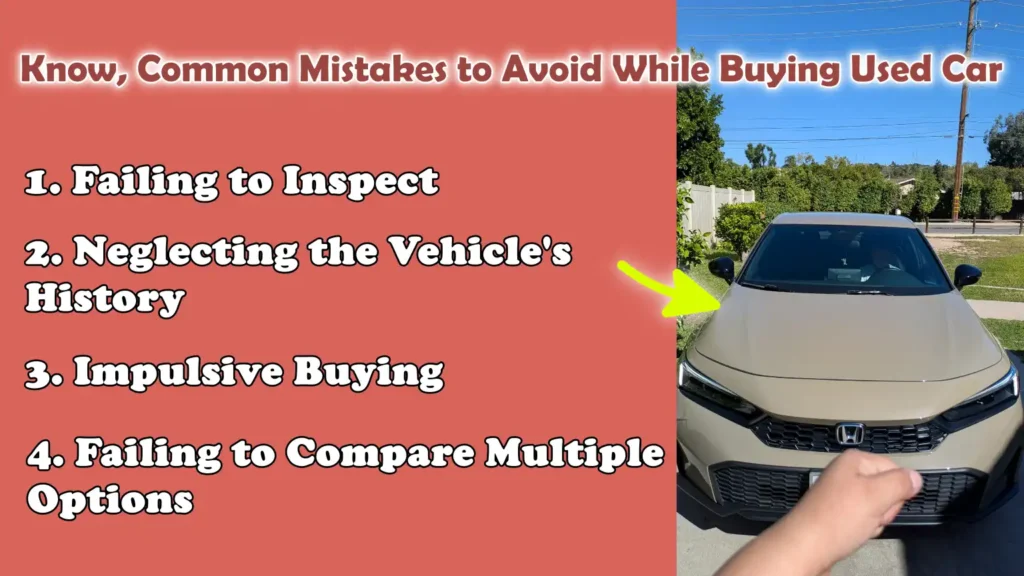
Know, Common Mistakes to Avoid While Buying Used Car
When purchasing a used car, avoiding common pitfalls is just as crucial as following the correct procedures, as even a single error can lead to long-term financial and practical complications.
Many buyers make decisions based on haste, a lack of information, or blind trust in the seller, decisions they often come to regret later.
Statistics from the automotive industry and consumer reports consistently demonstrate that most post-purchase issues are not the result of bad luck, but rather the consequence of mistakes made during the buying process itself.
Understanding these potential errors in advance allows you to remain vigilant, make informed decisions and safeguard your financial investment.
When you know what to avoid, you minimize risks and significantly increase your chances of acquiring a reliable, high-quality vehicle.
1. Failing to Inspect
Failing to conduct a proper inspection is one of the biggest mistakes a buyer can make, as it implies that you are relying entirely on the car’s outward appearance and the seller’s assertions.
Many issues such as: engine wear, brake malfunctions, or internal damage, often go unnoticed without a close and detailed examination.
Studies on vehicle maintenance indicate that early signs of major mechanical failure frequently surface during an inspection; however, if this essential step is skipped, these warning signs are easily overlooked.
Buyers who neglect to have an inspection performed often face unexpected repair costs shortly after the purchase, expenses that can sometimes even exceed the amount they initially saved on the car’s purchase price.
Taking the time to thoroughly inspect a vehicle, or having it examined by a qualified specialist, helps you identify potential issues early on and avoid costly expenses in the future.
2. Neglecting the Vehicle’s History
Ignoring a vehicle’s history report can lead you to purchase a car that harbors underlying issues such as: a prior accident, flood damage, or legal complications regarding its title.
Although a car may appear pristine and well-maintained on the surface, its history can reveal serious incidents that compromise its safety and performance.
Statistics from the used car market indicate that vehicles with a history of accidents or title irregularities are more prone to long-term mechanical problems and command a lower resale value.
By failing to check the history, you are making a decision without fully understanding the vehicle’s background.
Reviewing this information allows you to steer clear of high-risk vehicles and ensures that you are making a safe and well-informed purchase.
3. Impulsive Buying
Impulsive buying occurs when a purchaser makes a decision based solely on excitement, aesthetics, or external pressure, rather than on facts and careful consideration.
This often results in the oversight of crucial aspects such as: the car’s actual condition, its true market value, or the long-term costs associated with its ownership.
Many buyers develop an emotional attachment to a car based on its design or features, causing them to overlook warning signs that might surface during an inspection or price negotiation.
Behavioral studies suggest that, when making major purchases, decisions driven by emotion often lead to increased costs and diminished satisfaction.
By remaining calm and focusing on the facts, you can objectively evaluate the vehicle, thereby avoiding decisions you might later regret.
4. Failing to Compare Multiple Options
Neglecting to compare different vehicles is a mistake that can severely limit your choices and force you to pay more than necessary.
The used car market offers a wide array of options and prices can vary significantly depending on the vehicle’s condition, location and the seller.
Buyers who purchase the very first car that catches their eye often miss out on better deals, opportunities that offer greater value for the same price.
Market research indicates that comparing multiple vehicles provides buyers with a realistic understanding of fair pricing, enabling them to identify the optimal balance between a car’s condition, features and cost.
Taking the time to explore various options allows you to make a decision with greater confidence, ensuring that you secure the best possible deal within your budget.
Read More:
- How to Maintain Car for Long Life
- How to Store Car Long Term
- How to Winterize Your Car
- How to Prepare Your Car for a Long Trip
- How to Ceramic Coat Car
- How to Protect Car Paint
- How to Remove Bad Smell from Car
Know, Pro Tips for Getting the Best Deal
Securing the best deal on a used car isn’t just about haggling; it also involves understanding the right timing, strategy and market dynamics.
Many buyers focus solely on the price, but savvy buyers know that certain factors such as: when you buy, what you choose and how you compare options, as it can make a significant difference in the final cost.
Automotive market data indicates that used car prices can fluctuate based on demand, seasonality and seller pressure.
By adopting smart buying strategies, you can negotiate lower prices, avoid overpaying and get better value for your money.
These practical tips are grounded in real-world market behavior and can help you make a more informed and financially sound decision.
Plus, there’s research that shows that trust, perceived value and access to accurate information heavily influences the buyer’s choices, that’s why transparent history reports, proper documentation and verified sellers actually play a major role in helping the buyers that makes confident decisions as well.[¹]
1. Buy at the End of the Month or Year
Buying a car at the end of the month or year can be advantageous for you, as many dealerships and private sellers operate according to specific sales targets and deadlines.
As these deadlines approach, sellers are often more willing to lower prices or offer better deals in order to meet their quotas.
This provides buyers with an opportunity to negotiate more effectively.
Dealership sales data reveals that discounts and pricing flexibility are more common during these periods compared to the beginning of the month.
By carefully timing your purchase, you can secure a better deal without having to compromise on the car of your choice.
2. Shop During the Off-Season
The demand for used cars does not remain constant throughout the year and these fluctuations have a direct impact on pricing.
During certain specific periods such as: the festive season or when new car models are launched, demand surges suddenly, which can drive prices upward.
Conversely, when the market slows down and fewer buyers are active, sellers may lower prices to attract attention and generate interest.
This period is referred to as the “off-season,” and it can be an excellent time to make a purchase.
Market trends indicate that when demand is low, bargaining opportunities are often more favorable and prices tend to be more flexible.
By shopping during these times, you can capitalize on reduced competition and secure better deals.
3. Consider Older Models with Low Mileage
Older models with low mileage can offer excellent value, as they come with a lower upfront cost and exhibit significantly less wear and tear from usage.
Both a car’s age and its mileage influence its market value, yet these factors do not always depreciate at the same rate.
Some cars may be chronologically older but have been driven very sparingly; this implies that their critical mechanical components have undergone minimal wear.
These vehicles are often available at a lower price point compared to newer models, while still promising excellent performance and reliability.
Industry data suggests that mileage has a profound impact on mechanical wear; therefore, opting for a low-mileage car reduces the likelihood of needing major repairs.
This strategy helps you strike the right balance between cost and the vehicle’s overall condition.
4. If Prices Are High, Avoid High-Demand Models
High-demand models are popular due to their reputation, features, or brand value; however, this very popularity can drive up their prices in the used car market.
When demand is high, sellers may ask for a price exceeding the actual market value, making the deal less advantageous for buyers.
While these cars may still be viable options, paying a premium diminishes the overall value of your purchase.
Market analysis reveals that other comparable vehicles, which experience slightly lower demand, offer nearly identical features and promise similar reliability, yet at a more affordable price point.
By adopting a flexible approach and exploring alternative options, you can avoid overspending and ensure that you receive the best possible value for your money.
Conclusion – How to Buy a Used Car
So, in the end, a used car is not just about having a cheap deal, but it should help you everyday without having any complexities with their maintenance and performance.
One point emerges clearly throughout this comprehensive guide: most of the problems buyers face can be avoided by taking the right steps.
Industry data and real-world experiences consistently demonstrate that buyers who establish a budget beforehand, research various models, review vehicle history reports, conduct thorough inspections and verify all documentation are far less likely to face unexpected repair costs or financial strain.
A used car can offer excellent value, as it avoids the rapid depreciation associated with new vehicles, but this benefit is realized only when you make a wise choice.
This process may seem somewhat lengthy and intricate; nevertheless, every step plays a crucial role in mitigating risk.
If you skip even a single step such as: inspecting the vehicle or verifying the paperwork, you may face significant financial difficulties down the road.
Conversely, if you adopt a systematic approach, you maintain complete control over the entire car-buying process.
This helps you understand exactly what you are paying for, ensures that the vehicle meets your specific needs and empowers you to negotiate with absolute confidence.
Now, that’s it from this guide from How to Buy a Used Car, still having confusion: just comment for more.
Frequently Asked Questions
FAQ 1: How do I know if buying a used car is a good deal?
Buying a used car is a good deal when its price is fair relative to its condition, history and market value. You should compare the asking price against reliable pricing guides such as: Kelley Blue Book and Edmunds to determine the current market value of comparable vehicles. A good deal also implies that the car has a clean history, has not been involved in any major accidents and has been properly maintained. If the car drives smoothly, passes inspection and has clear title documents, it means you are getting true value for your money, not just a low price.
FAQ 2: How much mileage is considered too high for a used car?
Mileage isn’t just about the numbers; it also depends on how well the car has been maintained. Generally, a car with over 100,000 miles (approximately 160,000 kilometers) is considered a high-mileage vehicle, but this certainly does not mean it is a poor choice. If modern cars are serviced regularly, they can easily last well beyond this threshold. What matters more is the car’s service history, the condition of the engine and how it has been driven. A well-maintained, high-mileage car can often prove to be more reliable than a low-mileage car that has not been properly cared for.
FAQ 3: Is it better to buy from a car dealer or a private seller?
Buying from a car dealer is generally safer, as dealers often inspect their vehicles, offer limited warranties and handle the paperwork properly. However, prices at dealerships are typically higher. Private sellers may offer cars at lower prices, but this entails higher risk, as such deals typically do not include any warranty or professional inspection. If you decide to purchase a car from a private seller, it becomes even more crucial that you thoroughly inspect the vehicle, verify its documentation and have it professionally inspected before making any final decision.
FAQ 4: What things should I check before buying a used car?
Before purchasing a used car, you should examine the vehicle’s history, its exterior condition and its legal documentation. The history report should not reveal any major accidents, flood damage, or issues related to ownership. You should check the car for rust, dents, the condition of the engine and signs of wear and tear in the interior. You should also take the car for a test drive to evaluate its brakes and steering and to listen for any unusual noises. Finally, ensure that all documents such as: the registration, title and VIN that match perfectly, as this confirms the legal validity of your purchase.
FAQ 5: Why is a vehicle history report important?
A vehicle history report provides essential information regarding the car’s past records information that cannot be discerned merely by a superficial visual inspection of the vehicle. Services like Carfax and AutoCheck provide data regarding the car’s accident history, ownership records, actual mileage and title status. This allows you to avoid cars that may harbor hidden issues, such as flood damage or odometer tampering. Without this report, you assume a significantly higher risk, as sellers do not always disclose the full truth.
FAQ 6: How much should I spend on a used car?
You should spend an amount that aligns appropriately with your overall financial situation, rather than simply spending up to the absolute upper limit of your budget. A general rule of thumb is to make a down payment of at least 20% and ensure that your total monthly car-related expenses do not exceed 15% of your monthly income. This includes fuel, insurance, maintenance and loan installments. Staying within these limits helps you avoid financial stress and ensures that you can truly afford the car, not just today, but over the long term.
References:
[1] Determinants in Used Car Purchase Results
https://www.researchgate.net/publication/380786848_Determinants_in_Used_Car_Purchase_Results
Hello Folks, Dean Shali here to help you out to solve the problems with your lovely vehicle, as i have lots of experience and knowledge about automotive industry as i woks directly with the customers and repair vehicles and i love to help the people to keep their cars safe and running smoothly.