Written By: Dean Shali
Fact Checked By: Sabré Cook
Reviewed By: Tamara Warren
You should be aware of the fact that: from the unusual exhaust smells to the poor fuel efficiency, almost everything are the clear signals of having something to work with to get your emission test clear.
Without a doubt, it is the legal requirement in many countries to pass a car emission test, plus it is your responsibility to keep your the nature safe and sound, which is the ultimate source of your existence itself.
But, it is seen that every year: even millions of cars fail these tests due to the common and easily fixable issues such as: having faulty oxygen sensors, clogged air filters, leaking gas caps or a malfunctioning catalytic converter as well.
Basically, emissions tests measures harmful gases such as: carbon monoxide, hydrocarbons and nitrogen oxides that your car actually releases into the air, so from that if your vehicle fails that test then it can lead to heavy fines, costly repairs or even in the worst case scenario you can be unable to renew your vehicle registration as well.
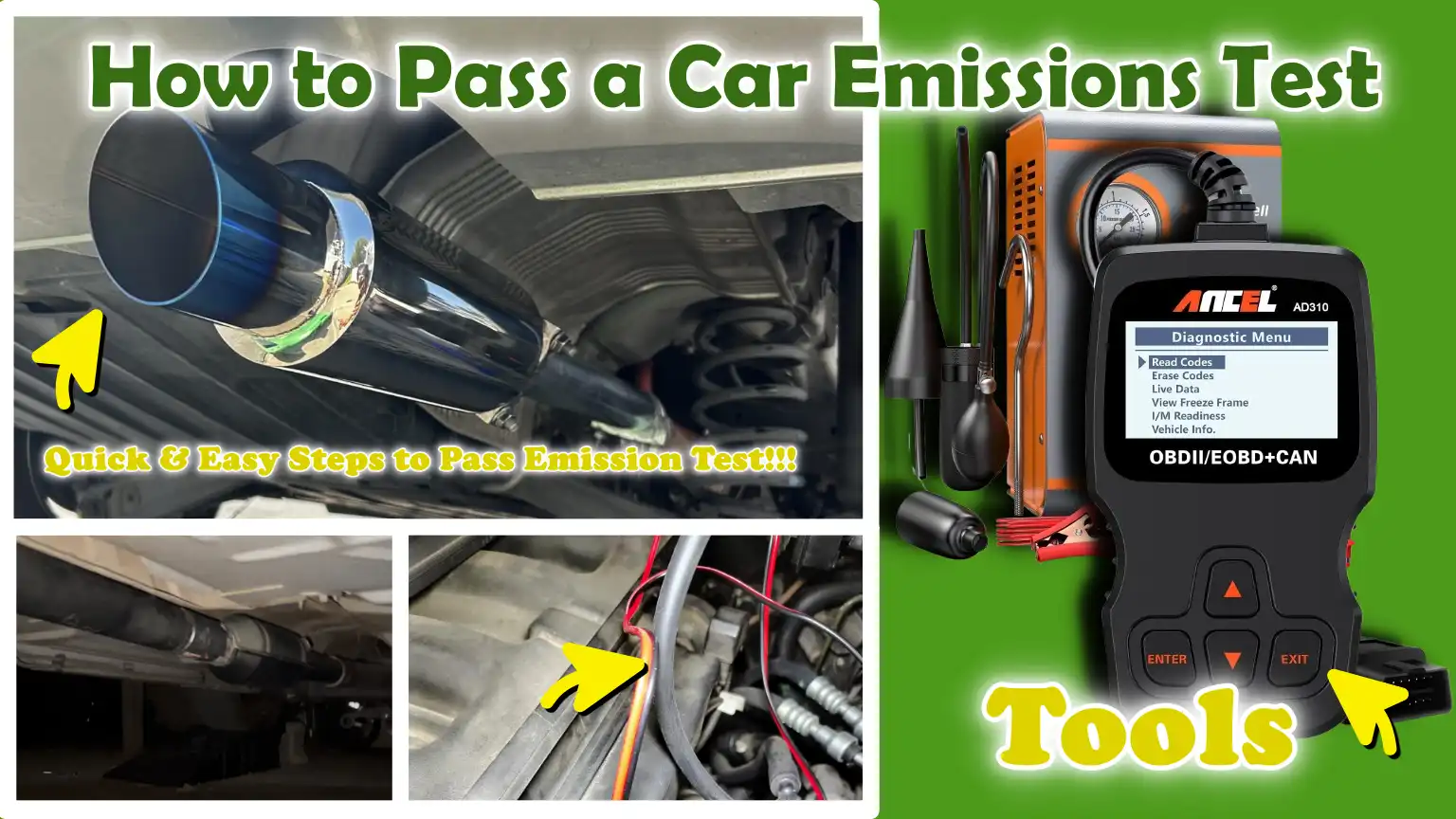
That’s why, in this guide you’ll learn How to Pass a Car Emissions Test, so that you can learn about the warning signs and quick solutions that helps you to pass the emissions test in confident way ahead.
Know, What is a Car Emission Test?
A car emission test is a simple inspection that determines how much pollution your vehicle is releasing into the air.
When fuel burns inside the engine, it releases gases such as carbon monoxide, hydrocarbons and nitrogen oxides.
If the levels of these gases become excessively high, they can cause harm to both human health and the environment.
Governments mandate these tests to ensure that cars do not emit pollution beyond established limits.
This test not only ensures compliance with regulations but also helps you understand whether your engine is functioning correctly; for if emission levels are elevated, it often indicates that a specific component of the car is malfunctioning.
1. A Simple Definition of Emission Testing
Simply put, an emission test reveals how clean, or dirty, your car’s exhaust is.
It analyzes the gases exiting the exhaust pipe and compares them against safety standards established by regulatory authorities.
If the levels of these gases exceed these limits, the car fails the test.
This typically implies that the engine is not burning fuel efficiently, or that certain specific components such as: sensors or filters, are not functioning properly.
A well-maintained vehicle generally emits fewer harmful gases and, consequently, is more likely to pass an emission test.
2. Types of Emission Tests
Different types of emission tests are conducted depending on the vehicle’s age, the technology utilized within it and local regulations.
Each type of test focuses on examining a specific aspect of the vehicle to ensure that its pollutant output remains within prescribed limits.
Modern vehicles are typically tested using electronic diagnostic systems, whereas older vehicles require the direct measurement of gases emitted from their exhaust pipes.
3. OBD2 Test
The OBD2 test involves checking for emission-related issues by utilizing the vehicle’s internal computer system.
OBD2 stands for ‘On-Board Diagnostics,’ and this system is installed in most cars manufactured after the late 1990s.
During this test, a scanner is connected to the vehicle to read stored ‘error codes’ and system-related data.
If the system detects any malfunctions such as: a faulty oxygen sensor, an engine misfire, or a defect in the emission control system, the car may fail the test.
This test is quite fast and accurate, as it relies directly on ‘real-time data’ (up-to-the-minute information) obtained from the vehicle itself.
4. Tailpipe Smog Test
The tailpipe test measures the gases emitted directly from the exhaust pipe.
For this test, a specialized device is attached to the end of the exhaust pipe to determine the volume of harmful gases released while the engine is running.
This test is more common for older vehicles that may not be equipped with modern computer systems.
It helps detect issues such as incomplete fuel combustion, which can lead to increased pollution and reduced fuel efficiency.
5. Visual Inspection
A visual inspection is a fundamental yet essential component of emission testing.
During this process, an inspector examines the external condition of emission-related components.
These components include the catalytic converter, exhaust system, hoses and fuel cap.
The objective is to ensure that no component is missing, damaged, or has been tampered with.
Even if your car passes the other tests, it may still fail the overall inspection if a critical component is broken or has been removed, as these parts play a vital role in controlling pollution.
6. How Testing Works, In Simple Terms
Simply put, an emissions test primarily checks for three things: Is your car’s system signaling any issues?
Are the exhaust gases within safe limits?
And are all the necessary components present and functioning correctly?
This process typically takes just a few minutes, yet it provides a clear picture of your car’s health.
If your car burns fuel cleanly, has no major malfunctions and all emissions-related components are functioning properly, it will easily pass the test.
Understand, Why Do Cars Fail Emission Tests?
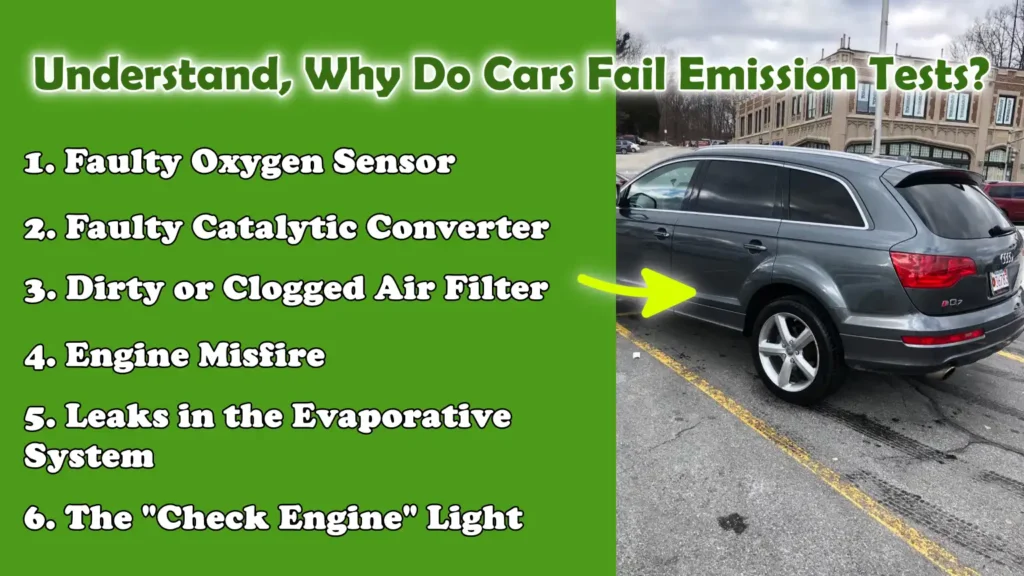
Cars typically fail emission tests because the engine is unable to burn fuel efficiently, or because essential emission control components are not functioning correctly.
When fuel does not burn properly, it results in the release of excessive amounts of harmful gases, such as carbon monoxide and hydrocarbons.
Many of these issues may initially appear minor and go unnoticed; however, over time, they contribute to increased pollution and diminished engine performance.
Understanding the root causes of test failures allows you to address these issues in a timely manner, thereby helping you avoid costly repairs and the hassle of repeated test failures.
1. Faulty Oxygen Sensor
The oxygen sensor plays a crucial role in regulating the amount of fuel consumed by the engine; it does this by measuring the oxygen levels within the exhaust gases.
If this sensor malfunctions, the engine may consume either too much or too little fuel, preventing complete combustion and leading to elevated emission levels.
This can result in reduced fuel efficiency and increased emissions of harmful gases.
A faulty oxygen sensor is one of the most common reasons for failing an emission test and replacing it is often a simple and affordable solution.
2. Faulty Catalytic Converter
The catalytic converter is one of the most critical components for reducing pollution.
It converts harmful gases such as: carbon monoxide and nitrogen oxides, into less harmful substances before they are expelled through the exhaust system.
If this component fails or becomes clogged, it is unable to effectively neutralize these gases, making a test failure almost inevitable.
A faulty catalytic converter can also diminish engine performance and cause strange or foul-smelling odors to emanate from the exhaust.
3. Dirty or Clogged Air Filter
The air filter ensures that the engine receives clean air, which is essential for proper fuel combustion.
When an air filter becomes dirty or clogged, it restricts airflow, thereby affecting the air-fuel mixture.
This prevents the fuel from burning completely, leading to increased emissions.
A dirty air filter can also compromise engine performance and fuel efficiency; however, this is one of the easiest and most inexpensive issues to resolve.
4. Engine Misfire
An engine misfire occurs when one or more cylinders fail to combust fuel properly.
This can be caused by faulty spark plugs, ignition-related issues, or problems within the fuel system.
When a misfire occurs, unburnt fuel enters the exhaust system, significantly increasing pollution levels.
Misfires not only pose a risk of failing emissions tests but can also cause damage to other engine components if not addressed in a timely manner.
5. Leaks in the Evaporative System
The evaporative emission control system, often referred to as the EVAP system, prevents fuel vapors from escaping into the atmosphere.
If there is a leak in this system, even something as minor as a loose or defective gas cap, fuel vapors can escape, potentially causing the vehicle to fail an emissions test.
These leaks do not always affect how the vehicle drives, making them difficult to detect without a proper inspection.
6. The “Check Engine” Light
If the “Check Engine” light is illuminated, the vehicle automatically fails the emissions test in many jurisdictions.
This light indicates that the vehicle’s onboard computer has detected an issue related to the engine or the emissions system.
Even if the vehicle appears to be running perfectly fine, this warning points to an underlying internal problem that must be resolved before the emissions test.
Ignoring this warning light can lead to more serious complications down the road and result in increased repair costs.
Know, Real-World Examples
In real-life scenarios, many drivers fail emissions tests due to minor issues that could have been easily fixed.
For instance, a driver might fail because of a loose gas cap, which allows fuel vapors to escape, or due to an engine misfire caused by a faulty spark plug.
Another common situation arises when a vehicle fails because the owner has ignored the “Check Engine” light for an extended period, leading to a sensor malfunction or damage to the catalytic converter.
These examples demonstrate that regular maintenance, and addressing minor issues in a timely manner, as it can make a significant difference in passing the test.
Clear Signs That Your Car Might Fail an Emissions Test
Before a car actually fails an emissions test, it often provides clear warning signs that something is not functioning correctly.
These signs are linked to how the engine combusts fuel and the efficiency with which the emissions control system performs its duties.
When components such as sensors, filters, or the exhaust system malfunction, the vehicle generates excessive amounts of harmful gases.
Paying attention to these early warning signs allows you to address issues in a timely manner, improve engine performance and avoid failing an emissions test.
1. Strong Odors from the Exhaust
A strong or unusual odor emanating from the exhaust is one of the clearest indicators of excessive emissions.
For instance, a smell resembling rotten eggs often suggests that the catalytic converter is not functioning properly, while a strong smell of fuel may indicate that the fuel is not combusting completely within the engine.
These odors directly signal that harmful gases are not being adequately controlled, a situation that can easily lead to a failed emissions test if the underlying internal issue is not resolved.
2. Poor Fuel Economy
If your car begins consuming significantly more fuel than usual, it may be a sign that the engine is not burning fuel efficiently.
This can be caused by issues such as a faulty oxygen sensor, a clogged air filter, or an incorrect fuel mixture.
When fuel does not burn properly, it leads to increased pollution and reduced fuel mileage.
Poor fuel economy is not only costly over time, but it also increases the likelihood of failing an emissions test due to the elevated levels of emissions being expelled from the exhaust.
3. Engine Malfunction or Stalling
When a car shakes, vibrates, or struggles to remain running while idling (when stationary), it is generally a sign that the engine is not functioning correctly.
This can be caused by issues such as engine misfires, clogged fuel injectors, or problems with the ignition system.
These conditions prevent fuel from burning completely, resulting in increased levels of harmful emissions.
If the engine stalls or runs erratically, it is a clear indication that the car will not pass an emissions test without repairs.
4. Dashboard Warning Lights
Dashboard warning lights, particularly the ‘Check Engine Light’, are among the most critical indicators that require immediate attention.
This light illuminates when the vehicle’s onboard diagnostic system detects a problem related to the engine or the emissions control system.
Even if the car feels normal while driving, an illuminated warning light typically signals an underlying internal issue that could cause the vehicle to fail an emissions test.
Ignoring these warning lights can lead to even more serious and costly problems over time.
5. The Benefits of Early Detection
Detecting these warning signs early saves both time and money, as fixing minor issues is generally easier and less expensive than repairing major malfunctions.
When problems are addressed promptly, the engine operates more efficiently, fuel combustion improves and emissions remain within safe legal limits.
Early detection also reduces the risk of repeated test failures and helps maintain the vehicle’s overall health and longevity.
By paying attention to these warning signs, drivers can take simple steps to ensure that their car is ready to successfully pass its emissions test.
How to Prepare Your Car for an Emissions Test
Preparing your car before an emissions test is the most effective way to increase your chances of passing on the very first attempt.
Many cars fail not due to major mechanical malfunctions, but rather because of minor issues such as: a cold engine, poor-quality fuel, or an overlooked warning light.
A well-prepared car burns fuel more cleanly, runs more smoothly and produces fewer harmful emissions.
A few simple steps such as: driving the car correctly before the test, fixing known issues and maintaining essential components, as it can make a significant difference in the final results.
1. Drive Your Car Before the Test
Driving your car before the test helps the engine reach its normal operating temperature, which is crucial for obtaining accurate emissions results.
When the engine is cold, fuel does not burn completely, which can lead to elevated levels of harmful emissions.
A warm engine facilitates more efficient fuel combustion and ensures that the emissions control system functions correctly.
In most cases, driving the car at normal speeds for approximately 15 to 20 minutes is sufficient to warm up the engine and prepare it for testing.
The Importance of a Warm Engine
A warm engine ensures that all systems, including the catalytic converter and oxygen sensors, are operating at peak efficiency.
These components require heat to function properly and to effectively reduce harmful emissions.
If the engine is not sufficiently warm, the catalytic converter cannot properly neutralize exhaust gases; this can result in elevated pollution levels and a higher likelihood of failing the test.
For this reason, driving your car before an emissions test is strongly recommended.
The Best Time to Drive the Car Before the Test
Driving the car for a short period, typically about 15 to 20 minutes, allows the engine and exhaust system to reach their optimal operating temperatures.
During this time, it is beneficial to drive at a steady speed rather than stopping frequently, as this helps maintain consistent engine performance.
Avoid turning off the engine immediately before the test, as doing so can cause the system to cool down and potentially affect the results.
2. Fix Issues Related to the ‘Check Engine Light’
If the ‘Check Engine’ light is illuminated, it is crucial to resolve the underlying issue before undergoing an emissions test.
This light indicates that the car’s onboard diagnostic system has detected a fault related to the engine or the emissions control system.
Even if the car appears to be running smoothly, an illuminated light means that, in many jurisdictions, the vehicle will automatically fail the test.
Ignoring this warning can allow minor issues to escalate into major, and more costly, repairs.
Why Is This Considered an Automatic Failure in Many Places?
In many regions, emissions testing regulations mandate that the onboard diagnostic system must not display any active faults.
If the ‘Check Engine’ light is on, it signifies that the system has already detected an issue that could compromise compliance with established emissions standards.
Consequently, the vehicle is often immediately declared a “fail” without any further diagnostic examination.
This rule helps ensure that all vehicles operating on public roads meet basic environmental standards.
Basic Troubleshooting Steps
Prior to an emissions test, common issues can often be identified and resolved by following a few basic troubleshooting steps.
This may involve checking for a loose or faulty gas cap, replacing worn-out spark plugs, or using a diagnostic scanner to read and interpret error codes.
Addressing these minor issues in a timely manner improves engine performance and reduces emissions, thereby increasing the likelihood of passing the test.
3. Use High-Quality Fuel
High-quality fuel plays a crucial role in how cleanly and efficiently combustion occurs within the engine.
Compared to poor-quality or adulterated fuel, high-quality fuel burns more completely and generates fewer harmful gases.
It also helps keep fuel injectors and other engine components clean, leading to improved overall performance and reduced emissions.
Benefits of High-Quality Fuel
High-quality fuel helps maintain the correct air-fuel mixture, which is essential for clean combustion.
It can also minimize the accumulation of deposits within the engine over time and improve fuel efficiency.
This ensures the engine runs more smoothly and keeps emission levels low, making it easier for the vehicle to pass the test.
Avoid Adulterated Fuel
Using adulterated fuel such as: fuel contaminated with water or other impurities, hinders proper combustion and increases emissions.
It can also damage engine components and degrade performance.
To avoid this, it is best to refuel only at reputable gas stations and to avoid storing fuel for extended periods.
4. Change Engine Oil When Necessary
Engine oil plays a crucial role in ensuring the smooth operation of an engine by reducing friction and dissipating heat.
Over time, the oil becomes contaminated and its effectiveness diminishes.
Dirty oil can negatively impact engine performance and lead to incomplete fuel combustion, thereby increasing emissions.
How Dirty Oil Affects Emissions
When oil becomes old or dirty, it forces the engine to work harder and operate less efficiently.
This can lead to elevated levels of harmful gases in the exhaust.
Changing the oil prior to a test, provided it is due for a change, helps the engine run more smoothly and improves the chances of passing the test.
5. Ensure Correct Tire Pressure
Although correct tire pressure may not appear to be directly linked to emissions, it significantly influences how efficiently a car operates.
Underinflated tires generate greater rolling resistance against the road surface, compelling the engine to consume more fuel.
The Relationship Between Efficiency and Emissions
When the engine consumes more fuel due to increased resistance, it generates a higher volume of emissions.
Properly inflated tires reduce this resistance, enhance fuel efficiency and enable the engine to function more effectively.
This indirectly lowers emission levels and contributes to overall better performance during the test.
How to Pass a Car Emissions Test – Quick & Effective Method
Passing a car emissions test becomes much easier when you follow a clear and practical process.
Most modern vehicles are designed to self-monitor their performance; therefore, the most critical step is ensuring that all systems are functioning correctly before the test takes place.
The primary reason for failing the test is often that drivers overlook a few simple steps such as: checking for error codes or driving the car long enough for its internal systems to reset.
By following the correct sequence, you can reduce harmful emissions, improve engine efficiency and significantly increase your chances of passing the test on your very first attempt.
1. Run a Diagnostic Scan – OBD2 Scanner
The first step is to check your car’s onboard systems using an OBD2 scanner.
This device connects to your vehicle and reads any stored error codes related to the engine or emissions system.
These codes can identify issues such as: faulty sensors, misfires, or problems with emissions controls, that are not typically apparent during normal driving.
Running this scan provides a clear indication of what needs attention before the test, making it one of the most essential steps in the preparation process.
2. Fix Identified Issues
Once the scan reveals any issues, it is crucial to resolve them before heading in for the test.
Even minor issues such as: a worn spark plug or a loose gas cap, as it can elevate emission levels and cause you to fail the test.
Ignoring these problems can lead to even greater damage over time.
Fixing identified issues ensures that the engine is combusting fuel properly and that all emission control systems are functioning exactly as they should.
3. Drive the Car to Reset the Monitors
Once the repair work is complete, it is crucial to drive the car for a while so that its internal monitoring systems can reset and verify that everything is functioning correctly.
These systems are often referred to as ‘readiness monitors’; they continuously check various components of the engine and emission systems during normal driving conditions.
If the monitors have not fully reset, the car may fail the test, even if the original problem has already been resolved.
Driving the car under normal conditions facilitates this process.
4. Ensure the Fuel Tank is Between 1/4 and 3/4 Full
The fuel level in your tank can impact certain emission tests, particularly those related to the evaporative system.
Keeping the fuel level between one-quarter and three-quarters full allows the system to perform its diagnostic checks accurately and without errors.
If the tank is either overfilled or nearly empty, the system will be unable to function properly, which may result in incomplete test results or a test failure.
5. Warm Up the Engine Before the Test
To obtain accurate emission results, it is essential that the engine is properly warmed up.
When the engine reaches its normal operating temperature, fuel combustion becomes more efficient, thereby reducing the emission of harmful gases.
Certain specific components, such as the catalytic converter, also operate more effectively when they are warm.
Driving the car for at least 15 to 20 minutes prior to the test ensures that all systems are operating at their optimal performance levels.
6. Avoid Turning Off The Engine Immediately Before the Test
Keeping the engine running before the test maintains its optimal operating temperature and ensures that all systems remain active.
If the engine is turned off and allowed to cool down, it may not function properly once the test begins.
This can lead to elevated emission levels and increase the risk of failing the test.
Keeping the engine running while waiting in line ensures that everything is ready for accurate testing and favorable results.
Simple Measures That Can Help You Pass the Test
Many cars fail emission tests not due to severe malfunctions, but rather because of minor, easily rectifiable issues.
A few simple measures can improve the way the engine burns fuel, reduce harmful gases and increase the likelihood of passing the test.
These measures are particularly useful when the problem is minor or when you require an immediate solution prior to the test.
Although some of these measures may offer only temporary improvements, when combined with proper maintenance and careful preparation, they can make a significant difference.
1. Use Fuel Additives (Temporary Fix)
Fuel additives are specialized fluids introduced into the fuel tank to assist in cleaning the internal components of the engine and fuel system.
They function by removing carbon deposits from the fuel injectors, intake valves and combustion chambers, thereby optimizing the fuel combustion process and reducing emissions.
This measure can be beneficial when the engine is slightly dirty or not operating at peak efficiency.
However, it is crucial to understand that fuel additives provide only a temporary solution and do not serve as a definitive remedy for serious mechanical issues.
2. Clean the Fuel Injectors
Fuel injectors are responsible for spraying fuel into the engine in a finely atomized and precisely controlled manner.
Over time, the accumulation of dirt and carbon deposits can cause them to become clogged, disrupting the fuel spray pattern and preventing complete combustion.
Cleaning the injectors restores proper fuel flow, enhances engine performance and reduces harmful emissions.
This task can be accomplished by using a fuel injector cleaning solution or by utilizing the services of a professional cleaning specialist.
3. Replace the Air Filter
The air filter ensures that clean air enters the engine, allowing fuel to burn efficiently.
When it becomes dirty or clogged, airflow is restricted, disrupting the balance between air and fuel.
Consequently, the fuel does not burn properly, leading to increased emissions.
Replacing the air filter is a simple and inexpensive measure that can immediately improve engine performance, fuel efficiency and emission levels.
4. Tighten or Replace the Gas Cap
The gas cap plays a crucial role in sealing the fuel system and preventing fuel vapors from escaping into the atmosphere.
If the gas cap is loose, damaged, or missing, a leak may occur in the evaporative emission system, which could cause you to fail an emissions test.
Properly tightening the cap, or replacing it if it is old or worn out, is a quick and easy way to resolve this issue.
5. Basic Tune-up Tips
A basic tune-up involves inspecting and replacing essential components that affect engine performance, such as spark plugs, ignition coils and filters.
Worn-out spark plugs can cause misfires, leading to increased emissions and reduced engine efficiency.
Ensuring that these components are in good condition helps the engine run smoothly and burn fuel more completely.
Regular tune-ups not only improve your chances of passing an emissions test but also extend the vehicle’s lifespan and maintain its overall performance.
Know, What to Do If Your Car Fails an Emissions Test?
Failing an emissions test can feel stressful, but it is a common occurrence and in most cases, it can be resolved without any major difficulties.
A failure simply means that your car is emitting harmful gases in excess of the prescribed limits, or that a specific component of the emissions system is not functioning correctly.
The most important thing is to remain calm and take a measured approach; rushing into repairs without fully understanding the root cause of the problem can result in a waste of both your time and money.
When handled correctly, most vehicles can pass the test after undergoing some basic repairs and proper preparation.
1. Stay Calm and Understand the Report
After failing the test, you will receive a report detailing exactly why your car did not pass.
This report typically includes error codes, specific emissions levels and information regarding which system is malfunctioning.
Understanding this report is crucial, as it directly identifies the root cause of the problem.
Rather than relying on guesswork, you can focus your attention specifically on the components that require attention.
Taking a little time to read and interpret the report allows you to make more informed decisions regarding repairs and avoid unnecessary work.
2. Information on Common Repairs
Many instances of emissions test failures are caused by common issues that can be easily rectified.
These issues typically involve sensors, components of the exhaust system, or the fuel vapor recovery system.
Addressing these problems not only helps you pass the emissions test but also improves engine performance and reduces environmental pollution.
3. Replacing Sensors
Sensors such as: oxygen sensors and mass airflow sensors, play a critical role in regulating the air-fuel mixture within the engine.
When these sensors malfunction or provide inaccurate readings, the engine either burns excessive fuel or too little, resulting in elevated emission levels.
Replacing a faulty sensor is often a straightforward repair, which quickly brings emission levels back within the prescribed limits.
4. Catalytic Converter Repair
The function of a catalytic converter is to reduce harmful gases before they are expelled through the exhaust system.
If it malfunctions, becomes clogged, or wears out, it is unable to perform its job effectively.
This leads to increased emission levels and causes the vehicle to fail the emissions test.
Repairing or replacing a catalytic converter can be more expensive compared to other repairs; however, it is essential for passing the test and maintaining the integrity of the exhaust system.
5. EVAP System Repair
The Evaporative Emission Control System (EVAP) prevents fuel vapors from escaping into the atmosphere.
Issues within this system are often caused by minor leaks such as: a loose gas cap, a cracked hose, or a faulty valve.
Although these issues may not necessarily affect the vehicle’s drivability, they can still cause the system to fail.
Repairing EVAP system issues is generally simple; once the source of the leak is identified, it can often be fixed quickly.
6. Retesting Process
Once repairs are complete, the vehicle must undergo a retest to ensure that it now meets emission standards.
In many cases, you may need to drive the vehicle for a certain period before the retest so that the onboard systems can reset and verify that all issues have been resolved.
This step is crucial because if the systems have not yet completed their diagnostic checks, testing the vehicle too soon could result in it failing the test again.
7. Cost Estimation
The cost of repairing emission-related issues can vary depending on the nature of the problem.
Simple tasks such as: replacing a gas cap, air filter, or sensor, are generally inexpensive, whereas more complex procedures, such as replacing a catalytic converter, can be costly.
Detecting a problem early and addressing it promptly can help keep expenses to a minimum.
Regular maintenance and timely repairs are the most effective ways to avoid significant future expenses and repeated test failures.
How Much Does an Emission Test Cost?
The cost of an emission test is generally affordable, although it may vary depending on where you live, the type of vehicle you own and the specific type of test required.
In many regions, test fees are kept low to encourage regular compliance with regulations; consequently, the cost is typically lower than most routine car repairs.
However, if a vehicle fails the test, the real financial burden often lies in the subsequent repairs.
Understanding both the test fees and potential repair costs allows you to plan more effectively and avoid unexpected expenses.
1. Average Price Ranges and Regional Variations
Emission test prices can vary significantly based on local regulations and testing methodologies.
In some areas, a standard test may be quite inexpensive, whereas more advanced tests, requiring detailed inspections or specialized equipment, may cost more.
Urban areas often have stricter emission standards and slightly higher test fees compared to rural areas.
The type of vehicle also plays a role; for instance, newer cars feature “onboard diagnostics” (self-diagnostic capabilities), which makes the testing process quicker, and sometimes cheaper, while older vehicles may require more detailed inspections, potentially increasing the cost.
2. Repair Costs vs Test Fees
While the test itself is generally not very expensive, repair costs depend entirely on the specific issues identified in the vehicle.
Minor repairs such as: replacing an air filter, tightening a gas cap, or replacing a sensor, are typically inexpensive and can be completed quickly.
However, major issues such as: a faulty catalytic converter or a significant engine problem, as it can be quite costly to fix.
This is why performing regular maintenance on your car is often the more economical approach; After all, preventing problems from occurring is far less expensive than fixing them after failing an emissions test.
3. Ways to Save Money
There are several simple ways to reduce the overall costs associated with emissions testing.
Regular maintenance such as: changing the engine oil, replacing filters and inspecting engine components, as it can help prevent your vehicle from failing the test and save you from costly repairs.
Performing a “diagnostic scan” (vehicle inspection) prior to the test allows you to identify minor issues and address them in a timely manner.
Driving the car properly before the test, and ensuring that the engine has reached its optimal operating temperature, as it can improve test results and minimize the likelihood of incurring re-test fees.
Taking these steps not only saves you money but also ensures that your car continues to run smoothly and that harmful emissions are kept to a minimum over time.
Read More:
- How to Fix Rotten Egg Smell in Car
- How to Diagnose a Bad Catalytic Converter
- How to Replace a Muffler
- How to Fix an Exhaust Leak
- How to Replace an Exhaust System
Tips for Keeping Your Car Low-Polluting Over the Long Term
Keeping your car low-polluting over the long term is not difficult, provided you adhere to a few simple habits and a regular maintenance schedule.
Pollution primarily increases when the engine is not functioning correctly, or when its key components have become worn out or dirty.
By properly maintaining your vehicle, you not only reduce harmful emissions but also improve fuel efficiency, extend the engine’s lifespan and enhance the vehicle’s overall performance.
Rather than attempting to fix problems after they have already arisen, taking a proactive approach to long-term care is always more effective, and less expensive.
Not only this, there’s Environmental Protection Agency that tells that vehicle that are properly tested and maintained actually releases far fewer harmful gases into the air, that clearly means that by simply keeping your vehicle in good condition and passing the emissions test, you literally helps in reduced pollution and that makes the air safer for everyone to breathe as well.[¹]
1. Regular Maintenance Schedule
One of the most crucial methods for controlling pollution is adhering to a regular maintenance schedule.
This includes timely oil changes, air filter replacements, spark plug inspections and servicing of the fuel system.
When these components are clean and in good condition, the engine combusts fuel more completely, thereby reducing emissions.
Neglecting maintenance can lead to the accumulation of dirt and wear on parts, potentially increasing pollution in the future and even causing the vehicle to fail emission tests.
2. Use of High-Quality Fuel and Oil
Using high-quality fuel and engine oil plays a pivotal role in keeping pollution levels low.
High-quality fuel burns more cleanly and helps prevent carbon deposits from forming inside the engine.
Similarly, good engine oil reduces friction, keeps engine components clean and facilitates the smooth operation of the engine.
The use of poor-quality fuel or oil can lead to incomplete combustion over time, resulting in increased pollution and diminished engine efficiency.
3. Periodic Engine Inspections
Regular engine inspections allow you to detect problems before they escalate into serious issues.
These inspections may involve scanning for error codes, checking sensors and examining components such as the catalytic converter and the exhaust system.
Early detection of problems enables you to promptly address minor issues, thereby preventing excessive pollution and avoiding costly repairs in the future.
Even if the vehicle feels normal to drive, periodic inspections ensure that everything is functioning exactly as it should.
4. Driving Habits That Reduce Pollution
The way you drive has a direct impact on pollution levels.
Accelerating smoothly, maintaining a steady speed and avoiding sudden braking, all these practices help the engine operate efficiently and burn fuel properly.
Frequent short trips, rapid acceleration and prolonged engine idling all contribute to increased fuel consumption and pollution.
By adopting calm and consistent driving habits, you can reduce pollution, save fuel and keep your car in better condition for a longer period.
Conclusion – How to Pass a Car Emissions Test
Now, you have understood that passing your emissions test is not just about one-time task, but it is actual and collective result of how well you actually care your car every single day.
Throughout this comprehensive guide, you have learned that most emissions test failures stem from common and preventable issues such as: faulty sensors, poor-quality fuel, clogged filters, or the neglect of early warning signs like unusual odors or illuminated dashboard warning lights.
Most importantly, your car invariably provides warning signals before any major component fails; heeding these signs can spare you from costly repair bills and the frustration of repeated test failures.
A well-maintained vehicle burns fuel efficiently, generates fewer harmful emissions and delivers optimal performance on the road.
A few simple measures such as: warming up the engine before a test, keeping the fuel system clean, promptly addressing minor issues and adhering to a regular maintenance schedule, as it can make a significant difference.
Now, that’s it from this guide about How to Pass a Car Emissions Test, even you can ask more questions in comment.
Frequently Asked Questions
FAQ 1: What happens if my car fails the emissions test?
If your car fails the emissions test, it means it is emitting harmful gases in excess of the prescribed limits, or there is an issue with its emissions control system. You will typically receive a report detailing the reason for the failure such as: a faulty sensor, an engine misfire, or an exhaust-related problem. Subsequently, you must have the issue repaired and then take your car back for a re-test. In many cases, minor repairs are sufficient to resolve the problem; therefore, it is crucial to carefully read and understand the report before taking any further steps.
FAQ 2: Can I pass the emissions test if the ‘Check Engine Light’ is on?
In most jurisdictions, you cannot pass the emissions test if the ‘Check Engine Light’ is illuminated. This light indicates that the car’s onboard diagnostic system has detected an issue related to the engine or emissions. Even if the car appears to drive normally, the presence of this warning light typically results in an automatic failure of the test. It is best to first have the underlying issue repaired and ensure that the light has turned off before taking your car in for the test.
FAQ 3: How long should I drive my car before an emissions test?
It is generally recommended that you drive your car for approximately 15 to 20 minutes prior to the test. This allows the engine to reach its normal operating temperature, which promotes more efficient fuel combustion and reduces harmful emissions. A warm engine also helps critical components such as: the catalytic converter function correctly, thereby increasing your chances of passing the test.
FAQ 4: Will ‘fuel additives’ help me pass the emissions test?
Fuel additives can sometimes help improve emissions by cleaning accumulated deposits within the fuel system and assisting the engine in burning fuel more efficiently. However, these are generally temporary measures and may not be sufficient to fully resolve serious underlying issues. If your car has a major problem such as: a faulty sensor or a defective catalytic converter fuel additives alone will not suffice. It is best to use them as a supplementary measure while simultaneously maintaining your vehicle properly.
FAQ 5: What are the most common reasons for failing an emissions test?
The most common causes include faulty oxygen sensors, defective catalytic converters, dirty air filters, engine misfires and leaks in the fuel vapor system. Another very common reason is ignoring the ‘Check Engine’ light. These issues affect how fuel burns inside the engine, leading to elevated levels of harmful gases and causing the vehicle to fail the test.
FAQ 6: How much does it cost to fix emissions-related problems?
The cost depends on the specific nature of the problem. Simple remedies such as: replacing an air filter, tightening a gas cap, or changing spark plugs are typically inexpensive. More complex repairs, such as replacing sensors or catalytic converters, can be quite costly. Generally, the sooner you identify and resolve these issues, the less money you will have to spend.
FAQ 7: Can a dirty air filter cause a vehicle to fail an emissions test?
Yes, a dirty air filter can restrict airflow to the engine, thereby affecting the air-fuel mixture. This prevents the fuel from burning completely, resulting in increased emission levels. Replacing a dirty air filter is a simple and cost-effective solution that can improve engine performance and help the vehicle pass an emissions test.
FAQ 8: What role does a catalytic converter play in controlling emissions?
A catalytic converter works to reduce harmful gases before they exit the exhaust system. It converts hazardous gases such as: carbon monoxide and nitrogen oxides into less harmful substances. If it is not functioning properly, the car will emit higher levels of pollutants, thereby increasing the likelihood of it failing an emissions test.
FAQ 9: How often should I get an emissions test?
The frequency of emissions testing depends on local regulations, but it is often required once a year or every few years. Even if frequent testing is not mandatory, it is still essential to maintain your car regularly to ensure that it consistently remains within safe emissions levels.
FAQ 10: Can older cars pass emissions tests?
Yes, if older cars are properly maintained, they too can pass emissions tests. However, they may require closer attention, as their components wear down over time and they typically lack the modern systems found in newer cars. With regular maintenance, timely repairs and proper tuning, older vehicles can also meet emissions standards.
FAQ 11: What should I check before going in for an emissions test?
Before heading in for the test, you should ensure that the ‘Check Engine’ light is off, the engine is running smoothly and there are no strange odors or noises. Additionally, checking the air filter, fuel system and tire pressure is also beneficial.
References:
[1] Vehicle and Fuel Emissions Testing
https://19january2017snapshot.epa.gov/vehicle-and-fuel-emissions-testing_.html
Hello Folks, Dean Shali here to help you out to solve the problems with your lovely vehicle, as i have lots of experience and knowledge about automotive industry as i woks directly with the customers and repair vehicles and i love to help the people to keep their cars safe and running smoothly.